The geometric mean (6.9) is all that really matters for investors, not the arithmetic mean (8.4) - the arithmetic mean under-weights the importance of negative years to long term performance.
For example, if the market is down 20% one year and up 20% the next year, the arithmetic mean will be 0%, but you'll be down 4% (0.8*1.2 = 0.96), which is reflected in the geometric mean of (about) -2%.
Depends, dollar cost averaging shifts things around. For a typical 401k style investor having down years mid career improves returns at retirement, but then increases risks in retirement.
The “average” investor gets paid cash and not in stock.
The public tech company employee has less to invest because a large portion of their income is in stock.
The private tech company employee is screwed because statistically, they have equity that won’t amount to shit in a bull market let alone a bear market.
The "average" investor is in jobs less hit by typical recession/down market impacts, since the odds of a hospitality worker or barista having a retirement account in the first place is much lower than the odds of a white collar employee.
The point of comparison would be average reduction in investment vs average reduction in stock price. It’s true people invest less, but stocks take much larger drops than the reduction in the workforce.
Are you arguing that the stock market is not correlated with unemployment? That’s a weird and plain stupid hill to die on because anybody can disprove it with 3 seconds of googling.
It might be a stupid hill to die on that general statement, but currently we have a falling stock market with very little unemployment which is part of the reason for the inflation.
> An inverse relationship between level of unemployment and forward stock market returns. In the current quintile (2.5% to 4.4% unemployment), the average S&P 500 return over the following year is 5.6% versus and average of 12.7% in all periods. The best returns historically have come after periods of high unemployment
Maybe you should use a source that is at least self consistent?
Inverse relationship between unemployment and returns - proceeds to show a table where the lowest quintiles of unemployment have the lowest returns. That doesn’t seem very inverse to me.
In any case even if you don’t use some trash site that can’t get a basic editor/proofreader and correct that error, it’s not counter to anything already told to you by me and others.
You both make valid points. The JPMorgan memo's point is that a view on the economy is insufficient for reaching a view on the market. If we're heading into a recession, that doesn't necessarily mean stocks will fall. If we've rounded the bottom, it doesn't mean stocks will rise. More pointedly, it's asking its clients not to sell even while it predicts a recession.
The Seeking Alpha piece doesn't support your argument. Returns one year post peak unemployment are good because valuations at peak unemployment are in their trough. The correlation drives the effect. The article could be summed up as buy when the market is low / unemployment is high.
There is a real effect that comes from the stock market being forward looking and the labor market backwards [1]. When unemployment goes up, markets go down, and that's a problem for forced sellers.
> An inverse relationship between level of unemployment and forward stock market returns. In the current quintile (2.5% to 4.4% unemployment), the average S&P 500 return over the following year is 5.6% versus and average of 12.7% in all periods. The best returns historically have come after periods of high unemployment
Of course they don’t, that’s not what your articles say. Did you read them? They, respectively, say that the market is forward-looking and that major gains are made after downturns.
It can simultaneously be true that major gains are made after downturns and that there has historically been a strong correlation between downturns and unemployment.
And even these days the typical investor probably uses a financial advisor, who would do such fund reallocation, even if they don't use target date funds explicitly (which they should).
Do they really? When I've looked around at financial advisors they've wanted at least several percent annually of AUM, which, to my mind, is just insane.
For this hypothetical, I don't think it makes sense to consider anything but a typical 401k investor that only invests in the sp500. Thats all that we're tracking here.
When spending down money you get the reverse of cost dollar averaging. In a good year you might sell say 1,000 shares but in a down year you might need to sell twice that to take out the same money. This means more of your shares are sold in down years than good years.
This is why people say to increase the bond ratio in retirement, but that also reduces expected returns.
I'll just share this. I've recorded every retirement contribution and date since I started saving for retirement back in the late 90's. From that, I can figure APY at any time by comparing to my balance.
I had some learning experiences early on but never totally lost my shirt. I went through the dotcom crash, the finsys crash, and the more recent stuff. And I've been following Bogle philosophy for a very long time, of an allocation model with a percentage in US stocks, intl stocks, bonds, and cash.
I would love to have 3.5% real over that time period.
Now, it's possible I'm the world's lousiest investor, but I don't think so. Because I did a similar exercise pretending "what if I had just bought S&P500 on those dates?" and looked at dividend-adjusted-close. And the results there were also nowhere near as high as you'd expect.
People just can't equate "stock market performance" with what their own performance will be. You might get laid off when economy is bad and markets are down. You might have more money to invest at the top of the market, and less at the bottom, which totally screws up dollar-cost-averaging. You won't be entirely in the stock market, keeping some in bonds in cash. Your "well, I'm getting old so I should keep less in the market" decision might align with the beginning of one of the most irrational bull markets in history. (All of the above have been true for me.)
I think the only real answers are just to save like crazy, keep expenses low, and push for a better social safety net. My own retirement projections assume Social Security will only pay out at 74%, and I'm feeling the need to have a big buffer due to economic/political uncertainty, which really sucks.
I have been a Betterment customer since 2014 - robo-advisor-driven portfolio since the start of my retirement journey.
Been 90% stocks/10% bonds the whole time, though the underlying basket has shifted a few times as I made decisions about how to skew the basket using Betterment's portfolio options.
8 years on, I have a total annualized return of 4.9%, with Betterment saying "All performance figures displayed reflect the actual performance of your account since its creation in terms of total time-weighted returns, net of Betterment's management fee, fund fees, and certain other fees, if applicable."
The most volatile part of my retirement journey has been how much money I am able to contribute in a given month; some of these years I've had the job security and consistent income to dollar cost average the whole year's worth of contributions every 2 weeks or every month; other years I've had to wait until some amount of money became available to do a more "lump sum" contribution.
Thank you for your comment as far as it can at least help me set expectations for how I might see this performance number continue to go up and down over time!
First, please repeat the standard mantra: past performance is no guarantee of future success.
Then tell me the 95th percentile and the median geometric returns based of fixed periods (say, copy the 20 years.)
Let us also grab what an inflation linked gov bond would have given over those same periods. Classically I would always think of pension returns as vs the risk free rate (heh, us gov credit risk) which is essentially an IL bond.
Then repeat the analysis on, say, the G8 or G20 countries. Oh, and lets do a variety of stock indexes as well. I am a great believer in diversification - so betting on the US is not my standard behaviour.
6.9% assumed return is mad for any individual. It would be mad for a DB scheme _and they at least have some risk pooling in their favour_.
But. I am hella risk averse and see the world through that lens.
Yep, long-term I'm okay at 3%, comfortable at 3.5%, happy at 4% and awesome anywhere above 4.5%. I find the benefit of going with a conservative plan is stress reduction during downturns.
Maxmizing log returns is very good in many respects. It has nice mathematical properties. It's not too far off from what people subjectively value. But it is an approximation. For instance, how upset would you be if you woke up to find your bank account was $0? Pretty upset I'm sure. Infinitely? Doubt it. Now some one gives you a single cent out of pity. Feeling a lot better? Hardly.
The subjective satisfaction we get from a certain amount of money is something that would take a lot of experimental science to figure out, and subject to change as society changes. How high up Maslows hierarchy of needs can you climb, and how long can you stay there until age brings you low?
Now where log returns really shine is if you make a very large number of similar bets. Thats where the asymptotic behavior dominates. But if you make a big once in a lifetime decision of whether to bet the farm on a new business idea, that's where you have to figure out your own values.
That's the thing. The Sharpe Ratio looks at a catastrophic situation and says it's ok. It's not appropriately scoring risk!
Let's say the risk-free rate of return is 3%.
Asset 1:
Every year, with 99% probability you get 8% return, and with 1% probability you get -100% return, i.e., you lose everything. This has an expected return of 7%, which is 4% above risk-free; the standard deviation is 0.1; and the Sharpe Ratio is 0.36. But the exponential of the mean log annual multiplier is zero; you will eventually lose everything.
Asset 2:
With 90% probability you get the risk-free rate of 3%, and with 10% probability, you get a 10,000% return (multiply balance by 101). Yes, this has a good average return of 1,000%, but it also has a giant standard deviation of 30, so its Sharpe Ratio is slightly worse, at 0.33. But, the exponential of the mean log multiplier is 1.62, which means that over time it will have a 62% annual return. Moreover, it literally never goes down; there's no risk.
Asset 3:
You just take the "risk free rate of return" at 3%.
Surely, the best choice is Asset 2. It's literally Asset 3 plus free lottery tickets. But it has the worst Sharpe Ratio of the three. And Asset 1, which has the flavor of some prudent tradeoff, is actually guaranteed to bankrupt you eventually.
> But maximizing log-return was proven by Kelly to be optimal, and you don't need to further penalize volatility.
This is what I'm questioning. We do need to further penalize volatility, if that is our preference.
The criteria is optimal in the sense of greatest expected return, in the limit of infinite number of bets. But we don't make infinite numbers of bets, and the variance matters.
Any truly optimal strategy has to factor in subjective preferences.
Example: We play a game where you are ill and need to pay for medical treatment. At the beginning of the game you obtain a sum of money exactly enough to pay for the treatment. Then you are allowed to place (a finite number of) bets in some gambling, possibly increasing your payoff, or losing part of it. I'd argue that in this scenario the "optimal" strategy is not playing, no matter what criteria is used to select the size of the bets.
It would make sense to allow a risk-averse utility function in our framework (say a concave function of total dollars at the end).
I don't think the identification "volatility" = "standard deviation" = "risk" matches anyone's actual preferences. So that part doesn't make sense to me.
But I like your example with the medical treatment. That could be modeled with a step utility function. Mixing it with my example, there'd be no problem choosing my Asset 2 or 3, since both guarantee that your capital will be preserved so you can pay for your treatment. If your utility function were truly a step, you'd be indifferent between Assets 2 and 3. More realistically, you'd assign minus infinity to values beneath the threshold and some monotonic function to values above (e.g. just the number of dollars), and you'd prefer Asset 2: It guarantees your medical treatment, which is what you really care about, but it throws in a free lottery ticket, so why not take that.
1. Im not sure that’s what the Kelly criterion is but I didn’t look it up.
2. Arithmetic mean of log returns is the same as the geometric mean of returns. Indeed it’s pretty typical to work with log returns for this reason as adding is easier/better for computers than multiplying. This equivalence is easy to prove:
Yeah, I should have been more clear. The point is that you can convert between them without needing any other information (like the original values that were averaged)
Who cares about returns over the next 150 years? Even half that is excessive. Someone investing at age 18 might care about the subsequent 50 years.
It's going to be a long time before some other country takes over the "reserve currency/investment market of last resort" position the US currently has. No other market is even close to providing the deep liquidity and rule of law the US market has over a wide variety of instruments.
Sure, someone will eventually take over that role, but there are no candidates today. And, to your point: it was clear by the late 19th century that the US dollar would displace Sterling, but it took another half a century for that to happen. On the scale of current human lifespan, you can assume it won't happen at all.
Keep in mind that the present value depends somewhat on the discounted future earnings, which by definition extends to the end of time. That being said, the associated time discounting heavily reduces the impact of earnings envisaged say 100 years from now (a 5% discount rate would mean ~13k USD in 100 years is worth about 100 USD now, and that's probably generous given historic market returns).
So, the US doing extremely well 100 years from now vs. the US doing very badly 100 years from now could have a non-trivial impact on the perceived value of US assets. I suspect that the large uncertainty about what the world will look like in 100 years means there is just some sort of seldom changing value baked into assets to account for this, but it nonetheless exists, and could change if there was some huge geopolitical shift.
And before you mention anyone on earth would be dead in 150 years, yes that's true, however you can always sell it to someone later on who will be alive in 150 years (or sell it to someone who can later sell it to someone etc. etc.).
Is that actually how it works? Money has to go somewhere regardless of future. Whatever looks the least bad at present is in demand, regardless of what the returns are. Inflation was above tbill rates yet people bought because they don’t have better options.
It’s like food. Food in 100 years does not help the need for food now.
If there was a futures market in foodstuffs that basically keep forever and is cheap to store (honey?) you would see that the expected price of that food in 100 years would have some effect on the current price.
In theory maybe, but I'm not sure this is right. The further out you go the more worthless expectations on returns become. Who actually has high confidence in a price model projecting 100 years out? What organization has the conviction to execute on this 100 year plan instead of signals with real correlation for returns over 1, 5, 10, 20 years?
Also, the US stock market, US Dollar and US economy/gdp aren't hard linked to one another these days. The companies listed can be selling to non US markets, employing internationally, founded internationally. They're just listing on the US stock market because well.. that's where the stock market is. The US could, in theory, become more or less popular a stock market regardless of its currency's popularity.
Meanwhile, both the Euro and RMB have similar size markets backing their currency. Neither one is currently trying to displace the USD. I think the importance of owning the international currency is somewhat speculative.
The reserve currency built atop the petrodollar system produces a cycle of the rest of world needing to acquire dollars to trade for commodities and most other commerce around the world. Because it gains this reserve status, it has stability and confidence, and thus since countries need it to buy input commodities and energy, they acquire foreign exchange surpluses by selling goods to the US and running trade surpluses. Since they have stockpiles of dollars, it is conducive that these dollars are also used for trade of other goods and also the creation of borrowing and lending demand in dollars outside of the US.
If countries then acquire dollar surpluses by running trade surpluses with the US, the US by contrast has a trade deficit. This is equivalent to having a capital surplus for the US. It means excess capital is funneled back into the US into the capital markets buying stocks and bonds.
This is maybe a chicken and egg phenomenon..is it the demand to invest in the US creating a capital surplus that creates the dynamic whereby the $ becomes reserve currency and the US runs increasingly large trade deficits? Is it the military/political power that creates all of the rest? Probably all of above. But in any case the reserve currency system has at its core the financial markets of the US that the rest of world invests their surplus into, incentivizing them to produce in excess and trade real goods and work with US in exchange for paper IOU's that they can invest into the US markets.
A big aspect of this $ financial/trade system isn't just the $ as currency itself but the unique and important position of US treasury debt as the premier reserve asset that countries store their surplus and forex reserve in, and which is the center piece of the eurodollar[0] lending markets.
Trade deficits and capital surpluses go hand in hand. This is easy to see. If the value of your imports exceeds the value of your exports (i.e. you have a trade deficit), the excess imports must be financed somehow—either borrowing money abroad or selling assets (such as equity) to the rest of the world. This results in a net flow of money into the country, i.e. a capital surplus.
The only problem with that is that because of the sanctions the Euro demand has plummeted and all major economies outside the west are dumping their dollar reserves and are moving to non dollar settlements, Saudi Arabia and the GCC just signed a massive cooperation deal with China and some other places have pegged their currencies to the Ruble. Yes the dollar is strong and will stay for a while, but to believe that nothing has changed in the recent past is to be wilfully oblivious of all the idiotic policies that have weakened the Euro and the Dollars position in the world.
There are waves of that effort periodically (use a different reserve currency) but they always peter out. It's simply too hard for reasons in my original comment. Eventually, yes, but unlikely in the lifetime of anyone alive today.
The policies you describe as "idiotic" are rationally imposed. The assumption is that they will weaken Russia's war effort, and that the cost, while high, is much lower than fighting a hot war down the road if Russia is allowed to continue to invade its neighbours.
You can argue that the policies aren't working, but while looks like that in the headlines, if you look at what's going on inside Russia all the lines are pointing down, even if the government's own figures claim otherwise. You could argue that a slightly different class of restrictions could be more effective.
But the only basis for "idiotic" is if you think it's none of the EU's business if Russia chooses to invade and try to conquer one of their neighbors.
Unlike the chicken/egg situation we know precisely when this system was born: the Bretton Woods Conference, 1944.
To some degree of course it recognized what was happening anyway (uh oh, chicken/egg is back) but rather than letting things evolve it built upon emerging practice to build the modern global financial system (basically still in place despite further evolution, like floating currencies).
Yeah, China has already indicated that it would prefer the ability to implement sudden, nearly total capital controls rather than be annoyed with the day-to-day of a reserve currency.
Stock markets are natural monopolies. Liquidity begets liquidity. What would cause companies to choose other exchanges and what stops the dominant exchanges from adapting to changes that threaten its liquidity advantage.
Is there anything stopping the NYSE, Nasdaq or CME/CBOT from handling trades in another currency?
> Is there anything stopping the NYSE, Nasdaq or CME/CBOT from handling trades in another currency?
It would reduce liquidity. Equity prices would fluctuate not only on buy/sell basis but exchange rates. Sure, computers could figure all that out these days but what's the advantage? Overwhelmingly, equity buyers and sellers (not "traders") buy in their local currency because they use the money to live in a local economy.
Companies list in other countries for access to those countries' buyers. What would be the point of Shell listing in Euro on the NYSE? They want to list in dollars. Nobody outside Nigeria lists on its exchange but local companies do because local people understand the companies and everything (both their operations and their stock) is in naira.
So if you want to be an exchange in a different currency, just buy a local exchange. NASDAQ did try to buy the London Stock Exchange, though I think it fell through.
Or we see a contraction in globalization in general in which all economies shrink.
It's entirely reasonable that we could enter a period of long, slow decline across the board. Especially as we continue to push the limits of natural resources and global supply chains.
For example suppose the US continues to move its push to return chip manufacturing to the US. This might mean both that US chip manufactures have a more healthy future than other more fragile tech companies and that they shrink in size. We could see a return of manufacturing to the US which leads to continued employment in US labor for while also meaning that labor force gets paid much less.
We're already starting to see evidence of this happening.
The concerning thing is that I'm not at all sure that our incredibly debt dependent global economy, which assumes future growth, can really handle a gradual contraction to a more sustainable economic structure.
Either way, assuming up is the only way for the market to go is a very naive assumption, but one nobody is happy questioning.
Before answering your question, you need to first be clear what "sustainable" means. For me sustainable means that we can continue to life as we do indefinitely.
Our current economic structure, due to its reliance on credit, requires perpetual growth and development in order to pay off today's debts. Debt in all forms has been growing increasingly and rapidly in recent years.
Infinite growth is not possible on a finite planet.
In many areas we are already seeing the limits of growth, from strains on oil supplies to global population growth starting to slow down. This is already, today, putting a strain on our economic systems.
Since our current way of life can only be sustained by future growth, it is by definition not sustainable unless you sincerely believe growth to be without limit (this would require near term interplanetary travel and energy advances such as fusion). As mentioned, we are already seeing system strain suggesting we are hitting limits.
Contraction is the preferable path of the two realistic alternatives, the other is complete collapse.
How do you propose the economy growth for the foreseeable future and becoming more sustainable?
By becoming more digital and services based. Most new added value is from non-physical activities, i.e. does not require significant raw material input. We'll also likely get better at recycling and using biology to create new sustainable sources for inputs, like hydrocarbons
>We could see a return of manufacturing to the US which leads to continued employment in US labor for while also meaning that labor force gets paid much less.
Interesting! Why is it happening? Shouldn’t labor earn more in this scenario?
Depends. Manufacturing in the US implies high automation. For those who maintain the machines there is a lot of money, but there are far less jobs and in turn far less in total in labor.
Though I suspect there is more need for such labor than people who can do the job. Hard to say, but there are a lot of things we haven't automated yet.
This is terrible advice. It’s more complicated than this and depends on your situation (age, social security, pensions, tax deferred account timing) but generally you want less stocks when you enter retirement but gradually going back up in retirement.
Why would you want to be more exposed to riskier equities (a la they are down 20% in the past year) when you are 65 years old and have no income other than dividends/bond yields?
First time I've heard this idea but it intuitively makes sense to me. You spend from your bond investments in the first part of your retirement, which is when you're most vulnerable to market declines. If you have a long retirement then you might still need the higher growth from equity holdings to fund the latter half of your retirement. So start putting spare cash back into equity for that.
"Accordingly, as the results support, for those looking to maximize their level of sustainable retirement income, and/or to reduce the potential magnitude of any shortfalls in adverse scenarios, portfolios that start off in the vicinity of 20% to 40% in equities and rise to the level of 60% to 80% in equities generally perform better than static rebalanced portfolios or declining equity glidepaths. Though as the results also reveal, in particular scenarios where the equity risk premium is depressed, the optimal glidepath includes less equity, and in scenarios where the goal is to withdraw at a level that stresses the portfolio and its expected growth rate, higher overall levels of equity are necessary; with such high-risk goals, having a relatively high-risk portfolio, with the danger that entails, is still the optimal solution (and for clients who cannot tolerate that level of risk, the ideal solution is to choose not a less risky portfolio, but a less risky and aggressive goal). Nonetheless, for everyone else looking to maximize a sustainable income level, or determine the amount of assets to support a (reasonable) target income level, rising equity glidepaths appear to both maximize the likelihood of success and sustainable income and reduce the magnitude of shortfalls when they occur."
1. After what happened to Russia every planner in China has
"the US government seizes our assets" as a plausible in the next 50 years.
2. It is implausible that the US will ever pay back its foreign debts in real terms. Anyone who lends to them will end up with less stuff in total.
3. We live in an age of computers and pervasive digital communication; things can happen a lot more quickly these days than in the 50s.
4. There is a consistent trend of dropping energy security in Western countries.
This is no time to be forecasting assuming things will happen at a comfortable pace. People should have contingencies ready in case something unprecedented happens. It is tense out there.
Actually, over nearly the past two decades, in the US, it has been the opposite of a “consistent trend of dropping energy security.” Considered like a trade balance, since 2019 the net energy balance in the US is positive.
https://ourworldindata.org/energy -> Chart per capita primary energy use -> pick the US -> observe steadily dropping per capita energy use per person since 2000.
Down ~20% from peak. That is not a country drowning in cheap energy, that is a coming under a lot of pressure. Not a time to be going "eh, long term trends take a while to kick in". The long term trends have been around for a while, we're well in to the part where we start reaching tipping points and step changes.
What is going to happen? Who knows. But it could happen quite quickly.
So your argument in support of the claim that the US isn't secure in its energy supplies is that we're using our energy more efficiently than we were before?
I can imagine how that could be a second order effect of energy insecurity, but there are other explanations that seem more likely, like:
* The move from incandescent to LED lighting
* Improved insulation and heating technology
* Energy efficient appliances
* Removal of inefficient vehicles in favor of more efficient vehicles
You're going to have to do better than "per capita energy use is dropping" to convince me there's a looming threat to US energy supplies.
The US political situation isn't remotely consistent with it being a country that has just freed up 20% of its energy for alternative uses. It is acting like a country that is being squeezed and has an increasingly desperate underclass that has gotten quite disgruntled.
20% is like having no energy on half of Saturday and all of Sunday. The improvements you listed are not comparable.
You seem to be referencing electricity. That is missing the energy which comes from oil. The energy from oil is the important stuff here, because it is the one that links into the US dollar and its performance.
And the US having access cheap oil is a good argument for why there might be a sudden step change in their economy - there are a lot of people with a serious interest in breaking the US dollar oil trade. Now including Russia and possibly China if they can read the writing on the wall. The US can't fight them both at once so China is in a pretty good position to get away with stuff right now if their regime survives COVID.
You dont think the largest oil producer in the world has cheap oil? Even compared to a country which is completely dependent on oil imports from the middle east and Russia?
If they had cheap oil, we'd be seeing people using more energy, a stable and improving political climate and rapid improvements in the quality of life of individual people. Like we see in China (or the rest of Asia) as they gain more access to energy. None of those things are evident in the US - it is a country that is seeing reduced access to energy.
Cheap oil in the US has been extinct for more than a decade.
> they had cheap oil, we'd be seeing people using more energy
America produces more oil than ever [1]. (We also produce more energy than we consume [2].)
Your argument that waste equals production is flawed because energy doesn’t turn into production at a fixed rate [3]. The fact that per capita energy intensity falls while per capita real production rises means the economy is becoming more efficient.
> cheap oil in the US has been extinct for more than a decade
American crude is among the cheapest in the world [4]. (Bonus: look at Canadian and Mexican crude prices. Cheaper still.) Production costs aren’t Arab, but it’s way cheaper than what China pays, even before transport [5].
What makes this fantasy particularly stupid, beyond being trivially fact checkable, is that it mistakes China’s strategic weakness for America’s. The weakness that pushed Japan to bomb Pearl Harbor: their energy comes in from abroad, mostly by sea. The United States can strangle their economy from thousands of miles away by interfering with their shipments of seaborne coal and crude.
This is why the South China Sea is militarising. This is where Belt & Road comes from. The Russia dependency. It makes sense. It’s a weakness Beijing is working to buttress. One which America doesn’t suffer from on account of its geography and geology.
Now join the dots together - the largest oil producer and one of the relative cheapest has run out of legitimately cheap oil. Domestic consumption of energy showing signs of serious stress. There isn't any external provider of cheap oil that they can import from - in fact, the global market is in such a state that the US is exporting!
It is hard to say exactly what that entails. Maybe the world gets lucky with a fission/fusion breakthrough of some sort - maybe even a political breakthrough to let us use proven-good nuclear tech. But in the interim it isn't easy to say that the US stock market will mirror its performance in an era where it had unchallenged dominance of a global network of easily available oil shipments. And it certainly isn't safe to say things will happen slowly. Things could start breaking and move quickly.
> the largest oil producer and one of the relative cheapest has run out of legitimately cheap oil
You keep saying this despite it being wrong. America hasn’t run out of cheap oil. Americans pay less for oil because we produce oil cheaper than most others, and that will be true relative to e.g. China for fundamental, structural reasons. All while the economy uses less oil [1], year after year, per person and unit of production. (Adjusted for inflation, WTI is about where it was in the 1980s, and lower than it was in the 1970s and most of last decade [2].)
Unless your argument is now peak oil. That we’re running out of oil, as a planet, i.e. that oil will cost more as we extract less. Something we’ve known for decades and are actively re-structuring our economy for. If that’s the case, then your comparisons to Southeast Asia don’t make sense—they pay more for oil, are less productive with it and thus will experience price increases more painfully than America will.
> Domestic consumption of energy showing signs of serious stress
This is a brand new plot point that is also entirely wrong. Total energy consumption is at an all-time high [3]. We’ve even recovered from the pandemic [4].
1. Seems like you're not going to contest the idea that we're running out of oil.
2. Just a few hours ago you referenced a link [0] showing that China has electricity prices sitting at half the US's. India too.
The US has lost access to a cheap form of energy and is likely going to be forced to rely on electricity going forward. I put it to you that it is by no means certain that the US market is going to be in a position where it can sustain even relative out-performance, let alone objectively good performance in line with historic figures. Depending on how optimistic we are about the communists continuing to adopt sane policies, it may even be unlikely based on the current trends.
Fortunately those trends will likely change as the squeeze the US is going through right now gets more pronounced. But the conditions we see now are simply not the conditions of the past 60 years, putting strategies based on the last ~150 years of data into a suspect light.
> America hasn’t run out of cheap oil ... all while the economy uses less oil, year after year
So cheap you can't afford to use it? I don't want to be exposed to your version of cheap.
> you're not going to contest the idea that we're running out of oil
Why would I? Everyone knows this. It’s just not a catastrophe for America.
> few hours ago you referenced a link [0] showing that China has electricity prices sitting at half the US's. India too
How did you misread “China pays more for power than American industry” as China pays less?! Look at the national price for business in China. Now look at our states’ industrial prices. Lots of variation, because e.g. New York has different policy preferences than Texas.
> US has lost access to a cheap form of energy and is likely going to be forced to rely on electricity going forward. I put it to you that it is by no means certain that the US market is going to be in a position where it can sustain even relative out-performance
This is a real argument. Thank you.
I agree it’s uncertain. The point, however, is that this won’t happen to America in a vacuum. And as it happens, it hurts others worse and first. I’d also challenge the assumption that we’re out of cheap energy [1], but that’s a separate discussion. My point is that in a world running out of oil, nobody is better positioned than America, with its domestic reserves, co-located industry and cheap electricity.
> cheap you can't afford to use it
You really can’t think of another reason we won’t use our fossil fuels?
Hint: it’s the same reason Chinese and Indian power prices are anomalously close to America’s.
Are you sure you posted the right link? I didn't realise there was a toggle between household and business prices and the business gap isn't as large; but even then for me it says China 0.092 and US 0.136 of electricity, so power in the US is ~50% more expensive than them (and ~36% more expensive than India).
I don't see individual states.
> You really can’t think of another reason we won’t use our fossil fuels?
The price rockets upwards and people start using less of the stuff. There are a lot of possible explanations beyond that, but it is safe to assume the obvious one that is most likely.
The second link [1]. 8.61¢ per kWh, national average for industry. Lower in the energy states.
> price rockets upwards
Again, where is this happening? I’ve provided numerous data points refuting this faulty hypothesis, yet you keep circling back to it.
Across the West, fossil fuels are being shifted away from for environmental reasons. India and China burn coal. That’s why Indian and Chinese power prices are even in America’s ballpark. Surprisingly, we’re finding some of the new generation methods, e.g. wind but increasingly also solar, to be even cheaper than coal and oil.
That isn't a fair comparison though; China will also have a big spread of prices between their provinces. And it would seem from the other link you posted that average Chinese business has much better access to electricity than the average US one. India too.
> isn't a fair comparison though; China will also have a big spread of prices between their provinces
Then use the national figures. Still cheaper.
And China won’t, not for oil. Oil is cheap in Texas because it’s pumped in Texas. China’s closest analogs are Russian pipeline terminals and seaports. The former, in aggregate, is less than a third of Texas aline’s oil production. The latter vulnerable. (Chinese electricity is cheaper in its mining provinces.)
> seem from the other link you posted that average Chinese business has much better access to electricity than the average US one. India too.
America is ridiculously more electrified than either country, so “better access” is the wrong phrase. I think you mean cheaper?
Short answer, mostly no. New York City adds power tariffs because they don’t want power-intensive industry in the city. If you’re doing energy-intensive work, you go upstate, where the tariffs are intentionally cheaper.
Will a shop in San Francisco pay more for power than one in Delhi? Sure. But now the energy intensity comes back to bite, because that shop in San Francisco is doing a better job turning energy into production. That means the fraction of income going towards power is smaller.
In any case, those are policies voters chose to impose on themselves. They could any day choose to prioritise cheaper power over environmental concerns and pay what Wyoming does. We’re comparing retail prices, after all, not generation costs.
You've given me two links [0] that show on average the US has notably more expensive electricity than China, and one link [1] that shows there is a lot of intra-country variance in the US which isn't really evidence because there will also be large intra-country variance in China.
How are you getting from that to "China pays more for power than American industry"? Could you do a summary in one place? Your links seems to support the opposite conclusion but maybe you've got something going on across a few comments that I've missed.
I also went to look at the absolute numbers out of interest and China produces 8 PWh total and the US 4 PWh total according to [2] and playing around with the "Electricity production by source" graph. Although obviously that means per-capita the US is still a way ahead.
> two links [0] that show on average the US has notably more expensive electricity than China
The median American pays more for everything than the median Chinese. Including power. For electricity, particularly for households, the difference is largely taxes.
The median kWh purchased in America, however, is bought for less than it is in China because power-hungry industry happens where it is cheap. This cost difference is partly because China underproduces energy by a third [1]. It’s partly because we make power more cheaply [2]. The first gives us security. The second economic advantage. (It’s also why ditching coal and oil is easier for America than it currently is for China.)
Also, fun fact: electricity is getting cheaper in America, and has been for at least forty years [3]. (Those are household figures. No ready source for industry, but same tale, you can deflate historic prices using the PPI.)
Well, I appreciate your dedication to responding after I kicked off this thread. Given the first response I didn’t feel it was worth the time to continue engaging, but you hit pretty much every point I would have.
I would hope that our energy consumption per capita is lower than it was 20+ years ago, given how much of it is from burning fossil fuels that we've been struggling to reduce.
Energy security is not about how much energy we do spend, but rather about how much energy we could spend, if we wanted. On this count, OP is right and the situation is still better than it used to be.
Almost all wrong, except #1. #1 is a definite risk, and a more interesting one than just Russian and Chinese "planners." Otherwise your note is nonsense.
2. No sovereign government debt is paid down in real terms over the very long run (this doesn't have to be so, but the data). So why should a non-national buy it?
If you buy US debt you get an asset that is supremely liquid and extremely unlikely to default. Over shorter terms from right now it appears likely to outperform other sovereign assets.
In very short terms at various times you can make money trading marginal countries' debt (even Argentinian!). But you take on a big risk premium for that!
3. There is so much analysis of technological advances of the 20th century that I won't even bother to try an summarize. WWII began with horse drawn artillery and ended with jet aircraft and ICBMs. My own grandmother was alive from kitty hawk to moon landings and robots spread out through the solar system. Things move frustratingly (for me) slowly these days.
4. Arrant nonsense, with the trend pointing the other way.
I'd rephrase this as only if they plan on doing something the Americans have done themselves many times in recent memory. Which makes predicting what will set off western ire difficult to predict.
I've got no particular clue. But if the plan is to assume things happen slowly over 50 years then that is a risky plan. If things play out like in the 1900s, we could see an entire world war play out over 5 years and that'd likely break the US dollar. Or some similar shock. We still don't really understand the impacts of the COVID pandemic and what that is doing in China.
> Money in mattress?
The response to every crisis the US has had for the last 3 decades is to print and borrow increasingly large amounts money. And they are probably the most responsible fiscal controller around at the moment.
If you see that changing for some reason then sure, maybe money under the mattress could help. I don't expect that strategy to change myself, and the last thing I'd want under my mattress is money.
The problem is that you have to pick an alternative. The default is probably cash, because that's how you get paid. If you can't even make an argument for an alternative then I think the overwhelmingly historically best option is the obvious decision. Gold is something people often make an argument for in this case but it's historical returns are pretty bad.
I can make an argument for anything being better than cash including a massive tinned baked bean stockpile. It is quite hard to do worse than cash.
> Gold is something people often make an argument for in this case but it's historical returns are pretty bad.
I don't follow, gold has been making pretty reasonable returns for about 20 years now and has been a far superior option to cash. What don't you like about it?
What does investing with possible WW3 taken into account look like? Heavy on canned food, bullets, and remote real estate I guess? Assuming nuclear weapons don’t just magically vanish.
> People should have contingencies ready in case something unprecedented happens.
> What kind of contingencies? Money in mattress?
The right to live in multiple countries on a permanent basis (foreign permanent residence and/or passports) and investments that automatically balance as world markets shift over time (e.g. the worldwide equivalent of VTI: VT)
If a world war causes the US stock market to crash you can be damn sure that the rest of the world is going to have bad time starting from a worse place. Not only are other countries so connected to the US's global economy, but many literally cannot secure trade without US security and US lead organizations.
>Someone investing at age 18 might care about the subsequent 50 years
Those 50 years are part of the next 150, and are no easier to forecast. Most market projections are for numbers ~7% annually, but periods worse than that would drastically alter investing plans, and hence social infrastructure planning.
That is why https://www.firecalc.com/ exists. The idea is that you save enough that over all the possible starting years, you would end up with money instead of broke, for the length of time you think you'll be alive.
It's my understanding that firecalc uses only US data. Japan has "lost decades" of price-weighted, non-dividend returns that are flat since 1988 (Nikkei 225). Seems worth considering that some version of this has some future probability of happening in the US and hedging that.
Another similar and popular US-data-only tool that is fun to play with is cFIREsim: https://www.cfiresim.com/
(Edit: of course, US companies have non-US revenues - helps out a bit)
> Someone investing at age 18 might care about the subsequent 50 years.
I get what you are saying, but your math here is a bit off.
50+18 = 68.
People generally can live longer than 68 years old, If we go out on longevity and assume people can live to 100 or 120, then it's more like 100 years.
Your next thought is, but people will retire before/around 68, fair enough, but they stay invested generally the entire rest of their lives.
So if the US dominance ends in the next 100 years, then today's teenagers might need to care about it. People in their 30's or 40's probably don't though.
The next 150 years, you are right todays teenagers might not need to care, unless many/all of our aspirational longer living goals happen.
No, this is poor investment advice. The closer you get to retirement, the more your money should be in extremely short term, non-volatile investments like T-bills. You should not be invested in the stock market, because the risk is too high that you could lose a lot of your savings just before you really need it.
On the first day of a typical someone’s retirement, they should probably be 40-50% invested in equities. An often cited rule of thumb is for your equity exposure in percentage to be 100 minus your age in years; others suggest 110 minus your age.
Directionally right. I saw older family members switch out of stocks at 65, only to discover that their ultra-safe fixed-income investments failed to keep pace with the next 25 years' relentless increases in medical and care expenses. Assuming that you're not facing an immediate health catastrophe, your time horizon at age 65 is still decades, not single-digit years.
Everybody says this, but stocks and bonds go up and down together now. I guess it's less an issue if you're holding bonds to maturity and laddering, but that might just be psychological, not sure.
Not really, they are somewhat correlated, but they are not completely correlated. Duration has a lot to do with it as well. Look up Long Term Treasuries(TLT/EDV are funds that hold these) and compare that to US stocks like VTI.
Bonds are like buying future cash-flow, stocks are about future growth.
i.e. if you buy a bond that's paying you $25k/yr, then you will get that $25k/yr regardless of what happens to the NAV until maturity(and/or bankruptcy obviously).
As long as interest rates keep rising is it a mistake to buy something like TLT? I'm looking into these products and am a bit lost. I am thinking a managed bonds fund is better than an automatic ETF bonds fund in this time. A manager could wait for interest rates to peak, but the ETF just mindlessly keeps buying treasuries. Is that a fair assessment?
Personally, I think it matters a lot on why you are wanting long term treasuries(LTT). There are lots of competing ideas around ownership.
If you just want bonds, then LTT may not be the best move, it just depends. BND would be a better general bond portfolio. i.e. I dunno what I want, I just know I want bonds, then buy something like BND, since it aims to just own all the bonds.
Managed bond funds have more cost than something like TLT or BND, since they are index based. You have to pay someone to actively manage the bond ownership. Is the cost worth it? Only you can make that decision, generally speaking after fees active management doesn't usually earn extra income vs an index. The average return of active management after fees is usually under-performance relative to a benchmark index.
I think it's important to think of bonds by what they return(yearly cash flow), not by the NAV. i.e. if you buy a bond(or fund) yielding 5%/yr with $10k. That's a $500/yr income you just bought yourself. It doesn't really matter what the price of the bond(NAV) does, you will still get your $500/yr (until maturity and/or bankruptcy). Bonds are a cash-flow investment. If you want $500/yr then you buy $10k worth of 5%/yr yielding bonds.
If you want $25k/yr in income and the yield is 4%, then you need about $630k worth of those bonds(or bond fund). Buy the cash-flow not the yield or NAV. On existing bonds, the yield can't change, so the NAV/price does change. On new bonds the yield changes instead.
It's the same difference. Think about you as a person buying bonds. You have 2 choices:
* Old bond paying 5%
* New bond paying 10%
Which would you rather buy? well the new bond of course, so if the person with the old bond wants to sell, what do they have to do to incentivize you to buy it instead? lower the price, so that when you buy it, you are getting around 10%/yr yield to match the new bond yield.
This is how bond markets work, in a few sentences.
Temporary defaults have happened in the history of the US govt, it's not exactly breaking news. Other governments have as well. Long term default is an entirely different matter.
Obviously you default temporarily enough times and people will stop thinking your promise is worth anything. So far that hasn't happened, let's hope it doesn't.
Sure, there are different asset classes that might be OK, but if you look across the landscape, bonds are still quite nice to have.
Bonds are just converting today's money to future cashflow.
TIPS are inflation adjusted bonds, so you can get a real return > 0% with bonds, guaranteed by the US govt. For baseline retirement expenses, it's hard to beat. Right now they are up over 3%/yr real. You can't buy inflation adjusted annuities anymore, basically Social Security is it.
If one has 50X expenses invested, it doesn't really matter what they do, they would be hard pressed to screw it up so badly as to run out.
If one only has 20X yearly expenses invested, they need to be a lot more careful, as they might not make it, especially if they get a bad sequence of returns.
It all depends on your personal financial situation, it's hard to make general rules that can apply to everyone. It's called personal finance for a reason.
Bonds are just a great default tool, but like all tools, they are not perfect.
My understanding is that development in some modern areas is exponential. This is the reason why China grew so fast. So a case could be made for faster timelines. US may not slow considerably but it will stop leading and being the only one.
Your assumptions presume that the pace of historical developments is the same as it was in the late 19th century, which seems clearly untrue. The rate that these things transform today may be breathtaking.
"The question is whether the power and influence of the U.S. will grow similarly over the next 150 years as it has over the last 150."
No, I think the question is more subtle ...
Will the relative power and influence of the US grow similarly.
... and I think that may be a very good bet.
The three closest "competitors" - the Eurozone, China and Japan - are, in their own unique ways, dysfunctional basket cases:
Europe's northern savers and taxpayers have to pay for southern workers to retire at 60 ... and southern workers need to eat benefit losses to avoid further (br)exits. This is a not-insignificant economic and cultural mismatch and the results of even minor adjustments are riots in the streets[1] ... or boring, orderly referenda[2].
It is unknown whether the CCP can survive any meaningful slowdown in growth and whether much of the growth of the last 10-15 years (enormous empty cities) was substantive or useful at all.
Japan is undergoing civilizational and cultural collapse.
So ... while there is much dysfunction - both economically and politically - in the United States, it is an enormous, resource rich country that can exist wholly independently from the rest of the world.
It also enjoys absolute control of the worlds oceans and brutally dictates economic and geo politics[3].
In a world of troubled and fraught investments, the US is probably the least troubled and fraught.
For a civilizational basket case, Japan's GDP/capita has held up pretty well. Their industrial output is very strong for a country with sparse internal resources.
Europe's problems are not unlike the U.S. internal problems where the tech and financial centers mainly on the coasts subsidize the rest of the country. The difference of course is that the states of the EU can exit, where the American states cannot. I'm not sure which situation is preferable.
China is a black box, but so far recent history has indicated the populace will go along with a lot of pain to avoid chaos.
Japan's real limitation here is primarily that they're relatively small (1/3 the size of US/EU), and their most "aligned" neighbors (Korea, Taiwan, Phillippines) don't like them very much. It's not like you could reasonably fit many more people on the islands as it is.
US wealth distribution is much flatter than European. The GDP/capita ratio between Mississippi and Connecticut is less than 1:2, while for Germany to Hungary it's more like 1:4.
China is... China. You can't call yourself the Communist Party and run the global financial system. The world can only tolerate so much contradiction.
The open question now is whether the dollar can be dethroned by nothing: can a basket of currencies become the default reserve?
<The world can only tolerate so much contradiction.>
My guess is the world can tolerate it as long as everybody is making money off it. When that stops, the contradiction might seem intolerable.
The world needs a default reserve that's not tied to any single central bank. For all the upsides there are also real downsides for the US having its currency as the default reserve.
> Europe's problems are not unlike the U.S. internal problems where the tech and financial centers mainly on the coasts subsidize the rest of the country.
Perhaps, but you could as easily make the argument that the interior subsidizes the stomachs of the coasts. That seems more like a symbiotic relationship than the parasitic one you seem to be implying.
Trend last few years is PRC closing gap and approaching parity in indicators like GDP (already exceeded by PPP), % of global gdp / trade, science and innovation indexes, value chain upgrades etc. Even PRC military development and diplomacy is sufficient to get countries hedge / not commit to US alignment, which was unthinkable 10+ years ago. IMO US will find it difficult to maintain relative "lead" when, in the words of state department, "China is the only country with the economic, diplomatic, military, and technological power to seriously challenge" US order. That said, I think US has headroom via dictating economic and geopolitics within her relatively wealthy bloc and grow at the expense of others.
>It is unknown whether the CCP can survive any meaningful slowdown in growth and whether much of the growth of the last 10-15 years (enormous empty cities) was substantive or useful at all.
Western fixation with PRC real estate waste as proxy indicator of China (econ) collapse is particularly stupid. It's like suggesting US who spends ~20% of GDP on healthcare (approximately PRC real estate) with suboptimal result is spinning development wheels. Same with PRC wasting a few trillion in suboptimal real estate when significant (majority) resources being invested to bring up other (above) indictators that has substantively contributed more to PRC "comprehensive national power". Like US isn't initiating unprecented PRC containment policies because of a bunch of empty of housing units.
> whether much of the growth of the last 10-15 years (enormous empty cities) was substantive or useful at all.
I don't think anyone who has seen the development in China over the last 10-15 years first-hand would say this.
There has been massive development in nearly every area, both in quantity and quality. Just to give one example, anyone who follows the scientific literature in just about any field will be aware of the massive increase in high-quality publications coming out of China over the last decade.
There are one or two examples of "ghost cities" (though most supposed "ghost cities" actually become populated over time), but that doesn't negate the massive, real development that is visible everywhere in China.
IMO population "collapse" or demographic "decline" not right lens for unevenly developed country with massive population and high import dependency especially in context of "relative power". TBH it's surface level PRC collapists narrative.
What will happen (by design or not) is PRC demographics is being "strategically optimized" with the greatest demographic uplift/upgrade in recorded history. Roughly replacing 2 low skilled, under-educated workers with 1 skilled worker with additional automation. Every ~10 years for the next few decades, PRC will be upgrading / swapping the human capita potential of 1 Nigeria for 1 Japan, it's less people, but much more productive people. With PRC pop base effect this is still multiple more educated labour pool per year than US or other blocs can generate with immigration, and 100s of million more in net talent. Less people also alleviates import dependency, PRC with 1B (400M less) people would have substantially more strategic space to operate. It works towards close relative power potential. CCP wants to smooth out the pyramid with more births for better managed transition, which structurally/culturally PRC with some of the highest house hold savings rate and minimal expectation for safety net is positioned to weather, but long term PRC comprehensive national power is best improved by having less net people, with more % skilled people.
I think this is a pretty optimistic take. I know there's a constant barrage of articles these days about the demise of China, but it's pretty hard to make the case that such a drastic decline in population is a good thing for their economy or geopolitical power.
Yes the Chinese population is becoming more skilled, but I think you're underestimating how much of a drag on the economy and aging population is. Old people don't innovate and require much more healthcare spending. They also cause heavy burdens on their children/grandchildren who must take care of them (see the 4-2-1 family structure).
There's also a lot less juice to squeeze out of urbanizing the population which is what drove a lot of GDP growth in the past few decades. About 65 percent of the population is urban now and the rate is starting to level off.
It's easy when drastic decline in population leaves behind a still massive country, with more productive potential and less security vunerabilities - PRC's future strategic posture will improve with respect to US relative to where PRC is now. PRC pop projection is 1.4B to 800M by 2100 in geography can barely sustain current 1.4B (1/3 of country is desert, 1/3 is plateau), with central gov working over drive to free agricultural resources in crowded 1/3 that's left. 800M is still an incredible amount of people for internal market and global competition. If higher % of population becomes educated/skilled over generations that in aggregate PRC will have more skilled labour pool with 800M than current 1.4B, then IMO she would be significantly better positioned geopolitically. It's still 200M more brains / bodies than US pop projection in 2100. 800M with current electrification efforts is PRC with feasible energy and calorie security, and combined with hammering automation at current rate, much more productive capacity.
>underestimating, urbanization
First important to recognize PRC currently has 600M+ of excess, relatively unproductive mouths that's taking up already scarce resources. Cohort skews old, are undereducated, unskilled - the ones left behind by modernization. The PRC demographic decline narrative vastly overestimates how much innovation / productivity this cohort of aging out demographics were / are capable of. ~600M in informal economy making subsistent tier ~2000 USD per year, bluntly they're excess people that doesn't substantively contribute to development let alone drag on economy by being even less productive when they retire, assuming they can. 100s of millions are already economic drag by merely living - part of reason why SOEs are so inefficient, or Chinese agriculture so labour intensive (200M+ farmers) when PRC only really needs 1/50th that amount with mechanized equipment, is to maintain 100Ms of make work jobs for folks that simply can't be integrated into modern economy. They're being replaced by new gens who can. Since 2000s education reforms, PRC has been generating 10-20 years worth of pre 2000 talent per year. They're the one's doing the high tier innovating and growth. Really look at SKR, JP, TW, all have grown developed to advanced economies while having terminal tier TFR simply by new generations being disproportionatedly educated / skilled. Even the economic case for integrating / urbanizing these unproductive corhorts are poor, urbanization drives growth when you're clustering productive people. Real reason to herd them into cities is short / medium term, state needs to consolidate land to improve food security, because again, too many mouths.
> healthcare, dependency ratios,
PRC has one of the highest home ownership / house hold savings rates, elders from poverty era culturally know they need to largely support themselves and there's little expectation for comprehensive safety net. Western analysis seems to project expectation that PRC would be crushed by welfare burdens like currently in west with typically onerous welfare systems with increasingly poor long term prospects, the reality is, most Chinese will simply make do with very little state support. Like most of humanity throughout history. PRC will have to accept life expectancy in high 70s (about US level) vs pouring in resources to reach low / mid 80s. Old also knows how to "eat bitter". That said there's plenty of room to up current 6% of GDP healthcare spending.
Sizable % of single kids will get dragged into support family, but this is where income disparity mitigates issue because burdens between rich (educated/skilled) and poor will be different. Folks doing strategic / important work that advances country up value chain and make decent money likely got their because they're priveleged and likely receiving end of support, or they weren't which means their high income will stretch far assisting family back in tier 3/4+ cities. These folks aren't going to be quitting fancy jobs to caretake. They'll pay for help or if it's anything like hollowed out country side where youth left, old people take care of each other. PRC still has lot of communal cultural elements that makes these kind of grass root social systems possible (also see how people organized for zero covid). Burden is going to be disproportionately shifted on that massive underclass, who again bluntly, don't substantively contribute to development / or the components that will increase national power. Really not too different from west. 1% does very well, top few quartiles do well, rest struggles. There's also considerations like when the 4-2 dies, multiple inheritences will go to the 1, and there's prediction of consumption and baby boom when resources eventually concentrate, which will be in the already affluent, talented and productive cohorts. Big reason PRC is having problem pivoting into consumption economy is savings redirected for nest eggs.
> Japan is undergoing civilizational and cultural collapse.
Certainly doesn't seem this way when you visit Japan. Sure, they haven't experienced wildly growing excessive consumption like some American states in the past couple decades, but their society is far from undergoing any sort of collapse.
> Europe's northern savers and taxpayers have to pay for southern workers to retire at 60
Using the yellow vests as representative of "southern workers" makes me doubt how well you've researched this answer. Paris is hardly in "southern Europe", and the rest of the southern European countries have retirement ages comparable to those of the "northern savers".
It was a Keyser Soze move that basically destroyed Russias bargaining position.
At the same time, it was an enormous fuck you to EU citizens and, in particular, Germany: "Oh yes you will buy our gas ..."
It appears to be panning out in a non-destructive way for the EU citizenry as they muddle through this winter but it was not obvious that would be the case and this (relatively) benign outcome could not have been predicted.
If I were an EU citizen (particularly a German) I would be upset. Even as an American I am disturbed ...
EDIT: You know that thing ... that crazy thing that Dick Cheney said in that interview[1] ? About how there is no reality and reality is whatever we say it is:
"We're an empire now, and when we act, we create our own reality."
... every day that goes by I become more and more convinced that he could be right. NS2 sabotage makes it hard to argue with him.
Another one of those interesting discussions that the news seems to have forgotten. It seems Ukraine had the most to gain, but from my limited understanding it's not so easy to robotically place explosives at the bottom of the sea in a precise, destructive manner unless you have a really well-funded naval force.
It kind of reminds me of the polonium poisoning that has become a Russian signature move. Despite not taking credit, the number of actors who have the capability to do it is so limited that it's basically outing them regardless.
No one seems to want to bring up the press conference where Biden said that if Russia invaded Ukraine there would no longer be a nord stream pipeline. When asked to clarify he said something like " oh youll see"
Nobody "forgot". Germany shut it down in February[1], like he said they would. The White House celebrated those words coming true literally the day after.[2]
> The result of all of this is the bizarre situation that the world’s foremost land power is also the world’s foremost naval power, which is also the world’s foremost diplomatic power, which is also the world’s foremost economic power, entrenched in the high ground of most of the world’s international institutions. One may of course argue that this situation is changing, albeit slowly, but at the moment the contrast is startling: the sphere of Russian influence does quite reach Kyiv (about 150 miles from the Russian border) and the sphere of Chinese influence does not quite reach Taipei (about the same distance, but over water), but American influence evidently reaches both despite the former being 4,300 miles and the latter 6,500 miles away from American shores.
> That has never happened before; it may well never happen again. We have seen regional hegemons similarly dominant in their local neighborhoods (the Roman Empire, the Han Dynasty, Achaemenid Persia, etc.) and to lack peers locally, but the United States is the first and only country to have done this on a global scale and to lack true peer competitors anywhere. Even as the ‘monopolar moment’ seems to be coming to an end, the United States’ position as ‘first among equals’ among the ‘great powers’ is historically unparalleled; no state has ever been so clearly without peers influence and power except for maybe – wait for it – the Mongols.
Yes, for better or worse, the US navy is the moderating force that maintains the Pax Americana. The US essentially controls all oceanic trade. As one might expect, having a global stranglehold over efficient trade corridors puts the US in a very unique situation, militarily, economically, and diplomatically.
Downvoted because the person you're responding to took the time to make a case, right or wrong, and your response is just this peremptory dismissal that adds nothing and only lowers the tone.
> It is unknown whether the CCP can survive any meaningful slowdown in growth
Is what really peeved me. Besides wrapping an extreme opinion in "it is unknown whether", it is ridiculous to insinuate that China is on the verge of collapse. They have built more wealth this century than the US and Chinese median wages are rapidly approaching America's.
Makes me wonder what nationalist propaganda has convinced that poster that America isn't an even-more dysfunctional basket case.
Umm, I won't comment on nationalist propaganda, but average annual wages in China are less than a quarter of the US or most industrialized countries while debt/GDB was 270% in 2020 and the last few years have not been kind (US including states is <150%). Gini statistic for China is also quite high, but since they don't release enough reliable data it's hard to tell exactly.
While wages in China are still only about 1/4 of US wages, 10 years ago it was 1/12th of US wages. If the trend continues, we should expect Chinese wages to reach parity with US wages in less than 15 years.
If you believe that will happen, you should probably invest all your money there. I'll note that in your chart the wage growth rate has plummeted over the last 10 years, and that these are means not medians (meaning the US is $87k in 2021?). During the same 10y period China's debt grew by almost 200% accelerating and the US about 30%.
I worked in China for almost 20 years. When I first arrived bicycles dominated the streets of Beijing. Amazing to watch it grow. I would not speculate there on anything longer than a 3-6month time horizon. I'll note that most Chinese that can do not invest there either.
I think this is conflating national debt with aggregate debt, which a lot of western reporting has mixed up and for some reason continues to repeat. In 2020, PRC national debt was ~55% (+20% in 10 years) of GDP vs US was ~140% (+40% in 10 years), total aggregate debt ~270% vs US ~800%. Some 2022 stats suggest US national debt is down to ~120% this year somehow and aggregate down to 780%, which I won't pretend to understand why.
With respect to income inequity / wage. Yeah PRC far behind, it's a stratified system by design (rural/coastal divide). If you look at something like quantiles, US quantile means was 10k/25k/42k/66k/142k in 2010, and 15k/40k/68k/110k/254k in 2020 [0]. Everyone doing better, but top 2 quantiles are killing it. PRC is roughly this chart, which ... tells fairly similar story:
The TLDR is PRC is still vastly poorer in terms of house hold incomes, but growing rapidly, and like US, top half / top 2 quantiles are getting disproportionate growth, although PRC bottom is growing more relative than US bottom but they're still poor as dirt, even in PPP terms. There was recent study trying to illustrate PRC income disparity increased under Xi, but actual data show something like top 1% got crushed, and a lot of growth was redistributed to top 30-40%. Again, IMO by design, it's more important to build up skilled middle/upper income class of 300-400 million that can compete with west, top 1% can get fucked while bottom 60% get some common prosperity "scraps" to keep the peace. Other caveat is wealth, since PRC has most household savings, locked up in speculative real estate which is hard to compare especially with different social safety nets etc.
On debt, you're not comparing apples to apples. Chinese national debt is relatively low: around 70% of GDP.
I don't know how you're getting to 270%, but I suspect you're lumping together all public and private debts in China, including by private companies and households. In particular, it sounds like you're quoting something like total credit to the non-financial sector. Total debt to GDP in China is not that different from the US.
More interesting that power and influence, which is an open question, is demographics. There is little to be done about shifting world demographics. Even if the us stays the premier world superpower, can that offset massive declines in the amount of people producing and consuming everywhere? While the us may actually be okay with shifting demographics (Zeihan has some interesting stuff on this), most major economies are facing rapidly declining populations over the next couple of decades.
Underrated comment. You can’t print human capital, and if fertility rates are declining everywhere, every nation is competing for a shrinking young, productive talent pool.
The US is well suited to solve this problem with more immigration, we already have more incredibly talented people banging on the doors then our nightmarish naturalization system can take.
Look at the most recent republican immigration bill - it was basically canada's or australia's immigration system. The electorate very much wants to keep skilled, legal immigration going.
You’re right on the first part, but you don’t need unification to stop something. We’re in the 11th or 12th speaker of the house vote because of ~20 folks.
Convincing the electorate of most things is just a matter of marketing, for better or worse. You’d be surprised how many former PR and marketing execs now work in DC think tanks and as lobbyists and political consultants.
Coca Cola has made and kept its fortune by successfully associating a syrup that is bad for you with Pure Happiness.
Marketing, media exposure, and subliminal messaging both turned Americans completely against weed from the 70s-2000s and then also now completely in support of weed legalization in the past decade.
Similarly, as we’re seeing play out today, the right has found success marketing the “danger” of drag queens to turn political opinion against the LGBTQ community, which itself gained overwhelmingly acceptance in the face of once-overwhelming disapproval by powerful self-determination and taking control of how they were portrayed in the media.
The same forces that convince people en masse to buy a certain brand can just as easily be used to affect how we view any political issue.
More importantly every nation is competing for a shrinking pile of consumers. Old people can be extremely productive, but they don't buy nearly as much on average, so all that productivity has nowhere to go if there are fewer young people to sell to.
You can't add 20+ million imigrants to Germany (and that's what's they'd need over the course of the next decade or two in order to avoid demographic collapse) without massive social problems and/or Germany no longer being Germany.
You can if you force every immigrant to be educated. Germany's problem is that their immigrants are not. There are more than enough educated people that want to immigrate to America, start with allowing every international college graduate to stay and your most of the way to solving the demographic problem.
Even still, the US is much less homogenous than germany. A variety of cultures is not a problem.
Imagine if 80 million people immigrated to the US over the next decade or two, most of them from non-Christian cultures. I imagine this would lead to, at least, a major political crisis in US history - i.e. major rise of xenophobic far right, talks of secession or even civil war etc. AND, that is in a country that's very open to immigration, compared to Germany.
That’s why I specified world demographic decline. It’s hard for everyone to get large amounts of immigration when there are just less people immigrating each year.
I’m actually not concerned about demographics. With coming automations and workforce becoming irrelevant societal changes are going to be so tremendous, that age of the population is not going to matter.
I've always wondered, why do American investors get to benefit from companies like Apple? Why does Apple choose to be a U.S. company? We're obviously in competition with other countries globally in terms of getting companies like Apple to give us their tax dollars.
The maturity and stability of the US stock market (by which I mean institutional and structural stability rather than price stability) make it the most frictionless, transparent and predictable place to raise equity capital. Add that dollars are also attached to a broad domestic market and the US corporate form is strongly entrenched in a culture of rule-of-law and there's a compelling case to create and maintain your company in the US.
> The maturity and stability of the US stock market (by which I mean institutional and structural stability rather than price stability) make it the most frictionless, transparent and predictable place to raise equity capital.
The number one way that Apple benefits from this is giving shares to employees as compensation, right?
They aren't commonly "financing" projects with stock as far as I understand it. aka, they aren't diluting existing shareholders by issuing fresh shares to take advantage of the share price.
Since they aren't doing that, how do they benefit financially from their share price?
When Apple compensates employees with shares they issue them out of thin air IIRC. These are dilutive and are listed on their quarterly financial statements. So yes, they are financing projects with stock.
They benefit from the stable marketplace every time a bit of ownership is exchanged from one party to another via stock transactions.
Compare this to some partnership or other private structure where owners may be unable to exit unless they can force the company to liquidate some assets to buy them out. Companies and investors who work that way can face liquidity hazards compared to a similar-sized stock corporation.
I think that it's because America is such an important market. Compared to Europe, Americans are richer and they all speak the same language. Many European companies struggle to expand from their home country to other EU countries.
Ah, it's a good question. Apple was founded in the U.S. obviously, but U.S. companies can and sometimes do move their headquarters to another country. Burger King did it in 2014, reincorporating in Canada for primarily tax reasons. You can look up "corporate inversions" to see some other examples.
But the advantages have be very large for this to be worth it. The U.S. is a great place to do business in many ways. And as you noted above, U.S. companies can still get a lot of "foreign" tax benefits by shifting assets around between foreign subsidiaries (Apple's Irish trick for instance).
There are also emotional complications. A company like Apple is not just headquartered in the U.S., it is tightly coupled with the U.S. cultural identity. Moving out of the U.S. would break some of those ties, with resulting harsh consequences for Apple in politics, culture, retail sales, maybe even employees. You can look up what happened after Burger King moved... people were pissed.
So the short answer is, they started in the U.S. and staying here has a lot of benefits, while moving would come with high costs and somewhat unpredictable risks.
> According to a report by a Congressional panel, Apple has avoided billions in taxes through the use of international subsidiaries.
> Apple has subsidiaries in Ireland where the company has negotiated a special tax rate of 2 percent. These units contract with manufacturers to assemble Apple products, sell the products to other subsidiaries for distribution, and return the profits up the chain of companies in the form of dividends. But some of these subsidiaries do not have a stated tax residence and pay no taxes at all.
This is from 2013 so I'm sure it's out of date-ish.
> These 3 subsidiaries are incorporated in Ireland, but have no country of tax residence
Looks like what I'm looking for is "country of incorporation and tax residence"
Seems like companies can choose to "file/create" their corporation in any country, then have miniature "subsidiaries" (is this the right word) in various other little countries.
A great example of this is Singapore. I’ve worked with a few companies in Asia and it’s amazing what: a) rule of law, b) stable political environment, c) free capital flows can do in terms of attracting capital.
Singapore is pretty much the only option in SE Asia and the money keeps flowing in.
Sweden, Switzerland, and the US are obvious outliers. Their economies have been abnormally stable, because they have not faced revolutions, civil wars, foreign occupations, and other forms of widespread destruction in a long time.
I’m not sure that’s it. Sure, Norway was invaded but it was a pretty “benign” invasion in comparison to what happened to others. Same with Denmark. Would be interesting to see their stock market returns.
The question is whether the power and influence of the U.S. will grow similarly over the next 150 years as it has over the last 150.
It does not need to . What matters is how much profits large companies are earning. There is no indication that profits are slowing. Even if GDP only grows at 2%/year, if multinationals generate 10% annual profit margins, that is $ that must still go to investors even if GDP growth is much lower.
When you compare foreign markets to the US, the US still comes out ahead by almost every metric. There is little indication to suggest this will change. Every problem that the US has, other countries have worse. So relatively speaking ,the US still will be ahead.
> The question is whether the power and influence of the U.S. will grow similarly over the next 150 years as it has over the last 150.
I don't think that's required. Most of these analyses use US stock data because it's so easy to gather compared to international data. The do trends hold internationally, but the magnitudes are reduced. So if you think the US will regress closer to the international mean (and I'd agree) then you can use things like the shape of the bell curve, just not the height. And indeed, this bears out if you look at the markets of the UK or most of the EU. Pretty much any reputable adviser will tell you that that's the consensus, that future returns will probably be lower for the next few decades than they were for the last few. (Usually you see this in the media amplified to a more ridiculous version but that's modern clickbait reporting for you.)
There are other possibilities like we could stagnate for 3 decades like Japan. But yes, that's investing, that's the nature of the bets you're taking.
I'm having trouble finding the quotes but around the turn of last century British economists were looking at the US's explosive economic growth compared to the UK and attributed it to the US having the equivalent of a sudden injection of capital in the form of a whole continent full of free real estate. That is, they reasoned that the UK's growth was limited to what they could do on their existing, mostly already owned and developed land but the US had more physical space for the balloon to expand into. They reasoned that soon that would happen though and the US would grow to fill that space and eventually its economic growth would slow down closer to the UK's. That clearly didn't happen then. I don't think the lesson is the US is exceptional and will continue to outpace the world forever, but I do think that a lesson is that predicting this stuff is hard and reasonable-sounding ad hoc hypothesis don't always bear out.
> The question is whether the power and influence of the U.S. will grow similarly over the next 150 years as it has over the last 150.
Over the next 150 years I have no idea. But over the next 30-50 then almost certainly. No other country is even close and most seem quite comfortable with the global state of affairs all things considered. USA hegemony has created a stable world where the vast majority of people are far better off than their ancestors. It isn't perfect of course but there's no reason to think anyone else would do better. Especially when compared to the previous tenant, Europe.
I always hate this “If it doesn’t work we have much more serious problems” attitude.
If the world did go into a multi-decade recession, what “more serious” problems would you have then your investments doing poorly?
You might answer things like “ buying food due to shortages” or something, but surely whatever problem you name, being more rich is going to solve it?
Now you can invest on the thesis that this isn’t going to happen, but to argue that the whole concept of investment is useless if it does seems very suspect to me.
Okay, let’s put it this way: There’s no strategy that avoids all risks. You have to balance risks and possible gains. You can balance the risk of investments in the stock market by allocating part of your money to other investments or stores of value that you believe will do better in the scenario where the markets go down long-term. In other words, diversify and allocate according to your risk aversion. This being said, a world index provides a maximum of diversification in the equity market.
Different scale of seriousness. If the whole world goes into a recession there is a big difference between food shortages that you can buy your way out of with cash and food shortages that come as a result of societal collapse and money being worthless.
Being rich only matters as long as your investments/assets hold any value. If truly serious problems around your investments go to 0, your assets are only worth something as long as you can maintain control of them (police won't be around, nor will judges be) and even then your car will be worthless without gas.
It all depends on what meaning a person assigns to "serious" in this context. Personally as long as being rich solves my Problems I wouldn't describe any situation as serious.
> Being rich only matters as long as your investments/assets hold any value.
Also, as long as poorer people are not after you and your properties (and your life, even) through a revolution, which revolution could be caused by world-wide economical and societal crisis (if not a revolution then maybe a civil-war where the rich are of the wrong ethnicity etc)
Therefore investing mechanically in the whole world might be a safer bet. Other than currency risk, home bias investment never felt like the optimal approach to me, even if your home is the world’s most powerful economy.
> The question is whether the power and influence of the U.S. will grow similarly over the next 150 years as it has over the last 150.
> To invest mechanically without thinking about what’s actually happening in the world is cargo cult behavior.
This is why it's suggested that unthinking mechanical investors invest globally, not just in the US. For example, VT, a single set and forget index fund has 40% international exposure. That's to speak nothing of the S&P 500 companies that do business internationally.
Your point is valid - we shouldn't take single-country risk in investing. Assuming you believe the world as a whole will get more productive and value creating, globally diversifying your stocks is the answer.
As an example that supports your point, the Japan stock market (Nikkei) peaked in 1989 and STILL has not returned to that high.
> Nikkei) peaked in 1989 and STILL has not returned to that high.
Also, the FTSE 100 has been almost flat since the financial crisis, so basically just a little over 10 years. It was at about 6300 in the first half of 2013, it's at ~7700 now, a ~22% return over 10 years is nothing to write home about. For comparison the SP500 was at ~2300 in the first half of 2013 vs ~3800 now, a 66% return. And that's after last year's 23% decline.
If you continued to invest in Japan throughout that period after, you'd be up today. The only case you were forever screwed is if you really aren't pouring more money into that (e.g. retirement).
I think about this a lot when you consider the world's largest companies today aren't stocks but sovereign wealth funds and oil reserves. Similarly in days past they were other state-owned entities like the East India Company.
The S&P 500 is not everything there is to be had...
A long time ago, naive me learned that tech companies also invest their money and that those returns count toward their valuation, and that seems wildly backwards to me, but I'm an engineer, not a financial expert.
I find the inflation as a variable very interesting. Countries that don't have strong economies generally tend to have higher inflation. So we may continue to see the stock market continue to rise indirectly due to inflation but the net return would be much lower.
You can only evaluate returns compared to the risk-free return (ie treasuries) - and favor treasuries cause less variance.
Stock market success depends entirely on when in history you got in and got out. When it comes to US dominance over the next century - who knows. I do trust in Fed interventionism and willingness to print money - so that certainly favors stock market investment.
Personally I find stock market is too high a variance and I prefer not speculate with money I can't afford to lose.
Buffet himself said their biggest peak to trough was 50%. Fine if you're already rich and investing a fund. Not so great if it's kiddos college money.
> Of course a country’s stock market will perform well as that country ascends to become the world’s dominant superpower.
There is probably more at play too. The number of banks, for example, has been declining steadily over time [1] as has the internet allowed single corporations connect to more buyers (nationally and internationally). Just think of all the local stores that Amazon has displaced.
> To invest mechanically without thinking about what’s actually happening in the world is cargo cult behavior.
If things go badly then the money I would have from not investing "mechanically" would probably be as useless as the investments. If everything is going to decline continually it seems the greater reward will almost always be in the investment. This also assumes you only invest in the current world superpower, seeking global diversification would probably be wise if you see a major change in polarity.
It's too hard to swallow for most people but you're right. There are significant headwinds coming ahead for most markets whilst productivity gains have stalled. See Robert J. Gordon's paper "IS U.S. ECONOMIC GROWTH OVER? FALTERING INNOVATION CONFRONTS THE SIX HEADWINDS".
I really think millenials should consider hedging their bet, maybe even spend 100% of their income.
>> To invest mechanically without thinking about what’s actually happening in the world is cargo cult behavior.
Maybe, but this describes the investment strategy of pretty much every index-based fund and they've been the big winners over a long time frame. Why do you care what happens to a market 100+ or even 50 years from now?
I don’t think we were much of a dominant superpower until after World War 2. Lots of Europe was decimated but our infrastructure wasn’t and we also won the Cold War . We had large factories created also.
If some other superpower does come around you could just try to find a foreign index fund and adjust your investments.
It's weird how most of the return from bonds comes not from yield but from capital appreciation [1], which happens because yields are dropping. There's something perverse and circular about it: "Make sure you buy your collectible widget today! It'll go up in value, because next year's widgets won't be as good! Prices only go up, because everything's downhill from here!"
About [1]: I'm wrong. If you look at TLT in TradingView, adjusted for "dividends" vs. not, from 2003 to 2019 you see nominal gains of about 150% (with) vs. 40% (without). So most gain is from income. That's ignoring tax.
Would also be good to compare to CPI to understand real returns. Or whatever other number seems to be a truer measure of inflation (house prices, for example).
I’d argue the average person’s investing window is more like 30-40 years, not 150.
And even then, you don’t have to be the dominant superpower to see a rising stock market. Plenty of examples of smaller countries who have seen substantial market gains.
Actually it looks like the US is already on the way of demotion from a global superpower to a regional power. There is no single country which comes as a replacement, but a multipolar world order instead. Many countries, mostly asian are emerging.
This is an analysis of U.S. stock market returns over the past 150 years.
A few insights:
The average return of the U.S. stock market has been 8.4% per year over the past 151 years (1871 to 2022); this is the "real total return" reflecting dividends and inflation
While the U.S. stock market has trended upwards over time, the market has declined in 31% of all years on record (47 years out of 151 years in total); for example: in 2022, the U.S. stock market dropped by 23.3%
The range of returns across 1-year periods has varied significantly (from negative 37.0% to +53.2%). However, the annualized returns across 20-year periods have a much tighter range (from +0.5% to +13.2%)
In other words, the stock market has never declined over any 20-year time period!
Sources: Professor Robert Shiller and Yahoo Finance; note: the “U.S. stock market” refers to the S&P Composite index from 1871 to 1957, and the S&P 500 index from 1957 until today
> The range of returns across 1-year periods has varied significantly (from negative 37.0% to +53.2%). However, the annualized returns across 20-year periods have a much tighter range (from +0.5% to +13.2%)
You'd expect something like this. For a normally distributed iid, the annualised volatility of returns over n years scales as sigma / root(n). So if your one year vol was 10%, the annualised vol over a 20 year period would be 10%/sqrt(20) = 2.23%.
if I invest for say 10 years with a conditional exit/hold strategy at tne end (i book profit and exit if I am in green, or decided to wait up to 5 more years till i turn green / with a minimum threshold) ...would that flexibility in investing strategy bump up my annualized returns (and presumably significantly reduce negative returns)?
This sounds at its core like a "wait until I've made my money back" strategy. And yes, per definition you're guaranteed to make your money back if you follow it.
There doesn't appear to be any period in question where you could invest in a broad-based index of funds and withdraw that investment 20 years later at a loss. That's what is shown in the FA and what the comment above means. Nobody's saying it has never declined.
What isn't true about the above statement? It's incredibly specific, yes, but it shows that at least historically buying and holding over time limits huge gains but also limits losses.
It doesn't limit anything. Let's say you put 100k in the market today. With probability p you will have 8% return at some unknown point in time in the future (your argument may be false even from a simple temporal point of view, take a day in which the market plummeted, and take the closing price of that day, not the end of the year value, and 20 years prior I doubt you would have made a profit, but I can't make any statistics as of now). That means your 8% is unknown. So you haven't really mitigated any loss. The distribution of returns is unknown, at any time period, dayly, yearly, whatever, so you can't know your p, so any wishful calculation is nothing.
Now, let's assume what I said up to now is wrong. I don't pretend to know the absolute truth anyway. Reflect on this: even if something has made a profit buying and holding for 20 years consistently for a millennia, it means nothing for my future. What guarantees me that I will make my profit in my 20 years? I can't travel back in time. Before discovering black swans, everyone thought swans could only be white.
Also, 150 years of data on a phenomenon that changes almost daily is nothing.
The linked page covers this in detail. The market goes down often, and sometimes goes down significantly for several years!
The specific point being made is that there has never been a 20-year period where the U.S. stock market declined -- when comparing the start versus end value of the S&P 500 index, on a dividend / inflation adjusted basis.
For me, the most shocking passage of his piece is this one:
> ...from the end of 1964 through 1981. Here’s what took place in that interval:
  DOW JONES INDUSTRIAL AVERAGE
  Dec. 31, 1964: 874.12
  Dec. 31, 1981: 875.00
Now I’m known as a long-term investor and a patient guy, but that is not my idea of a big move.
And here’s a major and very opposite fact: During that same 17 years, the GDP of the U.S.–that is, the business being done in this country–almost quintupled, rising by 370%. Or, if we look at another measure, the sales of the FORTUNE 500 (a changing mix of companies, of course) more than sextupled. And yet the Dow went exactly nowhere.
The point is that, despite massive economic growth (GDP quintupled) and very high rates of inflation (in the 1970's) during that 17-year period, at the end of those 17 years the market was valuing what at the time was the most prominent index of blue-chip companies at the same market capitalization they had at the beginning of the 17 years. In short, it seems that market valuations and economic performance can decouple for a very long time.
Note that the compound rate of inflation over that 17-year period was 6.5%. So, net of inflation, at the end of the 17 years, the market was valuing the DJIA's blue-chip companies at two-thirds less (!!!) than at the beginning of the 17 years. The S&P500, with all dividends reinvested, net of inflation, returned -0.2%/year over those 17 years.
the market was valuing what at the time was the most prominent index of blue-chip companies at the same market capitalization they had at the beginning of the 17 years.
And during those 17 years those companies paid out roughly their entire original value in dividends.
It's true that the Dow lagged the overall economy during that period, but not nearly to the degree that the quote implies.
He was comparing the point value of an index at two points to the /nominal/ dollar value of GDP at the same interval. That firms in the Dow in returned a lot of capital to shareholders in the form of dividends doesn't mean the market value of their equity increased any during the period. You're mixing capital returns with capital appreciation which isn't what he said at all. What he said was completely accurate. I think he knows what it was like to have lived and invested through the period.
> Or, if we look at another measure, the sales of the FORTUNE 500 (a changing mix of companies, of course) more than sextupled
Paying out a dividend devalues a company by the same amount it benefits the shareholders. So evaluating neither the appreciation nor the return make any sense without factoring in the dividend.
In theory, yes, but in practice market premiums are variable and greater than book values. It is true that dividend paying stocks fall somewhat on their ex-date. If they're undergoing capital appreciation too, that's generally made up for in short order.
I'm not saying to disregard dividends in terms of total return, either, only that Buffett wasn't talking about total return, so the "well, actually" I was responding to was just off the mark. If you or me were alive then and/or aware enough to watch the DJIA (classically in the 20th century, many American's measure of "the market" even if not technically the case) things really would have looked like they went nowhere (nominally) from the middle 60s until the early 80s.
> The point is that, despite massive economic growth (GDP quintupled) and very high rates of inflation (in the 1970's) during that 17-year period, at the end of those 17 years the market was valuing the index of blue-chip companies at the same market capitalization they had at the beginning of the 17 years.
Makes you think that perhaps the stock market is not a great reflection of any on-the-ground reality, and that then makes you wonder what it is a reflection of, and... well, best not to think about it. Let's destroy pensions and put all of our savings into this casino run by the wealthy.
> Let's destroy pensions and put all of our savings into this casino run by the wealthy.
The pensions are the reason why the US federal government will always bail out the stock market at large. All the investments the defined benefit pensions make are in those stocks (or correlated with them).
> Let's destroy pensions and put all of our savings into this casino run by the wealthy.
I'd rather take the gains from all companies in the US (or merely even be allowed to invest in whatever I want) than to utilize a pension from a specific company I worked for, for 40 years. Pensions are not even guaranteed to be paid out, there have been many examples in the past 30 years about this case, if the company goes bankrupt, doesn't have enough money, etc.
More often, I notice the people who advocate for pensions over 401ks or stocks know nothing about what the stock market is really like. Yes, if you put it all on GME or AMC, you'll lose your money, but as OP shows, you will make considerable wealth if you put it into VTI or another total stock market fund.
> I'd rather take the gains from all companies in the US
As the post I was replying to said:
> The point is that, despite massive economic growth (GDP quintupled) and very high rates of inflation (in the 1970's) during that 17-year period, at the end of those 17 years the market was valuing what at the time was the most prominent index of blue-chip companies at the same market capitalization they had at the beginning of the 17 years.
That's the point, the stock market is not related to the economy. You're not getting the gains. You're getting whatever scraps the bored rich people playing poker with each other accidentally drop off the table.
That's only a 17 year span. If you're funding retirement you should look at longer timescales. Also, DJIA is not the total market, and as someone else pointed out, S&P 500 "shows a nominal 6.34% return with dividends reinvested from Dec 1964 to Dec 1981."
> That's the point, the stock market is not related to the economy. You're not getting the gains. You're getting whatever scraps the bored rich people playing poker with each other accidentally drop off the table.
I am, though. I am getting the gains. Over the past X years, my and my family's gains from investing in the total stock market in the last 50 years (not even outliers like Google or Amazon or GameStop) have been enormous, on average 7% real as TFA shows. Maybe you're not, if you're not investing, but the stock market has consistently given us gains. Again, most people who mention the kind of "rich boys club" reasoning have been in my experience people who don't, won't, or can't invest in the stock market.
I'm glad you got lucky at the casino. You know all those articles about how market downturns can affect your retirement plans[1] or your compensation affecting your shorter-term plans[2]? It's funny how the people with the biggest impact on the market somehow never have their retirement plans or lifestyle impacted by market downturns. They don't even have to sell their yachts.
You're still not getting it. I explicitly said we invested in the total stock market, not specific stocks. That's not a casino, much as you think it to be. There are also ways to ameliorate market downturns for retirement, it's not an unsolved problem. See guides over at /r/personalfinance or /r/financialindependence if you want examples of how.
Again, if you're not investing, that's your problem, but don't blame it on the stock market itself. Thinking it's just another casino where you have to get "lucky" will cost you a lot of money in the future.
Edit: I just took a look at your links, they literally contradict the retirement doom and gloom you're referring to. From [1]:
> Historically Speaking, You Shouldn't Panic When the Market Crashes
> Nevertheless, history says that most well-diversified portfolios can and do recover over time.
> What Retirement Savers Can Do
> Even though the situation may seem dire given the long time horizon to recovery, there are multiple ways to guard against asset depletion. For example, investors can avoid selling off assets in a down market by holding one to two years' worth of planned withdrawals in cash. Worldwide, high-net-worth individuals often keep 21-28% of their assets in cash or cash equivalents, with the percentage leaning towards the higher end of the range during times of market crisis. This also opens an opportunity for better buys when the market eventually improves.
> Being flexible with withdrawal rates is also key to mitigating sequence risk. Morningstar analysts recommend: withdrawing a fixed percentage of your portfolio's value every year, not adjusting your withdrawal rate for inflation (i.e. not increasing your withdrawal percentage when inflation is high) or using a so-called guardrail approach where you reduce your withdrawal rate if it surpasses a set threshold.
Yeah there's strategies to help ease a bad pull at the slot machine, but it's still a slot machine. Remember the 2008 crash? Lots of people got rich in the lead-up to that, and the people who paid for their gains were the people who had to cash out their chips during the following decade for whatever reason. The people running the market won, as they always will.
The actual data of what's happened historically contradicts what you're claiming because you keep comparing poor strategy (eg individual or narrow stock selection and/or limited time periods) with correct strategy which demonstrably delivers the results claimed within the quantified risk parameters. It's just math and it is objectively correct.
That doesn't mean that there are no risks. There are always risks but the math allows us to quantify those risks to make informed choices. Executing an effective strategy requires understanding the data, identifying an approach that fits your goals and then, most of all, the financial discipline to rigorously stick to the plan over many years despite emotional ups and downs (eg fear in downturns, exuberance in upswings).
Personally, I've been executing such a plan for decades now and I can assure you it feels nothing like a "casino" or gambling. Instead, it's downright boring. Once a year I make a predetermined algorithmic rebalance to the broad portfolio and otherwise I do nothing and don't even think about it. When the portfolio was way up a couple years ago, I didn't cash in any extra nor even 'celebrate'. Now that the portfolio is down this year, I'm not selling or thinking about cutting "losses." Why? Because they aren't losses unless I need to sell and I don't need to sell now because those prior "winnings" from a few years ago are more than enough to cover several more years of downturn if necessary. I'm not worried. The same thing happened in 2001 and 2009 and both times the plan worked. So far, the overall multi-decade results are so far ahead of plan it would take a substantially larger and longer global crash than has ever happened to go negative (just as the article predicted at >20 years).
It's working, as predicted, and within parameters. What I'm doing isn't even complicated much less clever. It's just the standard "Bogglehead"-type strategy that's been studied forever, used by millions and freely available all over the web (eg buy and hold a balanced and broadly diversified self-managed portfolio of very low cost ETFs (VTI etc)). I have no stock broker, financial planner or advisor, I'm no financial guru and I only spend about 90 minutes once a year on my investment portfolio. Hell, I've never even bought an individual stock.
> 5%. So, net of inflation, at the end of the 17 years, the market was valuing the DJIA's blue-chip companies at two-thirds less (!!!) than at the beginning of the 17 years.
This means nothing because the DJIA means nothing, and is not a good proxy for anything.
>The S&P500, with all dividends reinvested, net of inflation, returned -0.2%/year over those 17 years.
This means something, which is that reward is proportionate to risk. Investing in the broad US market means your investment is backed by the federal US government, which means it is riskless on a sufficiently long timeline (assuming the US is still relatively powerful in the world stage).
You invest in SP500 (or Russell 3000 or whatever broad market fund) to keep up with inflation, over many years, not to earn more than inflation. If you want to do that, you have to take risks.
DJIA is a decent proxy for market returns. If you don't think so, just look at the DJIA and the s&p total return index. They track pretty closely overall.
Buffett isn't a dummy. If DJIA meant nothing, he wouldn't have quoted it.
My takeaway from that is that either DJIA has the wrong companies in it, or it's representative of a sector that experienced negative growth during that time.
Yes. Anyone who bought the indices in 1964 lost money before and after taxes for the better part of two decades.
In the past, the stock market has sometimes behaved in ways that in hindsight make no sense to anyone, with valuations staying depressed for much longer than anyone ever expected at the outset. I'd be wary of any predictions of stock market behavior for the next 5, 10, and 20 years.
That's not what he was doing. He was pointing out that stocks and the economy aren't the same thing. As in his example, if prices are too high at point X, then over the next 17 years prices can go down even if GDP is going up.
Buffett advises investing in SP500, because it does serve as a proxy for the economy. Assuming you think the US is going to be around in 10, 20, 30, 40 years in any formidable form, then surely the performance of its largest 500 businesses is some sort of proxy for the performance of its economy.
He advises investing in the SP500 because for people who don't know what they are doing he doesn't see a better alternative. And he's right.
And sure, it will almost certainly track the economy in some sense over decades, but it need not do that over 10-15 (or 17 in his example), and it isn't some law of physics type situation. The underlying factors that drive returns on capital through time (strong property rights, reasonable labor laws, stable government) also likely drive economic growth.
Comparing the value of a stock market index at two arbitrary points is not a good analysis.
Here are some reasons why - does this include dividends? Are the dividends reinvested? Does this include ongoing contributions in the interim, perhaps at times when the index was down, now leading to an increase in value?
Generally it would include dividends in their returns, yeah. However, unless your adjusting the size of the position when the dividend was paid, these analysis would not reinvest the dividends.
Absolutely doesn't include ongoing contributions, I think that is the big thing. It is rare to just buy a stock or ETF and hold it for 20 years... usually people are buying more or selling the position during that period.
No, those figures are just the Dow Jones index at those dates, it doesn't include dividends. You can use this site to calculate total return with dividends reinvested:
Plugging in those dates gives 0.078% return without reinvesting dividends (basically the figures given in the parent comment), 4.632% with dividends reinvested, and -1.941% with dividends reinvested and taking CPI into account.
So, you still come out negative due to inflation, even after reinvesting the dividends.
Outside America this has been pretty common or even worse. FTSE100 (UK), CAC40 (France) are right now trading the same values as 1999. Nikkei is the same level as 1988. HK is same as 2007.
Of course, those are cherry-picked selective endpoints used to make the point look more extreme than it is. Look at any other 17-year interval, or better yet the average of all of them, and you will see that the expected value of growth is indeed solidly high.
Interesting to note that if you'd bought and held the S&P500 index for the 20-year period of 1998 to 2018, you would have invested through the dotcom bubble and the great recession -- but still ended with an average real total return of 3.3% per year over that timeframe (adjusted for dividends and inflation)!
I never thought this was being too honest, as no one just buys the SPY once and forgets about it.
Most people invest at some interval (through their 401k, IRA, or whatever) and it is much better to run some kind of test that mimics this to some degree.
If you bought the SPY once a year, once a month, once a XXX from 1998 to 2018, what are your returns looking like?
Paul Merriman has a fun "lifetime investment calculator" that can get you those numbers, it assumes investing Jan 1 of every year (It's tuned to their recommended allocations but includes the S&P 500 as a baseline).
If you'd invested 100% in the S&P 500, say 10,000 a year on Jan 1 every year from 1998 to 2018, you'd have $522,135 from a $200,000 total principal, or roughly 13% annualized return (not including inflation)
The "rate of return" isn't quite as simple to define when you're talking about multiple contributions over time. The most straightforward approach is to look at it as a weighted average, and the exact value depends on how you do the weighting. But in this case, it's in the ballpark of 7%/year nominal, which is probably 4-5%/year after inflation.
As you can see, you get a big boost (at least in this cherry-picked example) by continuing to invest through the downturn.
Agreed that an example of buying once per year (or quarter / month) over time and calculating the return of that scenario is more applicable to the experience of a regular investor.
The bottom graph shows the annualized return for each 20-year period in market history. 20-year holding periods have this behaviour:
- Max: 13.2%
- Min: 0.5%
- Average: 6.6%
- Std. Dev.: 3%
So, if you dollar cost average over time and hold each of those investment cohorts for ~20 years, you should expect an average annual return of roughly 6% (+/- 3%).
Yup! Also diversification. It is rare to have ONLY equities (in my experience, though I only have equity & cash positions!!) and having even 10-20% of bonds would make a MASSIVE difference, especially through the 70s, 80s, 90s!!! (when yields were an average, EYEBALLING, like 8-9% or something!) see: https://www.macrotrends.net/2016/10-year-treasury-bond-rate-...
I think a useful analogy for engineers is that companies are machines, a black box that takes some amount of resource as inputs, and turn it into some outputs.
If we collapse the vector of those inputs (such as labor, materials, capital) and outputs (products, services) to a single unit such as "dollars" by which we measure those things, then any sustainable (i.e. profitable) business creates more output than input.
Personally, I like owning companies, because I like owning black boxes that take money in and produce more money out. :)
I do think the long-termist view, which this page promotes, raises several questions:
Do you believe that companies will, on average, continue being profitable in the long term?
Or do you believe that in the long term, profit margins drop to zero?
If capital is abundant, can companies remain profitable without there being a positive return on capital? (I.e. do those profits flow to entities other than shareholders?)
I do appreciate the graphs on this page, especially the rolling 5/10/20 year ones. When I get some free time, I may adapt that concept for my side project https://totalrealreturns.com/ which lets you graph the inflation-adjusted, dividend-reinvested returns of any publicly traded stock, ETF, or mutual fund.
I don’t think we need to worry about steady state economics as long as we are on Earth. Ultimately the whole economy is a proxy for measuring the flows of transformations of useless material and energy in to useful ones. The sun shines every day. That makes crops, which drive labor. Labor writes software, profits go up. The true input is the hydrogen cloud around the sun.
You're raising very valid questions. It seems to me that we'd need to have continued breakthroughs in science, technology, medicine, etc. in order to drive sustainable increases in economic growth.
Forecasters have predicted the end of innovation at many points, but humans do seem to have a knack of finding something new and valuable.
> Or do you believe that in the long term, profit margins drop to zero?
> If capital is abundant, can companies remain profitable without there being a positive return on capital? (I.e. do those profits flow to entities other than shareholders?)
> ...are steady-state corporate profits zero?
I learned the answers to these questions from economist George Reisman. I recommend his book Capitalism, specifically chapters 16 - 17, where he explains the answers and how he arrived at them. The book is available for free in PDF format here: https://capitalism.net/CAPITALISM_Internet.pdf
In short, the net amount of profit in the economy every year is the sum of the "net investment" plus "net consumption" during that year. "Net investment" and "net consumption" are both precisely defined in the text. Net investment is related to the changes in money supply and to the difference between the marginal productivity of capital versus the current rate of profit. And net consumption is related to the consumption behaviors of capital owners and the government. There is no general tendency towards a zero rate of aggregate net profit since there is no general tendency towards aggregate net investment + net consumption being zero.
That’s only for the money you put in the stock market in 2000 though. Usually you continually put new money into stocks, which somewhat flattens out the risk. Nevertheless, you arguably shouldn’t invest unless you’re prepared to hold for 10-15 years.
He's not leaving them zero or anything, and three of the foundations he's funding are run by his three children, so they benefit from his wealth. But they won't receive most of it.
Middle class? He owns a private jet and wears custom-designed suits. He appears to live moral frugally than most billionaires, but he hardly has a middle class lifestyle.
The argument that the US stock market always goes up over relatively long periods of time seems somewhat flawed to me. If it were true that it was always best to invest in US stocks, everyone’s (longish term) money would flow to that asset class, thus undervaluing something else in return. So it just seems that it can’t be a dominant strategy or else everyone would be doing it. Wouldn’t that leave assets like bonds, real estate, foreign stocks, etc undervalued?
I see it the other way: Corporations can invest in anything, so if any asset class outperformed equities we would soon see corporations listed on the stock market which simply held those assets. (This happened with BTC, with limited success, of course.)
So there are a couple of reasons that things wouldn't necessarily converge to equilibrium, and they're fairly well documented in all the asset classes you mention.
Foreign stocks: There's a well-documented effect called "home-country bias"[1]. Basically, investors tend to buy much fewer international stocks and are overly concentrated in their local domestic stocks. There's all kinds of reason for this, but they mostly seem to center around regulatory barriers (typically harder to open a fund to invest outside the country), political (major pension system are encouraged to invest at home for patriotic reasons), and reputational (losing money overseas tends to make the asset manager seem more reckless).
Real estate: Most governments heavily subsidize real estate from a combination of tax advantages and cheap credit. Look at how easy it is for the average Joe to buy a house with 400% leverage, no margin call, no capital gains on sale, and he gets all kinds of tax credits. Which means if you are getting those advantages than it's rational to invest in real estate, but if you look at raw returns real estate tends to underperform because investors with those advantages are willing to accept lower returns.
Bonds: The disparity between equity and bond returns is perhaps the most studied in all of finance, and is known as the "equity risk premium"[2]. There are numerous explanations, but two major ones standout. First, bond returns tend to be anti-correlated with the general economy. During recessions, when people are most likely to need liquidity, bonds tend to go up whereas stocks tend to go down. Second, many large classes of investors are basically forced to invest in bonds instead of stocks. For example insurance companies can only hold a tiny percent of their reserves in stocks and are required to invest in fixed income products. Similar story with banks, and to a lesser extent pension funds.
So at ~7% it takes 10 years to double your money. So that gives one about 4 doublings in ones working career. So, a bad ten year stretch like 98-08 which provided basically 0% over the decade makes a huge difference in ones ability to retire based solely on 401K/etc style returns and should be a strong argument in favor of defined benefit plans that basically pool the risk over a much longer horizon vs going it alone.
I would have expected someone to create a retirement insurance pool type thing that returns something close to the long term average s&p returns. But if you go looking for such a thing, the returns are closer to 1/2 the s&p. Its really the kind of thing the government should backstop but... "socialism" even if the math works out. Which really pisses me off because its apparently ok to "socalize" the poor mgmt at $BIGCORP that gets a handout once a decade or so at the current rate after spending billions on stock by backs but not socialize individual retirement risk in a meaningful way.
You're missing the part where ~7% is already the average including the bear periods. During bull periods, the market increases by more than that average.
Between 2009 and 2021, the S&P 500 went up by 13.8% per year.
Between 2005 and 2022, the S&P 500 went up by 8.3% per year (which of course included some market crashes).
> I would have expected someone to create a retirement insurance pool type thing that returns something close to the long term average s&p returns.
Target date doesn't solve any of these problems except to shift the investments from higher return/higher risk to lower return lower risk as you approach the target date. It helps with the problem that the market crashes right before you retire but in exchange you lose a percent or so over the lifetime of the fund. And while vangard is industry leading WRT to the expense ratio, right there on their page they note that the industry average is almost half a percent just in expenses. Never mind the lower returns.
And these days there really hasn't been anywhere to run since everything is so correlated. People close to retirement in those funds are going to be delaying retirement just like everyone else. -15% YOY with "safe" low risk/return investments really hurts. https://investor.vanguard.com/investment-products/mutual-fun...
The place I was at 15 years ago when I actually had money in a target date fund had a 1.5% expense ratio that was buried in a couple of different parts, fund expense ratio, and a underlying security expense ratio. And then on top of that the place I was at the "plan provider" or whatever they were called was scraping another .20% off of everything. There was a class action lawsuit, and the plan provider eventually lost. But, of the probably tens of thousands I lost vs just having my money in a IRA with vangard I think I got a check for something like $100.
I think what you're asking for is fundamentally against the basic principles of investment markets.
You're asking for the long term returns on any given short term period. That's just not how investment works. You get the best gains by staying in it for a long time. You can't get that nice long-term average without bearing the risk yourself.
Who is going to bear the risk for free?
Remember that stocks are investments in actual companies that take months and years to turn inputs into outputs. If I give Boeing a billion dollars I don't just come pick up my new plane prototype tomorrow.
Imagine giving venture money to a startup company like Slack and then demanding monthly repayment at the S&P 500 long term average from day one. Wouldn't my money be better used funding Slack's expansion rather than going back to my pocket and stunting growth?
That's why you can't get good guaranteed returns, because money has to be put to use transforming inputs to outputs over time.
> People close to retirement in those funds are going to be delaying retirement just like everyone else.
Only if they have a short-term view of their money or their savings rate wasn't high enough in the first place. Don't forget that the fund you linked me had a 16.87% increase in 2020 and a 11.50% increase in 2020. Plus, your target date is 2 years from now.
Your original comment wished for the government to step in and make a fund like this. That already happened in the form of social security and medicare. Both are funded by contributions made during working years, effectively a savings account. If you're wishing for a better rate of return, well, sorry, see my first point. Social Security and Medicare are structured as guaranteed annuities. Being alive means you get them.
> I would have expected someone to create a retirement insurance pool type thing that returns something close to the long term average s&p returns
This sounds like you're describing a defined benefit pension plan, or an government old age pension plan like Social Security (in the US) / Canada Pension Plan (in, well, Canada).
As usual, higher risk begets higher reward. If you don't want to face the prospects of volatile returns, you'll likely need to accept a lower long-term average return in exchange for the predictability.
Traditional US pension plans are all but dead except for a small number of people basically grandfathered into systems. Social security doesn't have a way to "buy up" and invest more to get it to say match ones yearly income.
So really every individual investor is on their own until they get to the point where they can sell the risk and buy an annuity (although those tend to be terrible too largely I guess because they want to make $$$$ and other reasons).
So, in the US outside of Social security, which isn't a retirement plan, there isn't any option other than to hope you don't have to retire during a downturn, or that you have to go live in a box for a few years to avoid burning all your capital when its value temporary falls for a couple years. Because there isn't any way to recover except to go work at walmart as a door greeter.
There have been a number of articles about this over the past decade or two, which boil down to, in the US you can do everything "right" but whether you can actually retire comes down to a bunch of lucky decisions and market timing. So basically its random, with some probably of "success" of landing into a bucket that actually allows you to retire even at 65 which is well into the "everyone is dying off" part of the morality curve.
Work till you die is the official plan, but then people might start reconsidering their life choices when there isn't this "you will retire happy" carrot at the end.
You can buy very safe investments like treasury bonds. Of course they won't give you the 8% risk-free returns you're looking for, but that's the point, nothing will.
"So at ~7% it takes 10 years to double your money."
No, it HAS taken 7% to double your money.
Most experts don't necessarily expect stocks to return 7% per year in the future. Instead they think stock returns are related to the price to earnings ratio, which has looked more and more unfavorable in recent years.
And even if you are basing your data merely on history, good luck designing an insurance that wouldn't have gone bankrupt during the great depression.
Note that there are 20 year periods where the net gain is close to 0. People starting their economically productive life during one of those intervals will not see any economic gains from investing in the stock market, and to the extent that the market echoes the economy their economic situation will likewise be stagnant. And worse, there will be all the people from the lucky intervals extorting these unluckly people to pick themselves up by their bootstraps.
People born in the lucky periods almost always describe their results as due to hard work, never as due to luck. And unlucky timing is almost always attributed to personal failures, not the economic situation.
Bogus. You’re assuming they invested all their dollars at the year 0 (peak) price an and sold everything at the 20 year trough. Of course that’s impossible, they invested over their entire careers which included intervals of much lower prices. So much should be obvious by just looking at the sp500 graph of performance over time. There’s no period where dollar cost averaging over twenty years gave a result like you’re saying.
One thing that's not intuitive is the drag of management fees in the long run.
If I have 5% average stock market returns over 60 years and pay 0.5% fees, then $100k invested grows by $13M. If I pay 1.5% fees, it nearly halves. This is why I'm a fan of Vanguard and other low-fee index funds.
Can we see the same analysis for the Japanese stock market? The JP225 index is still lower than it was 1989. Yes, the US is in a different situation. But any predictions towards the future of the US stock market is gambling IMHO. There are simply way too many variables and unknowns to determine future stock prices.
I remember people advising to buy things with loans and invest your cash because your returns are more than your interest rate. If you don't need that money for 10+ years, that might make sense, but when things go south, your money (and probably your income) will be gone, but you'll still have payments. (That's assuming the money is actually invested, and not frivolously spent.) Advice like that is why Wells Fargo, Bank of America, and JPMorgan are rubbing their hands in their shiny towers. F*** them.
Start investing and pumping money into the market, guys! This time it's safe, market will never go down again and noone will lose money! Promise!
/s
It's funny how they talk of money and market value being erased as if the money is definitely subtracted from balance without being added somewhere else, literally deleted from existance.
When the market crashes for you and others, there's always someone in the high echelons of the game who ends up getting richer.
Stock market up a lot today, almost 3%. It's days like today that make it worthwhile. You cannot have upside without also having some down days or even, occasionally, down years.
It's interesting how the DJIA has done so much better then the S&P 500. I think this shows the value of periodically removing weak components from the index and choosing only the largest of already large companies instead of 500 large companies. the DJIA also held up well in the 2000-2002 bear market.
Yep. "Avoiding the market’s downs may mean missing out on the ups as well. 78% of the stock market’s best days occur during a bear market or during the first two months of a bull market. If you missed the market’s 10 best days over the past 30 years, your returns would have been cut in half. And missing the best 30 days would have reduced your returns by an astonishing 83%."
Buffet’s simple advice for anyone wanting to invest but not sure how to start - Have at least some exposure the S&P500 for the long run. Pretty sound advice.
This justifies historical investment strategies like the very simple buy and hold forever (only blue chips and salsa please) or something marginally more sophisticated like dogs of the dow. The real question is whether growth will continue, or at least during our life times, be kept afloat by unfair practices by the wealthy.
This is bullshit: past returns aren't indicative of future returns. You can't predict the next catastrophe. "Zooming out" is the perfect way to loose money, even better than CAPM or similar stupid things.
Edit: Since I'm being downvoted, go read: "The misbehaviour of markets" by Mandelbrot or "The black swan" by Taleb, or just reflect on what "zooming " really is: averaging to keep out outliers.
Edit 2: to put it in less salty terms: yes, now it's down 23% from the previous year, so probably it will go up and you will make a profit, as long as US economy doesn't collapse. But you don't know the probability of such an event, since the distribution of returns in markets is unknown (we're not yet at the limit at which the central limit theorem holds). Not knowing that probability, you may die before you see your return. Or, as said, US economy may collapse, your bank or broker will, etc. Meaningless risks? Perhaps in a world of gaussian distributions, not our.
I think you have to see it more from "best alternative" mindset.
This shows that long term (20 years and plus) assets are best held in low cost stock index funds. Over cash (inflation), bonds, savings accounts, or other assets. It's the least bad option. And you are not suggesting something else. Hence I guess the downvotes.
Of course, markets can be irrational forever or tomorrow we could have a nuclear world war or aliens annex us or a meteor can hit us. This is life 101 though. This is not a deep insight.
Not suggesting something else isn't an argument. Long term from now you don't know anything, you know long term up to now. The risk of a market crash isn't the same as of a meteor hitting earth, since tails of the probability distribution (as can be estimated, so not cast in stone) are fat.
It's not the same type of risk. I'm not against risk taking, but betting everything in the stock market is plainly stupid. I'm ok with many people believing it's not however, I can keep benefiting from crashes ;)
If the US economy collapses (to black swan catastrophe levels), you are going to have a much different set of problems and markets will stop running all together, the world will collapse.
We do know that the probability of a collapse is so small that it is not worth worrying about for investment strategy. Better to worry about the things that might lead to such collapses and strategies to mitigate those
All that long-term data and presentation is lovely and all, but I disagree with the conclusion of "buying and holding has been a simple and straightforward way to build wealth".
Saying investing $1,000 in 1871 would be $22M now doesn't help me. Saying $1,000 in 1969 is now $23K doesn't help me - I wasn't alive then. It's not practical.
I didn't have $1,000 of savings until my late 20s. After paying for bachelors and masters, I had to borrow $500 from friend to eat and live until next pay check. Then car, house, furniture.
And if that $1,000 I invested in late 20s turns into $2,260 in 20 years - whoop-dee-doo, who cares.
Conclusion should be "buying and holding has been a simple and straightforward way to store wealth". But not going to build wealth unless I'm active - building resume, building business. In addition, I might as well take that $1,000 and swing for the fences and turn it into $10,000 or more looking for the next AAPL, GOOG etc. like venture capital.
I obviously can see your logic but I still think it's your best bet. I also think it's important to point out there's an order of importance. If you have low or no income you're first priority needs to be getting a higher paying job and or up skilling to enable you to get a higher paying job. From there assuming you got a decent job most of us will have a 401k option. You get a tax deduction, tax free growth and most importantly most of us get matching employer contributions of some form. If you put in enough to get the full match over the course of you're career you're going to end up ahead. If you have an HSA sames goes there. If you have a low enough income to qualify for the deduction on an IRA same goes there. Oh yea did I mention 529 for your kids future? Combining investing w/ special accounts that can grow tax free and offer tax deductions are going to maximize you're chances of overall success but again I agree all this is kind of riding on you being in a decent paying field and if you're not already that should be your first priority.
Yes, definitely need to optimize for the employer contributions and tax savings, but that wealth is still from the job. I guess disagree with the "look how much money you'll have from compounded returns!"... the timelines are too long to be practical in our life spans.
What you are overlooking is the risk aspect. If you are guaranteed a return of say 6 to 7%, you are looking at doubling the money in about 10 to 12 years. That kind of assurance means you can invest much more with specific goals in mind.
This is the reason people take a more balanced approach where they split their investments in say a 70-30 or 90-10 ratio and put a smaller percentage in short term high risk - high return investment.
If I start at 30 years old (as per my initial comment) with $10K and $7K per year, it shows $687K. At 4% withdrawal rate that is $27K per year in retirement. Of that $687K, I would have kicked in $255K of it as principal. Sure it's something, but that's over 35 year time frame. Wealth is going to come from other sources.
Doesn't really fit the "do what Warren Buffett did and be wealthy" narrative that people imply with buy-and-hold. Buffett made concentrated bets. He effectively used leveraged (using insurance premiums) to make bets. He prefers to be a business owner instead of shareholder (i know it's a subtle distinction). The Warren Buffett quotes people use to justify these strategies is misleading.
Depends on the metric and what you mean by growth per se.
If no physical object is involved but rather just changes or reconfiguration of the - let's say - human brain, in the end, all possible states are limited by the (overall) entropy of our universe. If multiverses turned out to be accessible (i.e. empirical objects) then according to our current understanding there seems to be no limit.
The closest limit isn't "economical" but much more "biological"/"societal". If we destroy the livelihood of our species before understanding/appreciating it - let alone transcending it fully (which some folks claim to be right around the corner) - we are just another failed (alien) civilisation who couldn't get past the threshold.
The mathematical "exponential" part isn't the isolated problem but in combination with our limited understanding; flawed evaluation and the gross deficiencies in our current social structures (institutions, governments, bureaucracies, corporations, distribution of resources, conflicts of interests, "war" ...). The current economical incentives are just a reflection of that.
I guess eventually the earth will be swallowed up by the sun, but for practical purposes economic growth happens when we rearrange the atoms and bits at our disposal into things that people consider more useful. All of the materials to create a car existed here thousands of years ago, but we didn't value it as much until somebody figured out how to assemble it into a useful form.
What's more, an old junk car might be valued at $3,000, but we can take most of the same materials and transform it into a new car with $15K (or other goods we consider worth more than the $3K car). The same finite resources + energy & labor (when used productively) = economic growth!
Growth isn’t solely tied to use of finite resources. Services also count. Two people can exchange a service, say a massage, which extracts zero finite resources, and at the same time, creates economic output.
I've wondered about that, but it doesn't seem to add up. Maybe you can help me find the flaw in my reasoning (below):
There's (at minimum) Time being exchanged. If A gives B a massage, A and B are investing that Time in this transaction (also, A is investing a space, a massage table, electricity for the physical space, etc.). All of these things are finite, and devoted to this service. If the service were not provided, these finite resources would not need to be locked up / extracted / used.
To say that the providing of this service happened in a vacuum of "extracts zero finite resources" seems a bit disingenuous.
Thanks for engaging, it's beneficial for me to also think through this reasoning. I'm sure there are flaws in my understanding/example as well, but here is how I would respond:
I think we are possibly using "finite" too loosely. A googled definition of "finite resource" is, "A resource that is concentrated or formed at a rate very much slower than its rate of consumption and so, for all practical purposes, is non-renewable."
I do not believe space would be considered finite as it cannot really be "consumed." occupying a space does not deplete the resource of the space itself. Space on earth is more finite than "space", but still, there are many types of spaces for a massage to take pace: masseuses residence, the client's home, a park or yard, etc. In the economic sense, space doesn't seem finite while it may be in the Physics sense.
A massage table doesn't seem finite either. If its made from wood, leather/cotton, those would be regeneratable resources and tables made with metal or plastics probably does not meet the definition of finite as a table is reusable and has a very very low rate of consumption (replaceability in this sense).
Finally the most controversial: electricity! hard to argue against this without some squirming but 1) if the massage is rendered in a space with good natural lighting or outdoors, electricity is not mandatory 2) humans may find a way to make this resource much less "finite" in the future.
Using the massage example was not a full-proof attempt on my part, but I can imagine others examples (vocal lessons, tutoring, coaching, selling flowers/eggs from a farm stand etc) that can be done without the "finite" resources we are discussing. My main point was that not all economic output is tied to the depletion of a finite resource.
>A massage table doesn't seem finite either. If its made from wood, leather/cotton, those would be regenerable resources
But it is finite, because those resources aren't infinitely regenerable. You're forgetting that, in order to grow a tree (or animals for wool/leather), you need to take energy and material from somewhere else. This is physics 101: you cannot create nor destroy matter or energy, you can only change its form, but to do so always takes away from somewhere else. Hence because it takes both material and energy to grow a tree, and energy and material aren't infinitely available to us, then you cannot have infinite wood tables. So, the amount of wood tables we can have is therefore finite.
Now if we converted all available material to us into wood tables, we can of course burn some them, so we again have more material to grow a new tree. Then after having grown a new a tree, we can turn it back into a wood table again. However, the amount of times we can repeatedly cycle back and forth like this between tables and trees, is not infinite, because this takes excess energy to do, and the amount of excess energy available to us is not infinite, ultimately because of the 2nd law of thermodynamics, but for anyone having trouble thoroughly understanding that law, more practically because the sun is eventually going to burn out.
Wow, this is a pretty big swing-and-a-miss, honestly.
This discussion is about finite vs infinite in Economics, not physics. Arguing that wood is finite, in an economic sense, would be a laughable position - wood is almost always used as an example of an infinitely renewable resource.
This is an ad hominem. I did not a miss at all. Economics is bounded by the laws of physics. So, because wood is finite in a physical sense, it is also finite economically speaking.
A message isn't zero finite resources. People think software is ephemeral. It's not. Software has a physical manifestation (should be obvious, it runs on hardware and uses energy).
By 2025 the internet alone will consume 20% of all energy.
Hello. see my response to the other comment RE finite resources and can you please provide a source for the stat about internet anergy consumption? seems suspicious to me...
energy and raw material per unit of GDP has been going down for a few decades (basically digital economy is more resource efficient). Sorry I don't have a citation handy.
Your other assumption is we are going to stay on one planet, which I don't think is true. We will consume asteroids + resources on other planets when it is economically viable to do so.
Also, the economy doesn't permanently "use up" earth's resources (other than a few exceptions that are fixed like land or go through a 1 way process like uranium). Water, wood, food, etc are all renewable resources. Even Petroleum might not be as finite as we currently think it is (https://www.scirp.org/journal/paperinformation.aspx?paperid=...)
Also interesting question from some perspective is putting a unit of currency in a market now and then in 10 years it being worth nearly double logical? Or in 40 years worth nearly 15 times?
This is actually horrifying if you think about it for a minute.
Given GDP is growing at a slower rate than this, this means that the rich will genuinely just get richer and get a larger slice of the pie while the poor get squeezed.
Land/house prices will increase to the maximum the market can bear and as that market will be full of money from those inheriting from their parent's patient investment... we'll end up in a society where your quality of life depends on the wealth of your ancestors.
That's the basic premise behind Piketty's book "Capitalism in the 21st Century". From wikipedia:
"The book's central thesis is that when the rate of return on capital (r) is greater than the rate of economic growth (g) over the long term, the result is concentration of wealth, and this unequal distribution of wealth causes social and economic instability. Piketty proposes a global system of progressive wealth taxes to help reduce inequality and avoid the vast majority of wealth coming under the control of a tiny minority."
As long as I have been browsing the English-language Internet the overall mood among Americans has been that the S&P500 and US dollar hegemony will collapse in a month.
Why is that? I'm European but the US doesn't seem too different from most of Europe in terms of stability and the risk of unrest.
On the internet, you never know who are those "Americans". Keywords such as "US dollar hegemony", "petrodollars" and "Yellowstone volcano explosion" are strong indicators of a certain country's troll operation.
It's my understanding that the return on investment has been slowly and constantly going down since at least the 70s, such that it is getting harder and harder to find good investments. That is made more problematic by low interest rates (can't just "bring it to the bank") and high inflation (can't "put it into a sock"). This is the cause of a lot of ailments. Money rushing into real estate, investors requiring a certain ROI, thus neccessarily raising housing prices. Something similar happens in the health sector.
How do I square that with this plot that seems to imply constant (although not stable) high returns for over a century? Are the stocks picked not representative (probably not) or not weighted properly? What does "adjusted for reinvested dividends" mean? (I could imagine in times of high inflation and low ROI, companies would want to get rid of cash and pay dividends, rather than investing it themselves for example.)
This data is based on the returns of the S&P 500 index, which is made up of the 500 largest publicly traded companies in the US: https://en.wikipedia.org/wiki/S%26P_500
Adjusting for reinvested dividends refers to an assumption that the cash dividends paid out by a company are re-invested to buy more shares of the stock. The concept being that a company can pay out a cash dividend or use that money to invest / grow their business. Therefore, to calculate a "total return" we need to factor in the price increases of a stock + the dividends that were paid by the company.
> the return on investment has been slowly and constantly going down since at least the 70s
Curious if you have a source for that?
> What does "adjusted for reinvested dividends" mean?
Dividends are payed out in cash and this means the analysis assumes they're used to buy more shares.
There's an argument that the American economy in the 20th century is itself a selection bias. It's the most successful economic period in history. Other countries in the same period or the world economy in other periods do not have such spectacular returns.
Some people think that we are facing secular stagnation, and the economic growth is slowing down. The avg federal reserve interest rates have been falling at 2% per decade for 5 decades, and signifies less growth in the economy. Sure, this low interest rates have actually fueled the stock market boom as the value of future earnings is high, but the growth is not sustainable. For one, we are going to end up with some stable p/e ratio, and the growth of stock market because of low interest rates will stop. And two, the interest rates will also stop going down as fast, as a rate of say -10% sounds pretty bad in what it means for the economy (negative growth of that magnitude), so people do not think we will have such a situation.
I'd agree that the decline in interest rates (and the asset inflation it fueled) has a limit. However, the actual earnings of publicly traded companies[1] is also increasing! So the predicted bottom off a stable p/e keeps going up.
To be honest, the belief that the market is overvalued is a big part of my motivation for buying individual stocks despite the overwhelming evidence that it's a fool's errand.


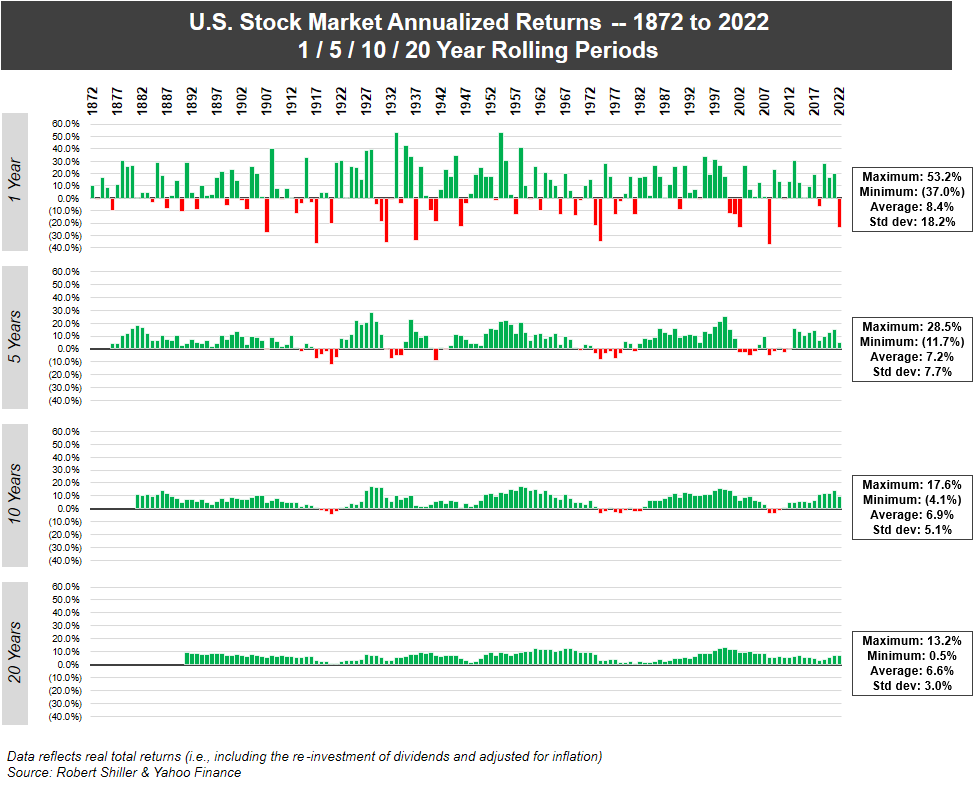
The geometric mean (6.9) is all that really matters for investors, not the arithmetic mean (8.4) - the arithmetic mean under-weights the importance of negative years to long term performance.
For example, if the market is down 20% one year and up 20% the next year, the arithmetic mean will be 0%, but you'll be down 4% (0.8*1.2 = 0.96), which is reflected in the geometric mean of (about) -2%.