I don't think you can argue exactly that Switzerland is prefering road expansion instead of rail. There is still an enormous amount spent on rail but the huge NEAT investment is done and now some failing old road tunnels are in need of work and the costs are tremendous.
One such tunnel requires building a 3rd because closing one of the two for x years is economicaly worse for the country than building the 3rd. The 3rd tunnel however will be closed at the end of construction and can not be used to expand capacity. It will be a service tunnel only.
Also Switzerland just presented their 2035 [1] and 2050 [2] rail plans. The 2035 plan alone includes several new tunnels and new/upgrades to rail stations. The expansion at Zürich Stadelhofen alone is estimated at 1.1 billion Swiss francs and that is not the main train station in Zürich. Zürich Hartbrücke also need to be upgraded and is estimated over triple digit millions as well.
Being in the US, it’s a shame these countries are making this same mistake. I’m probably warped being in Gen Z, but cars/car-centric infrastructure seem like a fundamental mistake, and a shameful investment. Everyone should have a right to walkability, and frankly in my experience, cities without it feel substantially less pleasant. Having good inner-city transit and inner/inter-city rail makes places feel so much nicer and more developed.
Obviously, cities with good transit are substantially rarer and probably far worse maintained in the US than Europe, so I’m sure Europe is in an overall far better spot with it - but I struggle to understand the appeal of developing against walkability and transit-ability in 2023.
>but cars/car-centric infrastructure seem like a fundamental mistake
The issue with public transport is the first word, public.
In a developing place, good public transport is a way better option, as it allows people without higher salaries to be able to spend money on other things than transportation, which in turn grows the economy.
However, once a place is developed economically, and people can afford cars, the general desire is to have a form of transport that does not depend on other people. Public transport can be late, you have to deal with inconsiderate people, there are additional weather issues you have to deal with, e.t.c.
Same goes for living in apartments/condos versus having your own piece of land. Apartments of course are the way to go for densely populated areas, but with everything else equal, people generally would prefer to live away from others for very good reasons.
The key to solving transportation is 2 fold.
First, there should be massive investments into autonomous driving from a policy level. I.e standardized systems, hardware, additional infrastructure. We did this for airplanes, no reason it can't be done for cars. Self driving shouldn't be a matter of having to train a neural net to drive from vision alone, having a car follow a path that it can reliably detect from external markers.
The second is way looser regulation on electric bicycles/mopeds and investment into that sector in general. There is HUGE value mismatch on those things. A gas powered scooter is often as expensive as an electric bike ($2-4k for a decent build), and can reach speeds that make it ok on roads, whereas the bike is speed limited for assist, and has way fewer moving parts. $2k more buys you a 300cc motorcycle that is highway worthy. If there are more affordable options for ebikes as well as options with higher power and no speed restrictions, you will have a much wider adoption of them, beyond even the current high market for them. You can pair this with regulation on disallowing car traffic on sectors within cities during certain times.
> Public transport can be late, you have to deal with inconsiderate people, there are additional weather issues you have to deal with, e.t.c.
People use public transport when it is convenient. If you are a rich country that has so many of these rich people then you can make your public transport good.
If cars and roads actually had to compete in terms of cost benefits, driving would be far more expensive.
> Same goes for living in apartments/condos versus having your own piece of land. Apartments of course are the way to go for densely populated areas, but with everything else equal, people generally would prefer to live away from others for very good reasons.
Having single family homes isn't an issue. Having only single family homes and no commercial is the issue. Row houses can be very popular and cost efficient for people who don't want to be in an apartment.
If you look at subburbs in the Netherlands for example, you will see a wild mix of different types of buildings, all still conected to public tranist and of course great bike infrastructure.
As long as people pay tax for using more land (land value tax ftw) and the car is put into an appropriate place in the transport hierarchy.
> First, there should be massive investments into autonomous driving
Absolutely terrible choice. Even the best case outcome isn't great.
If there is a place where self driving makes sense its in last mile transporting people in the subburbs.
> The second is way looser regulation on electric bicycles/mopeds and investment into that sector in general.
This isn't unreasonable.
> The key to solving transportation is 2 fold.
No the key is actually to have great bike and public infrastructure, and if you do most people will use it. If you also properly restrict cars specifically in cities and make drivers actually pay for all the issues with cars. Then biking and pubic transport will be incredibly popular.
And the cars that are left over are far less of a problem.
I struggle to understand the appeal of walking in the rain and snow and cuddling with strangers on public transport in any year, and that's without bags of groceries. You can walk if you want, everyone should have the right to drivability.
Everybody should have access to all modes of transportation that are sustainable and comfortable to them and the people around them. Transportation should be accessible. Period.
Be it high speed rail, car, bus, e-bike, e-scooter, etc. As long as what you are doing is safe, and you're not harming yourself or other people, you should be able to use whatever the hell kind of gadget you want to in order to get to the places you need to go. You shouldn't have police coming up to you telling you what you can and cannot put on the road because the laws are ancient and stagnant - and only get changed if there is a profit incentive.
You shouldn't have to worry about getting run off the road/sidewalk/crosswalk because the people who planned/make the roads think it's a good thing to build thin, one-lane on each side, roads, with no bike lane, with no shoulder or a very small shoulder, with poorly-maintained sidewalks, etc.
We really need to rethink how roads should work, how traffic lights should work, suggest speeds instead of set limits, and update our infrastructure. And standardize, standardize, standardize.
And specifically, here in the US, we need to change to the metric system, like the rest of the world. But that probably will never happen.
This precious drivability is what it making it suck everywhere. Including for the drivers. It would be better for all parties involved if it wasn't made to be the only viable method of transportation.
I live close to a small city in the Northeast of Germany and driving here is a dream. Nothing like LA. (Which is the city a deleted reply mentioned as an example of cars destroying nice cities. LA's problem is more one of overpopulation, if the population levels were as they were a few decades ago it would be wonderful to live and drive in LA.)
I would like to also mention the blatant disregard of traffic laws by the many cyclists here as an unnecessary burden on motorists. You should be required to take theoretical and practical driving exams no matter the vehicle if you intend to put wheels on the road, otherwise you are a danger to all parties. Helmets on the road should also be required just as it is for bikers.
> blatant disregard of traffic laws by the many cyclists
Enforcement of traffic law for cyclists would be good, but blatant disregard of traffic laws (e.g. running yellow/red lights, not yielding at crossings, stopping on bike paths before roundabouts etc.) by many motorists also exists, and typically is much more dangerous for others than the actions of cyclists (who typically only endanger themselves)
> Helmets on the road should also be required just as it is for bikers
Why? Cyclists don't usually fall off or hit their heads. The costs of mandatory helmets outweigh the benefits.
>At the same time, the report found, European governments had shut down more than 2,500 train stations since the mid-90s. They also closed about 8,523 miles (13,717 km) of regional passenger railway lines.
Yea but how much of that was the "people all moved to the cities leaving villages to rot away" problem that other countries face including Japan and the US? Europe was very much and still has many scattered villages and small towns in each country that are disappearing as time goes on. They had trains, people used them to move and leave grandma/grandpa on their farms.
I’ve said this for a long time: rail infrastructure is just too expensive to be worth it, with a small number of exceptions (Japan for example). Even people in Europe prefer to fly or drive because of costs.
It's high time that we stopped worrying about what's deemed expensive, and worry about what we can do to make the planet and its people healthier and happier; and their lives more fulfilling.
We have the technology and means to do better than we ever have before in every area; and at least here in the US, we're ripe to have this infrastructure put in place. We need a true Green New Deal, not a watered-down bill that allocates funding to the few to accomplish nothing or something small-scale and localized.
If we added thorough, accessible high speed rail infrastructure for transportation AND freight here in the US, we could reduce our fossil fuel emissions and dependence by a pretty large factor. And make travel more dignified and safe. It's absolutely ridiculous how we ship and receive goods - and it's absolutely ridiculous that the best means of travel from any place more than a few hours away is essentially just air. The roads are laughably bad, and they are clogged to the brim with tractor-trailers. It's time to stop.
The real, measurable cost of continuing fossil fuel dependence is higher than we know or predict most likely, and justifying continuing this solely because doing better is "expensive" or "problematic" just shows the lack of leadership we have and the massive tumors that we need to excise. The amount of jobs that a national infrastructure deal would create are staggering, and the new, more sustainable economies of scale that would develop around it are priceless.
There is so much low hanging fruit in the US its not even funny. If you want to invest money and get people in rail, start with proper S-Bahns and combine that with the historic rail network outside of the cities.
Add trams to your cities and proper bus service with priority lines and priority signaling.
And of course the absolutely brain dead land use and zoning policies in the US are the real issue even if you build public transit.
Worry about those things before dreaming up schemes of high speed trains.
That said the Great Lakes region high speed rail, combined with Canada would make a huge amount of sense.
Maybe it's expensive because in the car centric model the costs are shifted to the citizen to buy a vehicle. Great source of profits, we're starting to introduce 7 and 8 year car loans for our best selling vehicles the Ford F-Series, Chevy Silverado, and Ram Pickup in the US.
People preference is why I wait 2 minutes at a crosswalk to get to my local park.
Cost can be solved. I'm not sure car dependence can be.
You are so wrong. In Switzerland on medium distance trips, rail is actually more popular between cities. Rail has been and continues to be an absolutely fantastic investment.
Rail is preferable to planes on most places you want to go in Europe. And the places where its not, its because the rail infrastructure hasn't been built out. This is because of 60 years of overinvestment in roads and 60 years of under investment in roads.
Even Switzerland extreme successful increase in rail was born out of a necessity and a restricted budget. So much more could have been done.
Once rail infrastructure is built, its operation is efficient and much of the infrastructure lasts for 100+ years.
Its funny how people who like roads are all like 'train so expensive' and yet I see road dependent countries (like the US) with roads that look more like the Ukraine then anything else. If its so cheap why can't you maintain it?
> drive because of costs
Because drivers don't actually pay for the massive investment in roads over the last 60 years. Cars have been given incredibly valuable space for free in most cities. The list of things like that goes on and on.
And driving also leads to an absutly insane amount of death and other health defects that society is paying for.
Is it like 40000 deaths alone from cars in the US? Yeah fantastic that people safe some money over rail in some condition.
If you actually analyses effect on society as a whole, walking, biking and rail are all utterly fantastic investments.
Depends. With interrail this isn't really the case. I just spend the same amount going from Switzerland to Oslo by train and then fly back. Both cost about 250 Euro.
But with the train, I went multiple places over multiple days, going to Berlin, Hamburg, Kopenhagen, Gothenburg and Oslo.
A friend of mine travled even more, a monthly interrail is even better.
Railroads are also enormously expensive to build and maintain. According to some reports a few times more so than motorways (at least in the UK). I don't know if there are technical reasons for rail to be more expensive but most railway organizations are inefficient monopolies. In other areas competitions drives costs down (e. g. drives inefficient companies out of the market) but railways are natural monopolies.
The decentralization helps. When you can call your mayor and complain about roads being in bad shape, you can get them fixed. Meanwhile, if there’s bad train service in your town, you might need an act of Congress to help you.
Many of these are car-specific. Is there a reason you can't use buses on those roads, instead of building train tracks?
Buses use existing infrastructure, cost less than the train itself, are generally good when electric, require significantly less engineering to implement, cut down on noise and air pollution if they replace car drivers, etc.
Safety may or may not be as big a concern with buses; this article [0] seems to indicate Tha bus travel is as safe (if not safer) than train and car travel. That doesn't seem intuitive to me, but it's not a stretch to assume that bus travel isn't significantly less safe than train. This could even be improved with dedicated bus lanes.
Fast floods are definitely a concern, but I'm not qualified to say for certain how large the issue is.
There is literally a whole transit system called Bus Rapid Tranist 'BRT' that is exactly that sort of thing. And in the real world it isn't better or cheaper.
You know what, trains in most of the world also use existing infrastructure. The US had a very nice train infrastructure. So maybe the whole logic with 'lets not rip out infrastructure' should have been applied earlier.
Yes buses are good. Specially trolley buses. And you could built a country based all around trolley buses.
But the reality is, buses are actually operationally more expensive then trams or trains. Roads are more expensive long term. And the whole thing will be a lot less cost or space efficient.
As soon as you have sufficient scale, buses become impractical.
I live in a city of 70k people, we have electric double bend buses. These are huge 140+ people buses. And the are very often full.
People how don't live in a society based around public transport don't seem to understand what happens when you want to move a whole society, rather then disinfranchised poor people.
And just from a user-experience perspective, tram and trains are just so much better. Traveling threw the city, I rather spend a couple more minutes and take a tram route. Trams are just so much better and more comfortable.
We have routes in Zürich Switzerland, that only 1M people, where you have S-Bahn trains that are double stack and 12+ wagons long. They come every 5-10 minutes. And pretty much all of them are full during peak hours. Go to Zürich rush hour during those hours and just observe the amount of people, and then start to attempted to do it all with buses. And that's a small city, we aren't talking about Paris or Tokio.
> This could even be improved with dedicated bus lanes.
The running joke in the tranist community goes like this.
We could make buses better by using electric trolley buses rather then disel.
We could make buses better by giving buses a dedicated bus lane.
We could make dedicated bus lanes better by having steel rails rather then asphalt.
We could make buses better by having steel wheels as well.
Congratulations, you just invented a train.
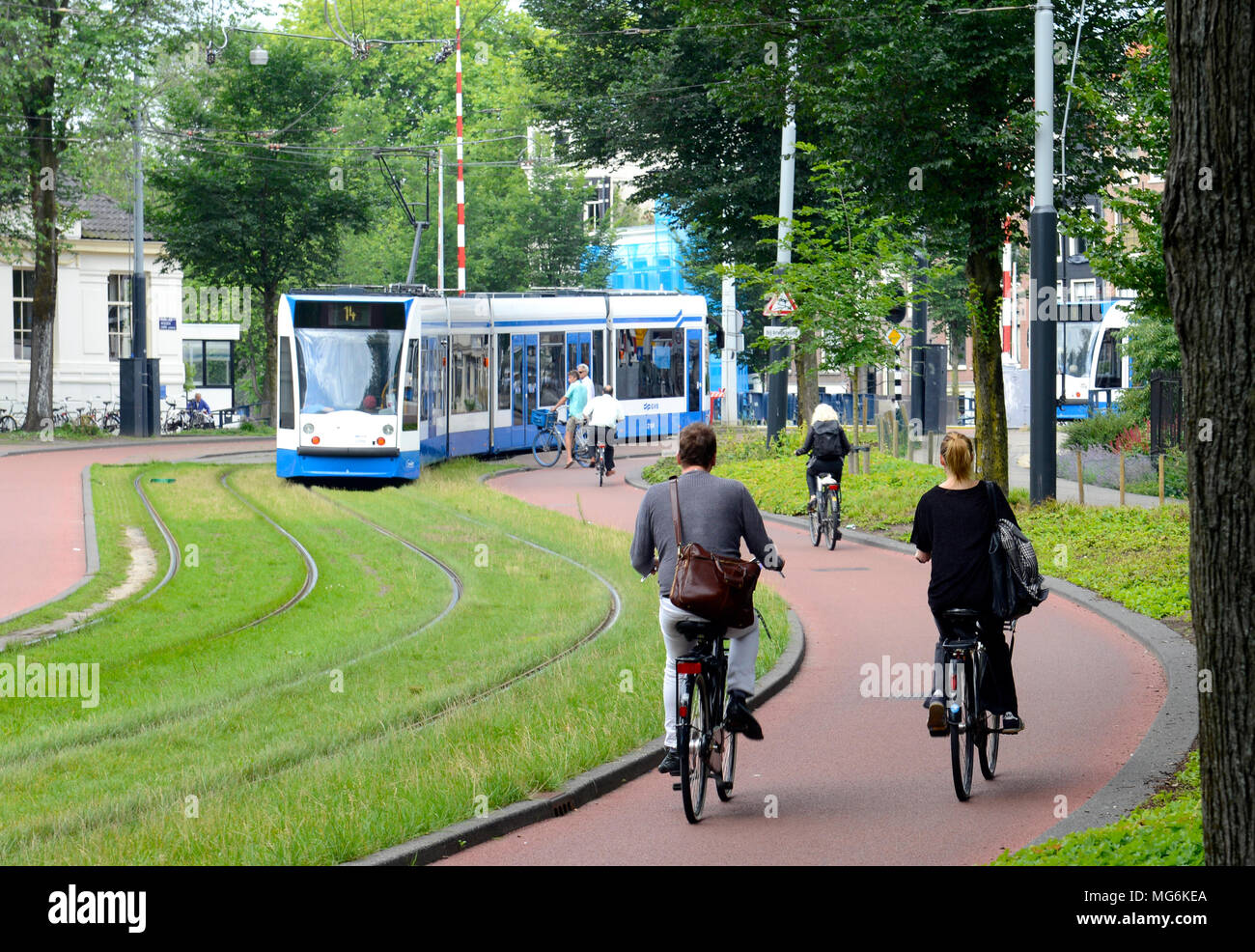
Truly ask yourself, what do you want in your city, this:
For a while the idea of 'Bus Rapid Tranist' was promised as some sort of solution. But real world shows this simply isn't the case. As soon as you actually have a successful BRT lane, you instantly start to think about that it would be far better as a tram line.
Yes, dedicated bus lanes are great, use the extra lanes you have and your existing bus fleet and try to improve the system as much as possible. But once you are serous and you have some users, build a tram or a subway.
P.S: Plastic wheels are also a big source of emission that you don't want to have in a city.
The reality is, people want walk-able neighborhoods. In fact, the places where they exists, they are so horrendously expensive that people can't afford to live there. There are so few of those places that the demand/supply is just crazy. So even if there was a good walk-able neighborhood most people couldn't afford it.
The Texas DoT isn't about transportation, its basically about highway building (and often right threw neighborhoods). 60 years of infrastructure investment in on thing lead to more of that thing.
There are about 160 car accidents a day in Houston alone. The amount of cost society gets from that is huge.
Population count is just one of many metrics when evaluating the "niceness" of a place. Maybe "destroyed" is not the best way of describing the effect of car dependency (my english is not that good) but a city that doesn't value walking sounds like hell to me.
Most US cities require parking to be built when you build a new location. You know what my city doesn't require? A safe connection between the required city side walk through the required parking lot to the business.
Roads also go where authorities want them to go. Have people actually bought into this 'F-150 cross country rover' blabalbal. Buy a Cybertruck and solar panels and live of the grid driving threw the desert.
Wtf is this nonsense? Do people not need water, electricity, internet, school and other things that all depend on 'the authorities'.
I will tell you something about true freedom. When I was 15, me and friends went from Switzerland to Czech Republic by our-self in the train. Parents didn't have to drop us off anywhere. We just went.
And today, I can literally get up, without thinking or planning, walk a couple minutes, and be anywhere in the country 2h later. I can can drink and go home no problem.
But I guess its a much better solution to just keep telling people 'don't drink and drive', because that has helped so much.
It continually amazes me how 40000 a year die, plus an unimaginable amount of property damage, policy cost, medical cost, infrastructure cost and so on and so on. And the defense for that is 'freedom bro'.
Road planners can respond to shifts in demand by reallocating resources. It's not easy, but it's possible. No such thing when it comes to fixed rail. Fixed rail involves investment of staggering amounts of money under the assumption that things will be exactly the same 50 years from now as they are today.
In any other context, hackers would be mortally offended by such a proposition... but for whatever reason, hackers love trains.
There's a weird inversion that happens around the concept of "freedom" w.r.t. cars--everyone insists owning a car is the ultimate expression of freedom, but they never pay heed to the fact that you, the human, become bound to a world built for rolling metal boxes when you own a car. You can only go places that have parking for it, you become responsible for driving yourself wherever you want to go.
With public transit, I can do whatever I want. I don't have to hunt (or pay) for parking, I don't have to worry about not having an extra beer when out with friends. If on a whim I decide I'm going over to a friends house or if I just want to explore the city, I don't have to circle back to where I left my car to continue my journey (or return home): I hop aboard the train from the nearest station.
When I'm on regional rail to visit a friend a few hours away, I'm not stressed about traffic or timing my bathroom trips--I get a snack and a drink from the cafe car and use the bathroom when I want, otherwise watching a movie from the comfort of my train seat.
Moreover, a car is a liability: it requires fuel, storage, maintenance, all of which have varying prices at the dictates of entities beyond us. War overseas? Gas prices go up 30%. Need to park at your apartment? That's another $100 a month. Weird sound coming from the wheel? Could be anything, I hope you've got a trustworthy mechanic. Let alone insurance!
But the subway is $2.50, the bus $2.25. I can get to the airport faster than I could drive, for less than I'd pay in gas, and I don't have to pay parking storage fees.
Cars turn our cities into endless expanses of pavement just to hold our idle vehicles when we're not using them. They isolate us from our world and our communities, limiting us to experiencing everything through metal and glass. Cars are the ultimate expression of wealth separating one from the world: of course hackers love trains and transit.
> You can only do things that some planning board sets up a route to get you from A to B
No, I have an entire grid of transit options to go most places within the city. It's not just A to B, it's anywhere along the co-ordinate grid formed by all the transit routes, plus what I'm willing to walk or bike. Moreover, it provides far easier access to most of the places I do want to go than driving would.
With a car, A to B is possible given that (1) there's car parking at both ends, (2) there isn't overwhelming traffic in-between those two points, and (3) that anywhere else you might want to go also meets those criteria. Providing (or guatunteeing) (1) (2) and (3) results in massive expanses of parking lots which are rarely ever filled, massive expanses of stroad to support all the traffic trying to get to those parking lots, and pushes everything further apart just to support cars, all requiring maintenance and upkeep. Not that trains don't, of course they do, but they're far more efficient in terms of space and money usage to person-miles travelled.
You clearly have no idea how a actual transport system works. You are so hilariously and completely wrong train infrastructure its not even funny.
Go back 50 years and look at the train usage patterns then and now in places like Japan and Switerland.
There are some rails that have been around for 100 years and have been used in many different ways. Going from mining, to transport to tourist attraction.
Rail planners regularly adjust train length to adjust for demands. Frequency of certain routes can be increased or decreased.
If you actually think about it for a while, you realize you need transport where people live. And people don't move to new places in a year or two, new cities don't just pop up.
Many city in and villages have been there for literally 1000+ years, they aren't moving. So the idea that we shouldn't build a train to them because 'who knows about what happens in 50 years' is just beyond idiotic.
If you government is actually smart, they make sure to build transport where they expect people to move. Sweden did this very nicely in Stockholm for example where they built out the train routes and zoned for living along those routes. And guess what people moved there.
This idea that each person is some rugged individualist who at any point my get up and leave to start a new colony somewhere over the horizon is ridiculous. People generally move to places where infrastructure exists.
> Fixed rail involves investment
Rail can be built and still used for 50+ years just fine. How many times do you have to repave and rebuild a road in the same time. Once you actually do the math and you are not guided by 50 year of propaganda, its clear that trains are a far better investment.
And also, just by the way. The US had a huge amount of fixed infrastructure, that was already built. And then dropped. It clear wasn't the up front investment cost that was the issue.
> but for whatever reason, hackers love trains.
Maybe they have thought about it for more then 5min.



One such tunnel requires building a 3rd because closing one of the two for x years is economicaly worse for the country than building the 3rd. The 3rd tunnel however will be closed at the end of construction and can not be used to expand capacity. It will be a service tunnel only.
Also Switzerland just presented their 2035 [1] and 2050 [2] rail plans. The 2035 plan alone includes several new tunnels and new/upgrades to rail stations. The expansion at Zürich Stadelhofen alone is estimated at 1.1 billion Swiss francs and that is not the main train station in Zürich. Zürich Hartbrücke also need to be upgraded and is estimated over triple digit millions as well.
[1] https://company.sbb.ch/de/ueber-die-sbb/projekte/nationale-p...
[2] https://www.bav.admin.ch/bav/de/home/verkehrsmittel/eisenbah...