So the good news is Hawaii isn't the "sudden explosion and everyone dies" kind of volcano. It's the oozy kind. You just have to not stand still and let the lava take you.
That's not to say it's risk free or that some people -- maybe even lots of people -- won't be homeless when the lava finishes flowing, but this isn't a high casualty sort of disaster.
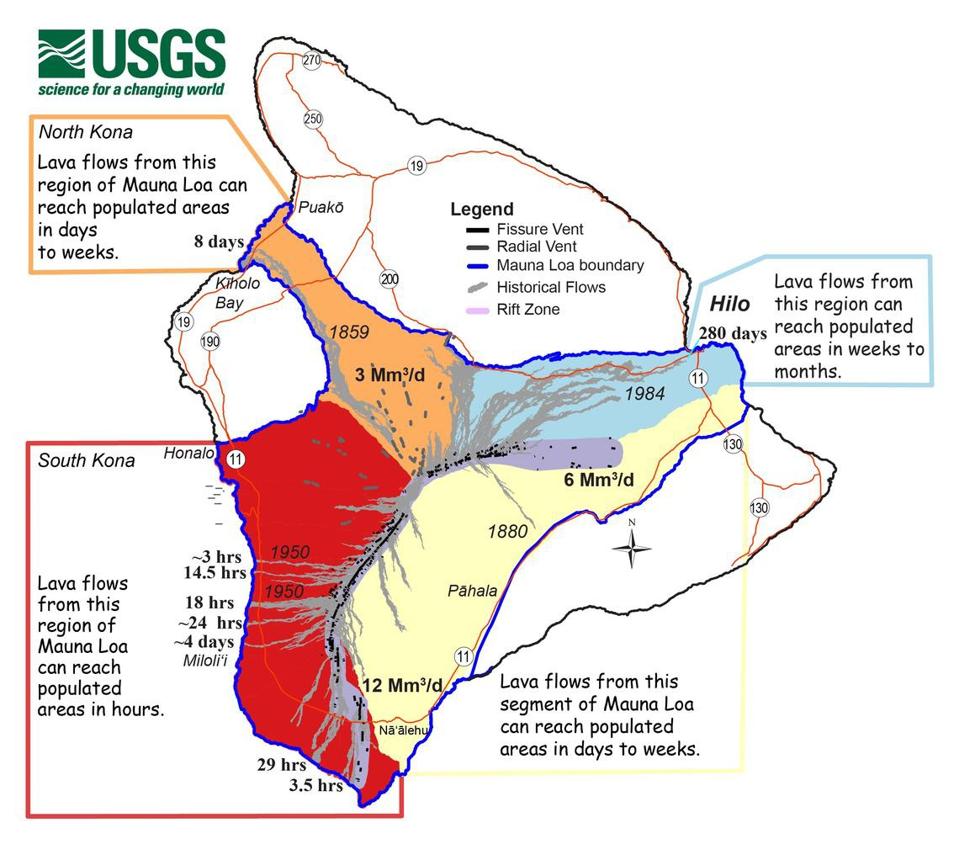
Well, Mauna Loa has a fast moving lava in much larger quantities than the nearby Kilauea, so the scenario might be grim there as well. Large areas can be flooded within hours, especially on the south-west.
Thanks. I sent my friend a message because I’m not sure where abouts in Hawaii he lives. Hopefully he replies soon. But happy to hear it’s not high casualty disaster. Obviously no casualty is better tho.
It is probably going to be a no casualty event -- according to the USGS, only one person has died due to an eruption in Hawaii this century. Radios and cars make evacuations a lot easier.
I'm not even sure we'd expect casualties from the evacuation -- if 100,000 people (twice the population of Hilo) drove entirely around the Big Island (300 miles), you'd only be at around 30 million passenger-miles, well short of the statistical 1 death per 100 million passenger-miles.
FYI: despite popular misconception, "casualty" doesn't imply death. A casualty of war, for example, might actually refer to someone who is wounded/maimed/etc. but still survives.
If a house is consumed by lava and the occupant becomes displaced/homeless, it could reasonably be argued that it didn't result in zero casualties. Same goes for other things that might be more commonly understood as "collateral damage".
The island is huge, 70 miles East-West and 90 miles North-South. If you've seen islands on inland lakes, on the Great Lakes, or off the Atlantic or Pacific coast, you're thinking too small. As long as you're not standing on the summit of Pike's Peak (or Mauna Loa), you're probably unable to see beyond the curvature of the earth to a horizon comparable to the distance from the caldera to where your friend lives, and the probability that a lava flow oozes all the way to the horizon is vanishingly remote.
However, the bigger factor in your friend's safety is that the vast majority of the population live near the coasts of the island, very very very few live near the peaks. Also, 5x as many people live on the 5x smaller island of Oahu in the city of Honolulu rather than on the island of Hawaii...if your friend lives "in Hawaii", statistically they probably live on an island 200 miles away, or potentially on the coast 40+ miles from the summit, it's extremely unlikely that a random Hawaiian lives on the slopes of Mauna Loa.
There are a number of islands in the Hawaiian Islands spread over a fairly large area. (For commercial travel, you need to fly between them.) The biggest, where the eruption is happening, is also called Hawaii although locals refer to it as Big Island unless they're referring to the state as a whole. Big Island is 4,028 square miles (10,430 km2) and has a population of about 200,000 most of which is on either the east or the west coast.
Most of the population of the state though is in Honolulu on Oahu (also where Pearl Harbor is). There are over 100 islands but just 8 main ones of which casual visitors might visit 5.
> Mauna Loa is among Earth's most active volcanoes, having erupted 33 times since its first well-documented historical eruption in 1843. It has produced large, voluminous flows of basalt that have reached the ocean eight times since 1868. It last erupted in 1984, when a lava flow came within 7.2 km (4.5 mi) of Hilo, the largest population center on the island. Mauna Loa is certain to erupt again, and with such a propensity to produce large flows, we carefully monitor the volcano for signs of unrest.
Edit: The island is decently big, so the impacts probably won't affect a significant amount of the island. That said, some settlements like Hilo are in the impact zone for a significant event.
Decent doesn't quite cover it for people unfamiliar with the size of the state. The island that this volcano is on is bigger than the states of Delaware and Rhode Island combined.
Eruptions on the big island happen pretty frequently, maybe about 1-2 times per decade (partly because there are several volcanoes there; Kilauea was erupting when I was there less than a decade ago). It's in some ways comparable to hurricanes on the gulf coast, but with fewer deaths historically. Not to say that it is safe as such, but residents of the big island are very good at dealing with it.
Kilauea (the other active volcano on Hawaii island) erupted continuously from 1983–2018. It erupted, again, in 2020-2021, and is currently erupting as best I can tell. It is more notable when it is not erupting!
It'll be days before the lava is potentially dangerous. It's slow moving so plenty of time to evacuate. It can take weeks for the lava to make its way to the ocean