I don't understand why consensus jumped to the conclusion that there must be a new form of undetectable matter instead trying to figure out what we don't know about gravity.
Theoretical particle physics is even worse. There haven't been any advances since the 1970's. Experimental particle physics has done a great job in verifying/testing the predictions from the 1960's/1970's but theoretical physicists are stuck in a rut.
> I don't understand why consensus jumped to the conclusion that there must be a new form of undetectable matter instead trying to figure out what we don't know about gravity.
Is it implied in "I don't understand" that "it's not understandable?" There is quite a bit of evidence that point towards dark matter and away from problems in our theories of gravity. We have direct evidence for forms of matter that do not interact with particular fields, it would be unsurprising to find other forms that are extremely difficult or impossible to detect.
Most notably if it was just gravity then we'd expect the effect to be more homogeneous. But with dark matter distribution it isn't. The distribution of dark matter is highly non-homogeneous and acts just like matter does, creating webs and clumps. It would be weird for a field to do this, especially since fields are associated with particles (we still haven't found the graviton, which is the exception to that statement, so far. But we also don't expect to find it without a substantially larger accelerator. One that would be difficult to build on earth)
My immediate take on "dark matter" was that there is something strange about gravity and inertia.
At the galactic level, however, there is a lot of cases where it seems you can see the mass distribution of dark matter. They've found starless hydrogen clouds that seem to be dragged around by a dark matter halo.
If you think about the evidence from galactic rotation curves you are likely to think that "this galaxy has some dark matter in it" but the modern point of view (which seems to work) is that "this dark matter has a galaxy in it."
When it comes to cosmology at the larger scales I don't really believe in the "multiple flavors of dark matter and dark energy" that is fashionable now. I wonder, for one thing, if the universe is really homogeneous at large scales and if that breaks the assumptions of current models.
Part of why dark matter is such an attractive explanation is because there are no constraints on it. Unfortunately this seems to have relieved pressure to explore and test modified gravity.
For example, how much of it there can be or where it comes from. Contrast with Neutrinos.
But you are correct, I don't know what I am talking about which is why my comments were phrased in the form of a question or literally with the words "I don't understand"
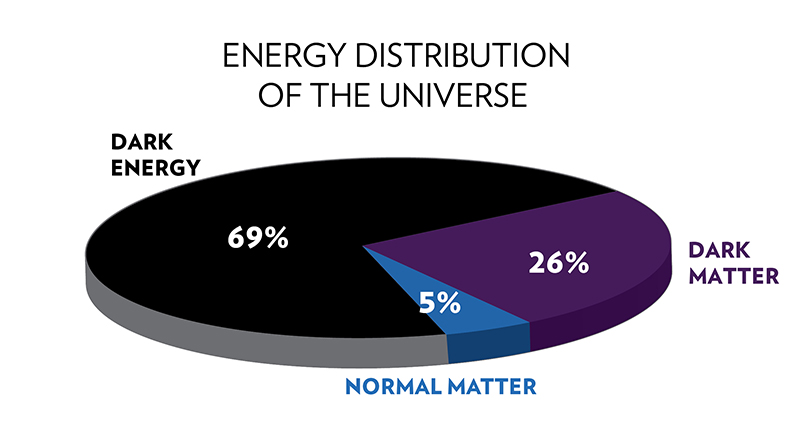
Is that a chart of how much we think there is (model fitting based on observations) or how much we think there should be based on how it is created?
With Neutrinos we know how they are created and have a very good upper limit on how much there should be and it's not nearly enough to explain the observed effects. Same for the CMBR.
I'm not saying there couldn't be much more Dark matter/energy than neutrinos or photons but it's a bit too convenient to introduce a variable that is allowed to take any value and match it to observations without an explanation of what it is (besides having mass) or how it is created.
I think they mean that the theory of dark matter has an infinity of parameters. For every point in space, one can (rather arbitrarily) assign a mass of dark matter to make the theory fit observations.
No, not really. We can observe it indirectly and have mapped out its structures. And intuitively, why do you find it implausible there is a massive particle that only interacts via gravitational force?
One of the more convincing argument I've heard is the "bullet cluster". Basically it's composed of two clusters of galaxies that recently collided. Since dark matter and normal matter interact differently (dark matter interacting weakly), you could imagine that the two would have different centers of mass following such a collision.
If there's really just modified gravity without any dark matter, the distribution of the regular matter would be sufficient to model the gravitational dynamics but if there is such a thing as dark matter, you'd see that the gravitational effects would be consistent with a center of mass which is displaced from the center of mass for the regular matter. This is, in fact, what you see, suggesting that there really is some type of dark matter.
What makes you think anyone is jumping to conclusions? Many explanations have been proposed but the undetectable matter explanation is still the leading candidate.
From observations, we can see dark matter acting independently of visible matter. It's very difficult to explain this any other way.
There's a lot of different data out there and a lot of different theories. The dark matter hypothesis fits a lot of the data really well with a very simple model, few extra constraints or variables.
The alternative theories don't fit the entire set of data as well. Or they do, but by choosing additional complexity, rules, constants that are chosen to make the model work, but can't be explained otherwise.
Dark matter isn't a full explanation, no doubt, but imho it's the best we have.
Well you never really “see” anything, you see effects of a thing. Especially at the edges of physics where all the low hanging fruit is understood.
We see an effect which isn’t accounted for by the things we understand well and come up with several theories to explain that effect. Eventually we gather enough evidence to confirm or deny those theories and science marches on.
There are several theories as to what causes the effects that are primarily attributed to dark matter, by no means is it settled. But the theory that fits the best is that there is quite a lot of mass out there that we can only observe so far by large scale gravitational effects on matter we can see more easily.
Sure, it could be something else but a really convincing candidate hasn’t come up.
We’re in the same situation physics was in towards the end of the 19th century. It seems like physics is nearly “done” with only a handful of odds and ends left unexplained. Maybe it is, maybe we’ll get a breakthrough that opens up a whole new world of physics. It’s hard to be sure but over and over we keep probing and not really finding significant “new physics”.
The trouble is that astronomers have limited ability to detect matter and estimate its mass. Given the predictions from GR, the idea that there was new astronomy and particle physics was easily more attractive.
~50 years on without significant progress for particle physics + GR means we are starting to be interested in alternatives.
Consensus shifted away from MOND and towards LCDM due to degrees of freedom in observations. A trivialized comparison would be "Why did artists give up on finding the best color and instead focus on finding the best arrangement of color on canvas?"


Theoretical particle physics is even worse. There haven't been any advances since the 1970's. Experimental particle physics has done a great job in verifying/testing the predictions from the 1960's/1970's but theoretical physicists are stuck in a rut.