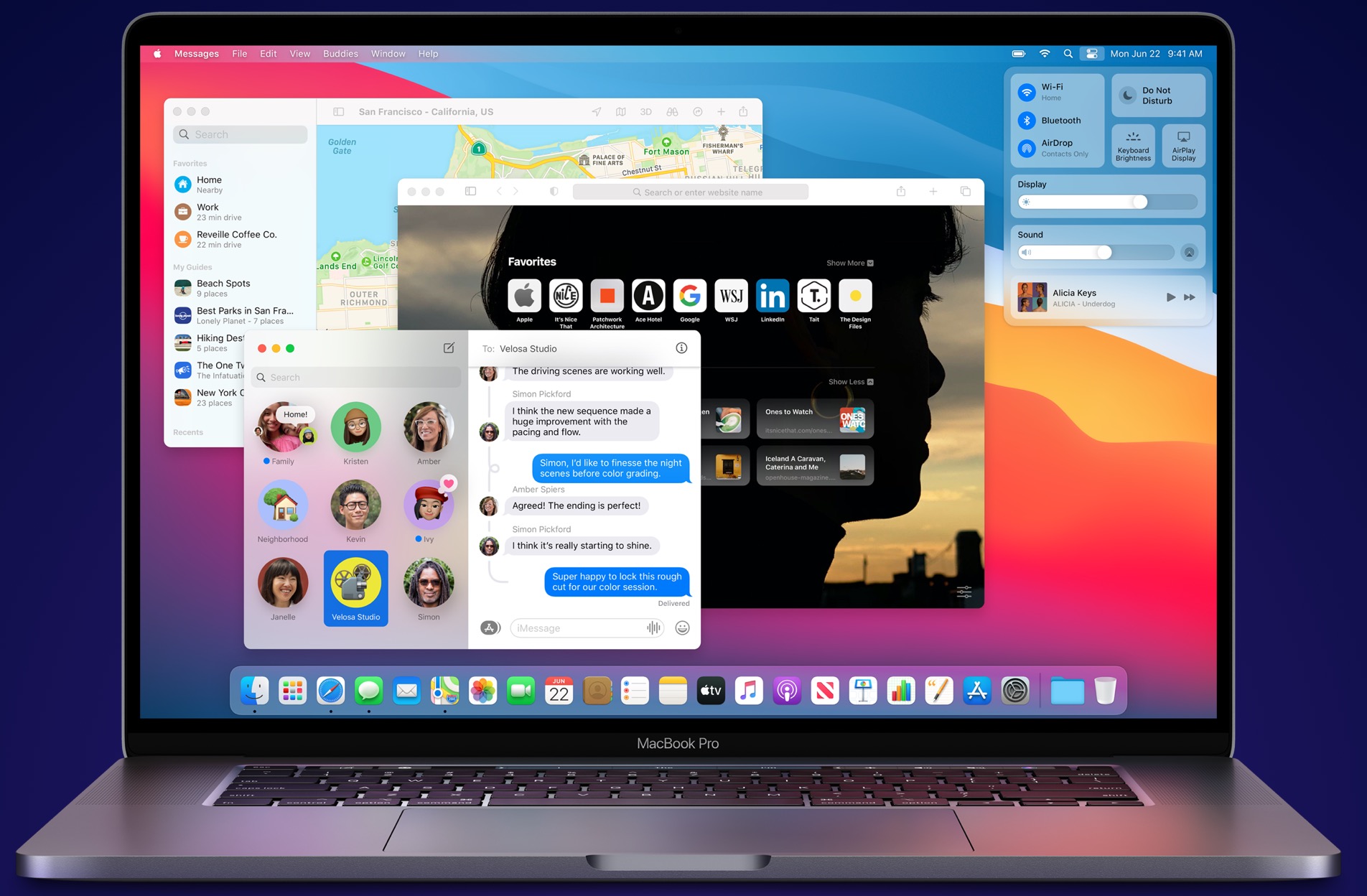
I mean this in the nicest way, but are you seriously suggesting Apple is looking to the open-source Linux community for UI design ideas? Isn't it much more likely the trend is just industry-wide, and Apple is part of it as much as Gnome is? Apple's own UI has been moving in that direction for years anyway before Big Sur.
General trends? Yes, of course. But at Jobs's very last WWDC event, they demoed a lot of new Mac developments for Lion that specifically (not generally) mirrored some of the features going into Gnome Shell after (very public) design iteration. At the time, I came away saying that it was basically "Gnome Shell, rotated 90 degrees".
Not sure what "open-source Linux community" means to you, besides a phrase that can be used to denigrate and diminish the work of people who have skill and vision by associating them with unrelated projects that lack polish.
You're also doing a pretty annoying thing where, rather than engaging with someone on the topic of discussion, you instead appeal to the audience's intuition and essentially suggest that the conversation need not happen because the other side can be dismissed outright due to Common Sense things that everyone Knows. (It's a great tactic when your goal is to prevent anyone from taking something seriously because serious examination would necessarily lead to confronting something uncomfortable.)
So, Gnome's design and Apple's didn't exist in a vacuum. I'm not saying Apple told someone to go rip off Gnome 3, or that Gnome 3 is just better than Big Sur in some way. But I think it's altogether too harsh to deny it had any influence when we look at the changes from Catalina to Big Sur.
To me, Big Sur's design is very clearly taking its aesthetics -- for better or worse (maybe better and worse) -- from iOS: minimizing "chrome" as much as possible to the point of making title bars vanish when it's deemed feasible, reducing buttons to flat single-color icons, and so on. Your screenshots of GNOME 3 look more like Catalina than Big Sur to me, honestly; the buttons still look like, well, buttons; the title/toolbar goes all the way across (unlike Big Sur but like Catalina), the buttons are grouped (unlike Big Sur but like Catalina), etc.
I don't think anyone would say design exists in a vacuum, nor that the open source community has no ideas that Apple or other companies would consider -- I mean, look at CUPS and KHTML! But open source has, well, not historically been great with its desktop UX design. The best free software interfaces that I see tend to take pretty direct cues from (hopefully well-designed!) commercial counterparts; more often than not deviations from those established norms make things worse rather than better.
I've been looking at the screenshots you've posted and I'm struggling to see what influence you're seeing in Big Sur that came from Gnome 3.
The best I've come up with is the switch from a two row title bar/header to a one that is integrated into just one row. Which could very well be inspired by Gnome 3 or parallel evolution.
Are there other UI elements that I should be seeing in Big Sur that look like they have inspiration, homage, blatant copying that I'm not seeing here?
To my eye they have a somewhat similar aesthetic but and general layout but their differences are many when looking closer.
This is true. Macos's window management is still a dumpster fire (Cmd-tab to go to the last window raises all windows in that application. And switching to the previous application across two monitors will focus on the application windows in the monitor of the most recently focused window - not the last window).
That's because Cmd-tab switches applications, not windows. Generally macOS doesn't do "window management" it does "application management". Once you start thinking "what application is active" instead of "which window is active" you'll find it pretty natural. Took me about a week of full-time use of decades of Windows/Linux. (Although, admittedly I had used MultiFinder back in the day, so I was already used to the paradigm.)
Calling it a "dumpster fire" is a bit overdoing it when it's just a different paradigm.
I think everyone is aware that it's a different paradigm. It was introduced in the 80s as a way to have floating windows for the application and reuse the same tool windows for e.g. Photoshop without a parent window. But now even Photoshop has a parenting window. Almost everyone just maximises all their applications since Mac window management doesn't work. And everyone else has to install Spectacle or Rectangle[1]
I am attacking the paradigm. It has had its time. It is done. It should leave.
What's the alternative? If cmd-tab switched windows, my own workflow would be a nightmare. The list of all windows when switching would be unmanageably large and I'd have to manually raise several windows after switching.
My preference would be to keep it as is but have window switching work like app switching. The separate order in which the two cycle is a pain.