- In the conclusion the authors mention:
Full details of these cells including electrode compositions, electrode loadings, electrolyte compositions, additives used, etc. have been provided in contrast to literature reports using commercial cells. This has been done so that others can re-create these cells and use them as benchmarks for their own R+D efforts be they in the spaces of Li-ion cells or “beyond Li-ion cells”.
> Full details of these cells including electrode compositions, electrode loadings, electrolyte compositions, additives used, etc. have been provided in contrast to literature reports using commercial cells. This has been done so that others can re-create these cells and use them as benchmarks for their own R+D efforts be they in the spaces of Li-ion cells or “beyond Li-ion cells”.
That's incredible.
Normally I walk into these wunderbattery threads expecting to heap reproducibility scorn (we're still waiting for solid state glass batteries, and will in all likelihood be waiting forever) but pathways to reproducibility aren't something I'm used to in battery vaporware.
I'm actually excited for battery tech, which seems weird given all the disappointment over the previous decade or two. Feels like being excited for another cancer cure in mice.
For those commenting that the discharge rate is too slow in the test, or the depth of discharge was fudged... the tests were run with a high discharge rate combined with 100% charge at storage.
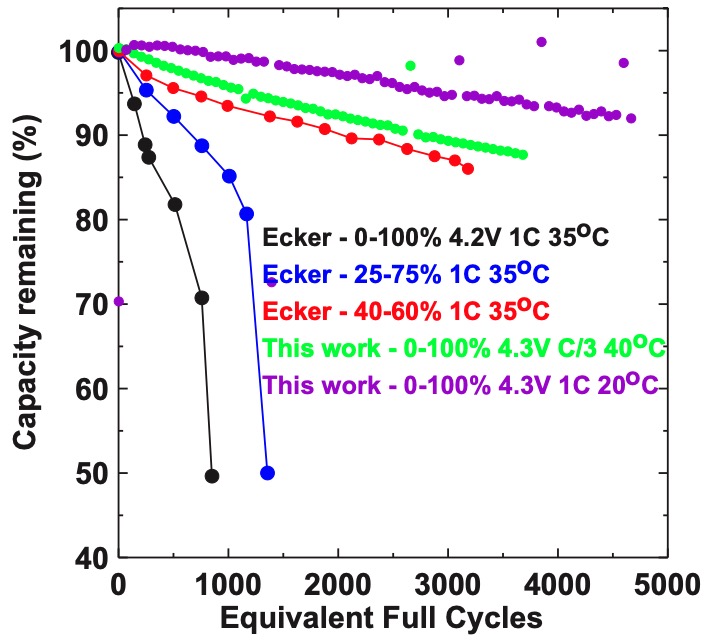
> Figure 23 shows the projected fractional capacity of these NMC532/graphite cells as a function of time in years in a scenario where the cells are cycled once per day (100% DOD to 4.3 V) in a cycling event that takes 6 hours. It is also assumed that during the remaining time, cells are stored at full state of charge. It is clear from Figure 23 that these cells would provide an exceptionally long total driving range in an EV if the cells were maintained at an average tem- perature of 20°C. Even if the cells were continually at 40°C, 10 years of lifetime to 70% capacity and a total driven distance of 1,200,000 km is projected. It is worth noting that only 3650 cycles would be required for this total driven distance and 3700 cycles have been demonstrated in Figure 16.
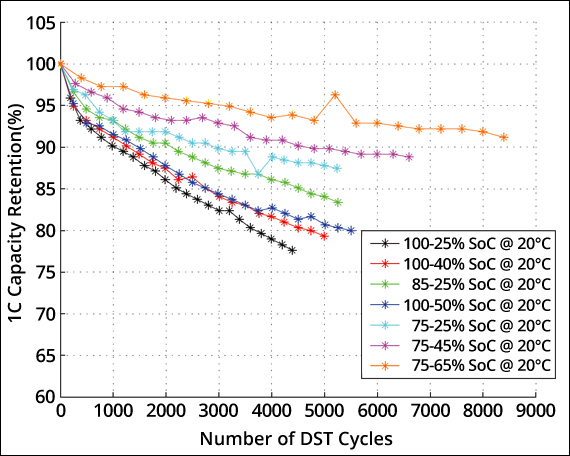
> Most important to realize is that Figure 23 assumes 100% DOD cycling on every cycle and storage at full state of charge. If the reader reviews the literature data in Figures 1 and 2, the reader will realize that the lifetime will be much better in situations where the DOD is limited and in situations where cells are stored at lower states of charge. Admittedly, the projections in Figure 23 use the incredibly simple model described by equation 1. It is our opinion that more sophisticated models will lead to even longer lifetime projections.
1) 532 is not a new chemistry. It's not even the lowest cobalt chemistry; there's 511 and 811 beyond that (811, or 80% nickel, 10% manganese, and 10% cobalt, is not yet technically feasible).
2) Range is decreased. 532 has lower energy density.
3) Maybe..? But nothing truly significant. The additives in this chemistry mean a lot of heat gets generated during charge/discharge. Heat is the limiting factor during charge, so swapping directly to this would mean lower top charging speed. However with better cooling... maybe? It can sustain high charge current for longer, but not as high overall.
4) The buffer for EVs is ~10%. It's not a big factor in cost or weight.
5) Yes, 5x longer lifespan. The caveat is that they havent actually tested >3 years, but IMO this is probably a 50 year battery. The paper is more conservative and gives it 20 years.
This will be pretty enormous for grid storage, since a battery that lasts 5x as long costs 5x less. It may be important for trucks and buses, since they are much higher mileage and will want to run at 100% depth of discharge. Cars on the other hand run closer to 20%, where normal batteries will also last for many thousands of cycles.
> since a battery that lasts 5x as long costs 5x less.
This is only true if there is an inflation-adjusted discount rate of 0%, which is unrealistic even in this era of low interest rates. Adjusted for inflation, paying $10 now and again at years 10, 20, 30 and 40 is better than paying $50 up front would be. (By adjusted for inflation, I mean that the $10 you pay in 10 years might actually be $11, but still $10 in 2019 dollars)
"which is unrealistic even in this era of low interest rates"
What? It doesn't seem unrealistic to me. Interest rates are increasingly negative in nominal terms, but much more frequently near zero or negative in real terms. Even in the US, 5 year real rates have averaged around zero from 2010 to present.[1]
Adjusted for inflation, paying $10 now and again at years 10, 20, 30 and 40 is better than paying $50 up front would be.
This ignores the economic realities of how projects of this nature are funded. Once projects reach a certain scale, it's much easier to find $50x once than $10x multiple times, especially when that $10x spend does not include costs that may increase over time, such as labor and regulatory compliance.
It's assuming that the item you're purchasing would maintain the same real price. If it cost $10 to start, and after 10% inflation the battery now costs $11, this holds. (Well, it holds if you have some way to beat inflation with safe returns. US government bonds often but not always meet this requirement)
In the case of batteries specifically, I think it's likely that prices drop even without adjusting for inflation. This makes the price advantage even clearer.
What you are saying doesn't even make sense. The original comment was that a battery that lasts 5x as long costs 1/5th the price over time, and your hypothetical is buying a much cheaper battery for some reason. There is no reason to play semantic games with the time value of money, it is clear what the original person was saying.
My point was that as lifetimes get longer, value does not scale linearly. Would you pay 1000x as much for a battery bank that would last until 12019, or would you assume that it would be made obsolete at some point over that period? Maybe we've all moved to fusion, and grid-scale storage is useless. Or perhaps prices decreased by 10x over the next 20 years, and so getting a 20 year battery + a 9980 year battery would only cost 2+998/10=101.8 times as much as the original 10 year instead of 1000 times.
Time value of money is important, and IMO would be enough on its own. But opportunity cost from excluding future improvements matters too - and given the improvements in battery tech over the past decade, one that would certainly be relevant over the next five decades.
It's unfortunate they call it grid storage. Apparently you can make money by connecting a battery to the grid as the one in South Australia does make money, but I have no idea how it does it. Perhaps the price goes through the roof when a coal generator trips out and a battery can react so fast it gets first dibs on the money. The one in South Australia has certainly done that. It must be something like that as the storage is so small and the batteries so expensive they would have to get an astronomical price on what they do sell.
A house battery on the other hand - that's a different matter. The price of retail electricity at is 3 times the wholesale price, and unlike the grid battery the house usually pays nothing to charge it - it comes from the root top solar. Even so batteries aren't competitive yet, as in the return you get on installing one in a house in Australia is currently negative. But if the price drops by 1/2 it will save money by adding a battery.
I struggle to see how grid batteries fit in, but house batteries (which are really a grid battery installed at the other end of the wire) seem like they are just around the corner.
> Apparently you can make money by connecting a battery to the grid as the one in South Australia does make money, but I have no idea how it does it.
It is called the ancillary market. Basically if the grid voltage or frequency drifts off target too much, the mismatch causes semi-catastrophic shutdown of connected generation. It's... Kind of like if the timing belt in your car broke? Multi-ton generators rotating at thousands of RPM suddenly start to change direction, and they would fly apart if not for safety shutdowns.
The ancillary market exists to prevent that. Standing contracts are posted to bring fast generation like hydro power or gas turbines on the second power gets too low or too high. In Southern Australia there is very little of those resources and due to technical neglect and the governments pro-coal policies, the growth in power demand led to an unstable grid. Their limited number of fast "peaker" plants just couldn't keep up. That's why the battery made money hand over fist- 1.5 years to pay for itself, a wholly unheard of thing in civil projects like this.
Note that I've elided over a lot and ancillary markets worldwide are very highly regulated. They are very complicated, require sub-second reactions, and are generally a problem of the commons. One of the major problems that lead to the SA blackouts was the government expanding the acceptable frequency window- to ~5x what the rest of the world does (iirc). Companies immediately stopped making an effort to switch quickly and made poor long term decisions, relying on undercutting competition.
> I struggle to see how grid batteries fit in, but house batteries (which are really a grid battery installed at the other end of the wire) seem like they are just around the corner.
I think nuclear is one of the likely use cases, but it requires huge changes in carbon regulation. Nuclear is also highly capital intensive and benefits just as much as renewables from storage. A carbon tax is required to make the costs make sense though.
> The ancillary market exists to prevent that. Standing contracts are posted to bring fast generation like hydro power or gas turbines on the second power gets too low or too high.
Ahhh, so that's how it works. Thanks.
> In Southern Australia there is very little of those resources and due to technical neglect and the governments pro-coal policies,
I struggle with that. South Australia is in the position it is is (50% renewable, 100% on occasions) because it has very little coal, and what they do have is low quality. In fact they import it from QLD and NSW. All that posturing from federal liberal politicians blaming SA Labor for choosing renewables is just that. In reality they didn't have much choice. It's very hard to be pro-coal when you don't have any.
> Nuclear is also highly capital intensive and benefits just as much as renewables from storage.
I've never thought about it - but that's probably correct. However I'm firmly in the camp of "if it was truly cheaper than coal or renewables, nuclear would be everywhere now". The data makes it fairly plain safety concerns are overblown - it's actually one of the safer forms of energy production. If it was cheap the loud protests from the anti-nuclear nuclear lobby would be ignored, just as the protests from the anti-wind lobby are mostly ignored.
I think it is referring to the fact that it is ubiquitous to leave some amount of reserve so that the battery is never fully charged (100% SoC) or discharged (0% SoC). This formulation is capable of going the full 0-100%, while most formulations will last significantly longer if they don't do that.[1] In that graph, charging to 75% and discharging to 25% gives you about 3x more life than from 25%-100%.
NB that most li-ion cells are rated for 300-1000 cycles at 100% Depth of Discharge. Reducing the DoD to 90% or 80% will get you thousands or tens of thousands of cycles, although it is abnormal to actually measure that long. A charge-discharge cycle at .1 C (the former standard) takes 20 hours.
24kw leaf battery is an example of this with user stats seemingly bearing it out. Charge it to 80% each time, you can expect 3000 cycles before it's spent (drops below 85% of original capacity). If you charge to 100% each time, you'll only get 1000 cycles.
3-4 years versus 8-10 years use makes a big difference.
The 85% capacity benchmark seems pretty arbitrary to me. I'd imagine most owners very rarely use more than 85% of their range (or at least, could avoid doing so easily) at which point 85% isn't "needs expensive battery replacement", it's just "slightly less range buffer". I imagine in 20 years' time we'll see plenty of old beaters, student cars etc. with 50% or less range that are still quite happily driving around.
Nothing here indicates a discharge rate. I'm having trouble finding the actual wattage produced by these cells over the 6 hour discharge time. Also, 6 hours is a longer than the current Tesla will run full charge at highway speeds (350 mile range, 75 mph ~= 4.5 hours). Plus, the current tesla can be re-charged and continue to operate, conditions I don't see mentioned.
If it is similar to existing batteries though... great!
In battery terminology, and this paper, charge/discharge rate is referred to as "C". Charging or discharging at 1C means a battery would be fully charged/discharged in 1 hour. A 100 Wh cell discharging at 1C would produce 100 W. Likewise, at 3C it would take 20 minutes and produce 300 W. At C/3, it would take 3 hours.
That doesn’t give us any information on the capacity of the cells. Once we know the MAh of the cells, that gives us the output amperage, but without the capacity (or an amperage/watt value to derive the capacity), it’s a useless value.
This is very exciting. BEVs that were made before 2016 (I think that was when the last breakthrough trickled down to BEVs in the market) typically had a battery lifetime of about 70k miles or maybe a bit more before reaching 70% capacity. Fast-charging regularly might reduce capacity by several percent points within a few hot summer months. Basically, you bought a car for €30k and it might become useless 5-7 years later. Within a couple of years, we have gone from "I don't know, it's a bit risky to buy" to "My grandkids might be able to use this battery in their static storage system in a few decades".
I think that was mainly due to early EVs having low battery capacities in general (because batteries cost a lot more then) so daily commuting would cycle them much more deeply than current high-capacity models. This 2017 article[1] shows battery life data for hundreds of Tesla Model S's (which have always come with large-capacity batteries). One of the highest-mileage cars in their data pool had just over 220k km (137k mi) on its battery with 90% of the original capacity remaining. There are also a few outliers with under 100k km that are below 90% capacity, I suspect those are cars that have been subject to a lot of long drives and supercharging.
The difference in lifespan that I mentioned occurred in packs of similar sizes, for all manufacturers but Tesla. Tesla is in its league when it comes to battery lifespan.
My 2012 tesla model s didn't seem to follow this. At 5 years old it had barely less capacity than original capacity. Est range went from 275 to 265. If you follow teslas, there are many (100s) of people with great than 100k of miles. The battery heating and cooling system was crucial. The leafs do suffer from serious problems. I wasn't aware they weren't charging up the battery. When speaking of evs, you really have to discuss two worlds, tesla and everyone else.
Indeed, Tesla has always had a superior BMS, and I keep hearing that they have a custom electrolyte or something that Panasonic uses for their cells? They seem to get 2-3x the lifetime out of similar cells. The Leafs don't have liquid cooling, and that's the only reason why I won't buy one - it's both bad for battery life, and fast-charging (Leaf owners call it Rapidgate).
Can anyone tell whether this is a solid state electrolyte? I’m still hooked on what I saw in that Netflix documentary where the guy was able to cut and puncture the battery without combustion. Also seemed capable of being much more dense.
It is not. This is a fairly conventional cell, with a different crystal structure for one of the ingredients, and a tweaked mix of liquid electrolytes.
The most important part of this paper is that they actually prove that optimizing for cycle and calendar life can have such incredible effects.
Will we end up with seasonal battery's? Many already accustomed to switching tiers in winter. Whilst temperature management of batteries would cover many aspects, some locations a better tuned battery would make it more efficient overall perhaps.
Very unlikely. Winter batteries aren't a huge problem as long as you are gentle until the pack is warm. Hot batteries are more of an issue, as they don't really like temperatures above 90-100 F. Keeping the battery at half charge helps reduce that damage a lot.
Ultimately if you live in a hot climate the best thing to do is have a cool garage. The higher heat while out and about is not an issue, just the constant level of high heat. The only people who would get a real benefit from high temperature batteries are those without. Batteries are much more expensive than tires and the market is smaller.
Was wondering about if you could put a liquid coolant loop from the battery to the charging socket on the car, then have a heat exchanger in the plug and run water to and from it using a jacket round the cable, so you can have a rapid charge that also helps heat your bath water.
A supercharger tops out at 250 kW throttles down when the battery pack gets to ~115 F. Hot water heaters run from 120-140 F. Domestic circuits at at most ~7kW, so you'll realistically never be able to do anything useful with the waste heat. At low power like that battery charging is 98-99% efficient.
Another problem is that the coolant loop needs to be kept quite clean. The fins are only about a few millimeters wide and in some cars (eg Model 3) they're electrically hot. Any grit or buildup making its way into the system is a huge problem and just having a valve that can open can cause problems.
I'm talking about having a domestic supercharger. You can get up to 70kW at the company head fuse as a standard residential customer in the UK. You can also go higher, but you have to apply for a quote, so at the moment getting a true domestic supercharger is a bit pricy.
However, they are going to have to upgrade it all anyway if we get loads of electric cars.
As for the coolant loop, I wasn't suggesting to have a valve that can open, just a closed loop to the socket and a heat exchanger that then heats the water flowing through the handle of the plug.
You then store the water in an insulated tank and use it as a preheated supply feeding your main water heating system.
It’s probably worth it for locations that see extreme heat throughout the year though. Phoenix, LV, etc would probably be cheaper markets at scale with specially engineered batteries.
Having a cell that tolerates 100% discharge seems like a big deal, if it has similar energy density to other modern cells. A lot of lithium-ion cells shouldn't be discharge to less than 20% capacity or so, as it damages the cell.
As someone who works in gov contracting, please no. Spend money literally any other way. Give it to the DOE. Fuck, just signing Musk a check would probably be better. The DoD is singularly ineffective.
Militaries don't have magic, they just tend to have lots of money. Foreigners' deaths are profitable for capitalist sociopaths, and good for election prospects of political sociopaths.
Now, divert government money from death industries to battery research, and we'd be talking.
>> The new battery tested is a Li-Ion battery cell with a next-generation “single crystal” NMC cathode and a new advanced electrolyte.
If this is anything like growing single-crystal parts for aircraft, it won't be cheap. The real question should be whether these new battery modules will last twice as long while remaining less than twice as expensive.
>> Controlling the charge to less than 100% state-of-charge also helps push the longevity.
Um, that is cheating. Running any battery at less than capacity will extend its life. You could put two batteries in the car, run them at 50% or alternate between them, and get double the life. No prizes for that.
> >> Controlling the charge to less than 100% state-of-charge also helps push the longevity.
> Um, that is cheating. Running any battery at less than capacity will extend its life. You could put two batteries in the car, run them at 50% or alternate between them, and get double the life. No prizes for that.
I imagine the idea is that by going to X% instead of 100% fill, you extend by more than 1/X. So at 95%, perhaps we gain 20% life instead of the expected, 1/.95 ~= 1.05 -> extra 5% life.
Exactly. And this practice is widely followed by basically every BEV car manufacturer. Most of the more recent models even have a bigger battery than specified, and charge only up to 90-95% capacity while providing the specified range.
> Um, that is cheating. Running any battery at less than capacity will extend its life. You could put two batteries in the car, run them at 50% or alternate between them, and get double the life. No prizes for that.
Don't phones already do this? (IE: 100% is not really 100%, 0% is not really 0%.)
I don't see it as cheating, it's akin to the practical limit vs. the actual limit
Many laptops do it too. Lenovo even markets it as a visible (and annoying) power management feature. Most however simply handle the charge cycles behind the scenes, and adjust their definition of "100%" over time, so the user can remain blissfully unaware (and less likely to change the setting).
I don't mind this really. Batteries degrade over time; that's kinda just how they work, and I'd much rather have 100% mean "my device is done charging" and 0% mean "my device can no longer run." The specifics of what voltage or charge level or whatever actually translates to those numbers is not important, and honestly the battery / laptop manufacturer probably knows the right settings for those better than I ever will, so it's fine.
> Lenovo even markets it as a visible (and annoying) power management feature.
I wish macOS/Windows allowed this natively. I'm travelling this week with my Macbook, but it's been docked for the past couple months at 100% charge. Would be better for the battery if I could keep it at 60% charge until I plan on travelling.
> If this is anything like growing single-crystal parts for aircraft, it won't be cheap.
I'm still catching up, but it won't be expensive like that. You grow single crystals by keeping them hot and cooling them very slowly in a controlled atmosphere. Turbine blades are meant to operate in the hottest conditions in any machine on earth. Accordingly, they must be cooled at extremely high temperatures. The cost of single crystal turbine blades also pales in comparison to the cost of the blades themselves.
> Um, that is cheating. Running any battery at less than capacity will extend its life. You could put two batteries in the car, run them at 50% or alternate between them, and get double the life.
Cycle life is often plotted as equivalent full cycles. If you get two batteries, running both at 50% DoD, you will increase the amount of lifetime full-cycle equivalents by ~10-50x, depending on the chemistry.
Lowering the depth of discharge means lowering the voltage difference between the electrodes. At 4.0 V you have very few side reactions. At 4.2 V, the battery is charged. At 4.3 V (~110% charge) the battery is dangerous. At 4.6 V (~120%) the battery is plating lithium onto its anode and is about to short circuit and blow its pressure release. Fire is heavily involved. Small decreases in voltage lead to big improvements in stability.
Who would have thought that microchips would become so cheap? And they are built on silicon crystals. The economies of scale for batteries for cars, phones, computers, will kick in in a way that they don’t for aerospace. Car or phone battery tech will end up in airplanes!
The amount of silicon in a microchip is tiny.
By contrast, single crystal metal alloys for modern turbo fans comprise a significant portion of their cost.
well microchips are small compared to turbo fans. Turbo fans are also hollow and inflated via some crazy trade secret process which the Chinese haven't figured out yet, hence them not making their own engines.
So the anode or cathode on a battery, or even a whole AA size battery cell, is more on the scale of a microchip than a turbofan blade I think. plus the battery won't have to be subject to the same QA process of x-raying to ensure there are no microscopic cracks or defects. If one cell in your battery pack isn't as good as the rest it will just be managed around instead of subjecting all the cells to insane QA.
Why did you think it necessary to gauge GP's comment on a scale measuring how likely it could have come from someone with what is considered a mental disorder?
You could have easily omitted that phrase and the post would have conveyed the same meaning.
Here, you’ve either a) derided the non-malicious, involuntary behavior of a group of people, or b) tactlessly called out GP for being a member of this group. There’s nothing good that could have come from that. Please try to have more empathy in the future.
A more positive read would be that this new battery lasts as many charges are necessary for a model 3 equipped with a battery pack of this type to drive 1 million miles. (Which is how I interpreted it.)
This just needs some context to make sense, and when you add in the "in robot taxis" that is on the original article, that makes a very sensical context: a vehicle that can carry people.
All language requires these sorts of assumptions; its implicit in pretty much every sentence. For most people, they will understand what is meant very quickly. Could it be better? Sure. But the question is better for whom, and with what implicit assumptions about the world?
>All language requires these sorts of assumptions; its implicit in pretty much every sentence. For most people, they will understand what is meant very quickly.
I have a snarky saying that no matter how clear you make yourself, someone can always misunderstand you if they really want to.
Any robo-taxi can be programmed to drive like a grand-ma to improve battery life. The cost of a x2 battery size is easier to amortize. Its life time can be managed and optimized with ML.
And yes - it can get the greatest and latest battery chemistry.
At this stage - we just dont need a "battery miracle" or a Musk-moonshot (trade-mark?) for passenger EVs.
The point of the Robotaxi use case is it presents a very high duty cycle (multiple full charges per day) but with lower maximum range constraints.
So it’s particularly well suited for a chemistry which provides slightly lower density trade-off for double the total lifetime cycles. Similarly for EV buses and trucks.
Better chemistry at lower cost benefits passenger cars but also public transit and grid storage. It’s a multi-hundred-billion if not trillion dollar market overall.
It has nothing particularly to do with “Musk-moonshot” other than Tesla hyping and accelerating the pace of EV mass adoption, which drives a virtuous cycle for battery chemistry investment.



- The article is CC-BY and downloable without scribd horrible UI: http://jes.ecsdl.org/content/166/13/A3031 PDF direct http://jes.ecsdl.org/content/166/13/A3031.full.pdf HTML direct http://jes.ecsdl.org/content/166/13/A3031.full.html
- In the conclusion the authors mention: Full details of these cells including electrode compositions, electrode loadings, electrolyte compositions, additives used, etc. have been provided in contrast to literature reports using commercial cells. This has been done so that others can re-create these cells and use them as benchmarks for their own R+D efforts be they in the spaces of Li-ion cells or “beyond Li-ion cells”.
So it's science as it should be!