They also mention that it would have had to spend almost the entirety of it's life eating, rarely even sleeping, and that simply falling over could have greatly harmed it.
Maybe this was some other sort of generally less unwieldy dinosaur, except this particular specimen had some sort of gigantism disorder. Might explain why it appears the bones were continuing to grow even at that massive size, and why it became stuck.
Sounds a little like Bean, from the Ender's Shadow series. A mutation caused him to grow indefinitely. The researchers may have missed a nominative opportunity here.
I wondered the same thing as soon as I saw the headline. Endless growth doesn't seem like a sustainable strategy for a land animal. How was it supposed to reproduce? If it needed to eat so much then two of them in the same area would seem like a starvation risk, to say nothing of of the risks of injury or death during mating.
That's exactly what I was thinking. Could the rest of its species be slightly more reasonable sized, while this particular specimen had some kind of growth disorder? But I suspect any large sauropod would need too much specialized adaptation to survive at a larger than usual size.
"They also mention that it would have had to spend almost the entirety of it's life eating, rarely even sleeping, and that simply falling over could have greatly harmed it."
interesting. i wonder if they had to mate at an early age or never, and if after they got to a certain size that they barely moved at all, just stood there and used their necks to reach new food
"The sauropod's neck became what the hook-and-ladder is to a firefighter: a means of extended reach that could be critical. It gave these animals an ability to graze a much wider radius of ground vegetation without moving a step."
Also, I never knew that sauropods didn't have molars. They quickly bite and swallow as much as possible, and let their immense gut break it down over many days.
graze a much wider radius of ground vegetation without moving a step
How does that work? I've seen suggestions that the bones of the neck lock together to form a rigid structure, so that the whole thing is cantilevered off the shoulders and chest without muscles needing to do work to support it. But if that's the case it doesn't seem like it would be flexible, which means the animal could only graze along the circumference of a circle without moving, not the whole area in front of itself.
Were their necks flexible and muscular so that they could graze a large area without moving, or rigid and self-supporting so that they didn't need to do as much work, but had to move more to graze?
Did they not share this scientific judgement with the illustrator?
It makes me wonder if the illustration has anything to do with best scientific guess of what the thing looked like, or was just some guy who was told "hey, draw some really big dinosaur for us, okay?"
Just as cool, the full name Dreadnoughtus schrani is partially named after the technology entrepreneur who helped finance the research Adam Schran. I've been looking him up, but wow that is cool to have a Dinosaur named after you! http://investing.businessweek.com/research/stocks/private/pe...
which I thought was odd when I read the arstechnica article and saw the chart which showed the beast at ~59,000kg, or 59 tons, but then I remembered that our tons (tonnes) are 1000kg and the US ones are about 907kg
Not mentioned in the article, but you'd think an animal like this would need to be semi-immersed, such that the water would support much of its weight. A blue whale is about 170 tons for example.
Yup - I think you've hit the nail on the head here - these guys probably spent most of their time up to their shoulders in water - keeps predators away, supports a big chunk of their mass, eliminates the "fall over and you're dead" problem - which would be something of an evolutionary disadvantage if they were purely terrestrial, and would probably preclude their very existence were this the case.
Also - it happily explains how it ended up in quicksand, at the bottom of a lake or what have you.
Edit: further to this, this is also supported by the huge chevrons on this thing, as if you're a big-ass dinosaur who likes to paddle, you're going to want to use your tail for locomotion, which mandates big muscles, which mandates big anchors for your big muscles.
I'm always curious how dinosaurs this large even got to food. Did they just bulldoze their way through trees and use their long knecks to strip the foliage all around themselves?
Elephants can do it at 5 tons, I'm sure at 65 tons they could knock down any tree.
Back to back, most likely - docking with cloacas and all that - unless of course this is a female, and they've estimated the size incorrectly, as it might have disproportionately massive legs in order to take the additional mass of a male on her back, and may in fact be a smaller dinosaur with abnormally stocky legs due to breeding practices.
If it would have been deadly for it to fall over, the problem is, how would any given dreadnoughtus know that it's never supposed to allow itself to fall over or even lie down (at least once it has reached a certain size?)
It was probably a bad idea long before it was deadly, both in evolutionary terms and individual lifespans. In either case, there'd be some pressure against - whether it would "know" depends partly on how we define "know".
I thought about that, but could something that large have evolved in the face of perishing so easily due to its size?
Extreme example: could an organism evolve to withstand a 4000K temperature? How would it do so, if regardless of its genetic mutations, all individuals are vaporized?
I suspect that the hypothesis is false; 65 tons or not, the animal in fact had a way to lie down and get up again.
And evolution could select for that: evolution to huge sizes occurs under the condition that those individuals survive and pass on their genes who are able to get up.
There is another possible hypothesis: maybe this particular dinosaur had an endocrine disorder, leading to something similar to acromegaly in humans.
How do we know whether we are looking at a large type, or a large individual?
> I thought about that, but could something that large have evolved in the face of perishing so easily due to its size?
I'm not convinced that it would be easy for it to fall. Presumably as its ancestors grew larger, they would have evolved both physiological and instinctual safeguards against falling. If it had a stable stance and moved slowly, perhaps one leg at a time, it would be extremely unlikely to slip and fall by accident. I don't think there's evidence of predators large enough to knock it over or force it to flee recklessly. We have no idea if it engaged in dominance fights within its own species, but other animals that do that generally do so in ways that are unlikely to cause serious injury.
It's not like they are looting them to Philly to put them on display. They shipped them to Drexel university to do additional research like extracting proteins and trying to extract DNA so they can make Jurassic Park.
"The researchers performed laser scans of all of the bones and published 3-D models of each. That could allow other paleontologists to study the fossil from afar and even print three-dimensional replicas of the bones. Dr. Lacovara and his collaborators are undertaking additional research to use the models to study how Dreadnoughtus moved.
Even some softer tissues like tendons were preserved, and the scientists are trying to extract proteins and possibly DNA from some of the bones."
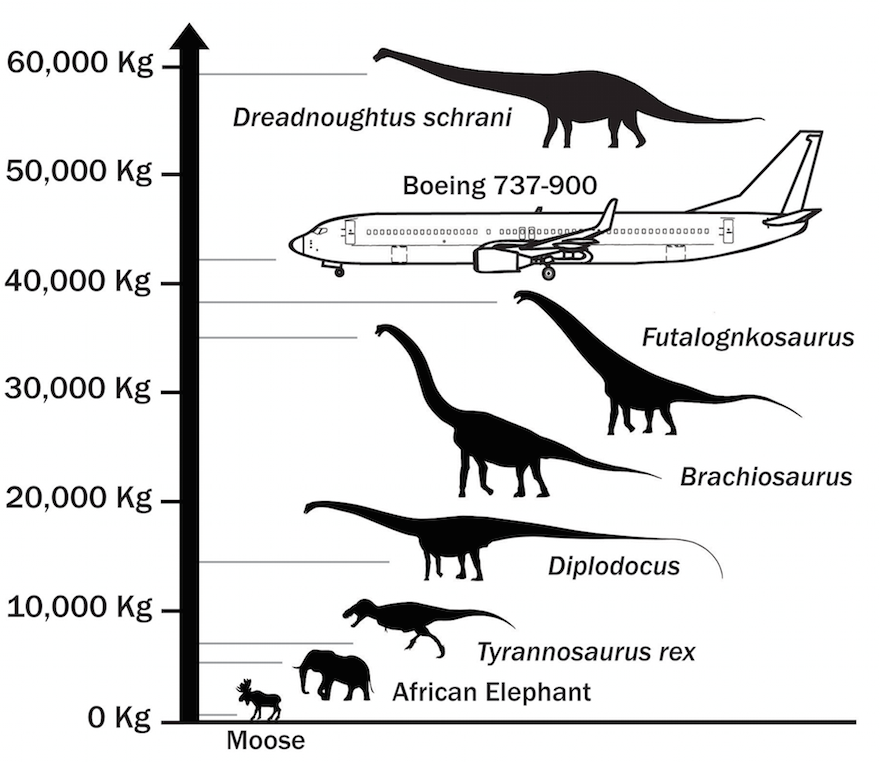
Hmm, the WP article said that Dreadnoughtus weighed more than Boeing 737, so I was expecting it to be at least similarly sized. Was confused for a while because the 737 is much bigger in the chart.
Turns out the plane in the chart is the biggest version of the 737 series, which is nearly 50% longer and heavier than the smallest version. The weight shown in the chart (44 tonnes) is the 737-900's empty weight. When fully loaded, it can weigh up to 85 tonnes, much heavier than the Dreadnoughtus. The weight mentioned in the WP article (50 tonnes) is for a fully loaded 737-100, the oldest and smallest version.
The distinction between forelegs, arms, and wings can be fairly arbitrary at times, especially when we don't know how the animal carried itself.
Although in the case of sauropods, yeah, forelegs would be much more appropriate. Really can't imagine that behemoth standing on its hind legs for any length of time.


That seems pretty strange. You'd think they'd need huge mouths to eat enough food to survive.