Watts is not a useful measure of visibility for humans, I would hope they're using lumens. Unless it's safe to assume that it reflects very similar amounts of visible light to the moon, but I don't know if that's the case.
In most contexts. But it's used frequently in "infrared light" too. Watts include radiation across the entire EM spectrum, from radio up to gamma rays, while lumens are normalized to human perception.
You basically take the number of watts at each wavelength and multiply it by a factor that represents the eye's sensitivity at that wavelength. So 1 watt of IR is zero lumens, and 1 watt of blue light is fewer than 1 watt of yellow.
Take a look at the spectral distribution of daylight [1]. You'll notice the area under the curve in IR is pretty similar to the amount of visible light.
If the IR reflectivity of a comet were high and the visible were low (relative to the moon), knowing that they were reflecting about the same wattage wouldn't tell you much about relative brightness.


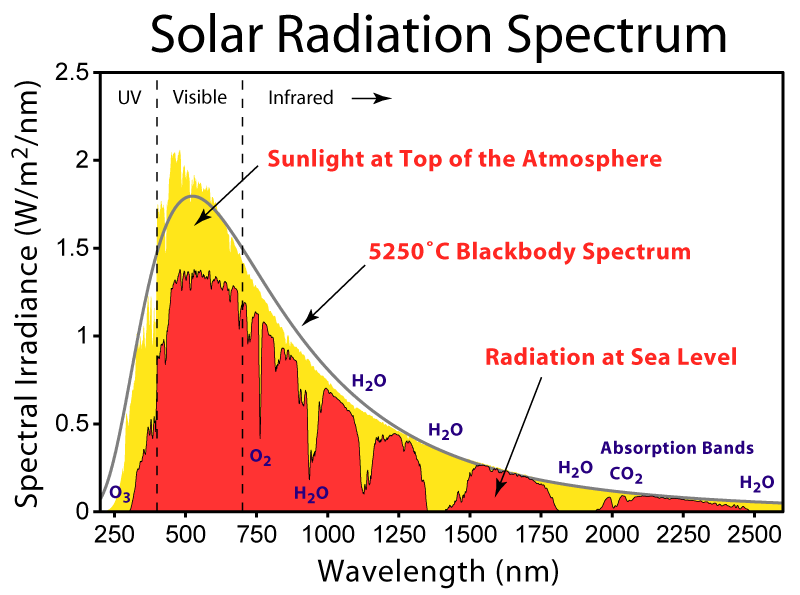
Anyway the answer to your question is no. The article is talking about total light, in Watts. Area is not a factor.