I think the success or failure depends on too many factors to just say "It won't work" based on the idea alone.
I remember that just a few years ago (in 2000), Amsterdam aborted a pilot program for public bicycles, because they all got stolen or vandalised [1]. Since 2006 a new nationwide scheme is being operated by the country's largest train company and it's doing great.
I currently live in London and the Barclays Cycle Hire scheme, operated by the TFL, is pretty successful. Successful enough to recently get expanded to cover a greater area [2]. It's not just popular with tourists, but also with people who use it to commute to work. I rarely see a bicycle vandalised and you have to be an idiot to steal one.
Some differences that I think make the London bicycles successful, whereas other plans failed:
1. To hire a bike, you need to either rent one on the spot, or become a member. In both cases, you are using a credit or debit card, knowing that you will be charged if the bike gets stolen or vandalised on your watch. They are also linked to your name.
2. Hiring a bike gets progressively expensive as you keep it longer, so you are likely to return it to a docking point sooner rather than later.
3. The bikes are ugly, heavy and instantly recognisable. Not something you'd like to keep home.
4. The bikes are built like tanks. I don't think it's easy to remove things like bicycle seats etc. at all.
5. The scheme only costs slightly over £50 a year. That is how much I pay in maintenance of my own bike.
6. Even if you buy a bike in London, you cannot always park it at your home or workplace. Renting allows you to bike and just park it in a docking station in the city.
The London bike plan also has plenty of problems (no available docking points, AARGH!), but overall it seems to work pretty well. I wouldn't discount the concept altogether.
Heh, the cure sounds worse than the disease. "Make the bikes so unpleasant that no will want to steal them (or use them)."
I agree that there is room for creativity here. There are so many things to try. For instance, I noticed that ViaCycle seems to be piloting on college campuses. Might it be possible to put docking stations _inside_ of academic buildings, requiring a college ID swipe to get in, and possibly being within viewing distance of a building attendant?
Having used the London bikes when I visited, they really aren't so bad. Not as good as the bike I have at home, but they do everything you'd want out of a beater bike. No one is racing them or anything, just going from one place to another.
There are quite a few cycle hire alleycats around the world. The London ones are fun.
One of my friends rode the Dunwich Dynamo on a cycle hire bike. 200km overnight on a bike that you couldn't service or fix a puncture on... pretty brave.
You are misunderstanding. The bikes are not at all unpleasant to ride (although they are quite heavy, they also feel very sturdy and resilient to all road conditions). They would however be very unpleasant to steal and own, because they are too different from normal bikes. It would be a pain in the ass to park them in the city or service them at home and everyone would recognise it as an out of place rental bike.
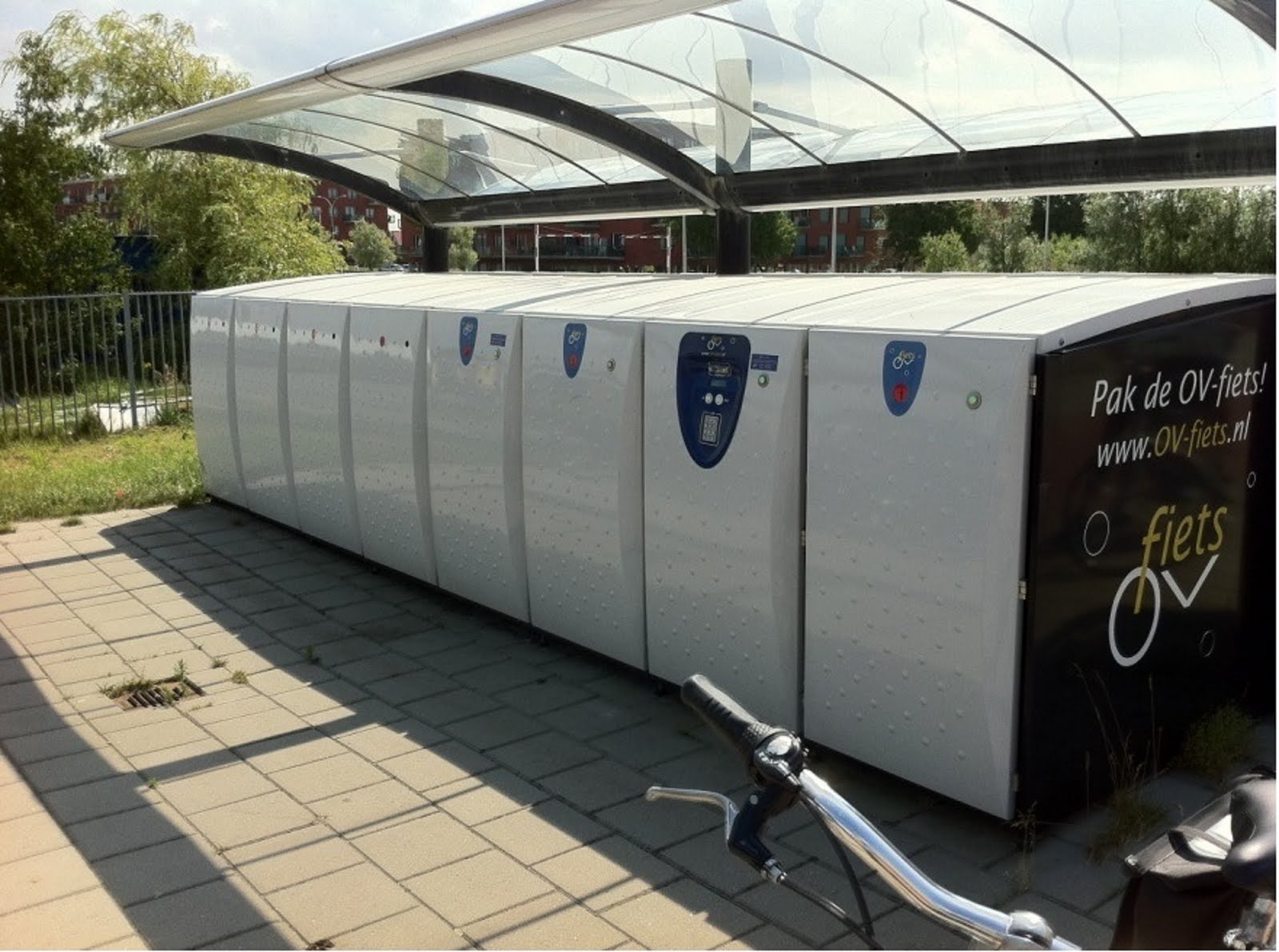
By the way, stashing bikes behind locked doors is actually what the "OV-fiets" plan in The Netherlands is doing (they are more like lockers, really: http://3.bp.blogspot.com/-PeUfIZbrzY4/Ti8hHZCsLyI/AAAAAAAAAE...), and it works quite well. As a bonus, you can also rent those lockers for your own bike.
Then you get one of the best folding bikes, perfectly good for general use too.
They have plans for long-term hires too so you can use a bike daily and guarantee it is there for your commute. In the UK these Brompton Docks are mostly located at rail stations so that you have a bike waiting for you at the end.
Montreal has the same system (Bixi), with exactly the same sturdy features as the London system. Some local management issues aside, the system is running quite smoothly.
It's a stretch to say "This will never work!" when something already is working, and avoiding the specific issues complained about.
"In total, the Montreal operation will bring in $7.4 million. Bixi will spend $7.3 million on operations, marketing, administration and research and development."
That's for 2012. Projections aren't results, but things don't sound too far off. What are you basing your statement on?
One can expect a little bit of taxpayer subsidy in the future, since it is freeing up incredibly valuable road space that in most city centers is a limited resource that can't be expanded.
It's a free system, because the 20 kroner coin that is used to unlock the bike is released when the bike is returned. These bikes have 20-inch wheel, which are non-pneumatic. Single-gear with a coaster brake. And weigh about 50 pounds. Also built like tanks. As a tourist, it increased my enjoyment of the city by a factor of 10.


I remember that just a few years ago (in 2000), Amsterdam aborted a pilot program for public bicycles, because they all got stolen or vandalised [1]. Since 2006 a new nationwide scheme is being operated by the country's largest train company and it's doing great.
I currently live in London and the Barclays Cycle Hire scheme, operated by the TFL, is pretty successful. Successful enough to recently get expanded to cover a greater area [2]. It's not just popular with tourists, but also with people who use it to commute to work. I rarely see a bicycle vandalised and you have to be an idiot to steal one.
Some differences that I think make the London bicycles successful, whereas other plans failed:
1. To hire a bike, you need to either rent one on the spot, or become a member. In both cases, you are using a credit or debit card, knowing that you will be charged if the bike gets stolen or vandalised on your watch. They are also linked to your name.
2. Hiring a bike gets progressively expensive as you keep it longer, so you are likely to return it to a docking point sooner rather than later.
3. The bikes are ugly, heavy and instantly recognisable. Not something you'd like to keep home.
4. The bikes are built like tanks. I don't think it's easy to remove things like bicycle seats etc. at all.
5. The scheme only costs slightly over £50 a year. That is how much I pay in maintenance of my own bike.
6. Even if you buy a bike in London, you cannot always park it at your home or workplace. Renting allows you to bike and just park it in a docking station in the city.
The London bike plan also has plenty of problems (no available docking points, AARGH!), but overall it seems to work pretty well. I wouldn't discount the concept altogether.
[1] http://nl.wikipedia.org/wiki/Witte_fiets
[2] http://www.tfl.gov.uk/corporate/media/newscentre/metro/18137...