Thing with Nuclear is its long term. It's 10 years to plan (theres always some customisation), fund, develop and train then another 5-10 before you move to profitability. Then through the life cycle there's constant government scrutiny and regulation before a complex decommissioning process that is pre-paid. This doesnt fit well with political election cycles.
Solar and wind are winning not because they are cheaper or more balanced for the grid but because you can buy off the shelf components, install them quickly and make it to profitability sooner. There's just a whole lot less time and risk.
I do agree wind and solar are cheaper presently. But this is primarily because they're being deployed in the context of supplementing a fossil-fuel backed grid. Provisioning more wind and solar starts becoming much dicier when you start saturating the grid during hours of peak production. In theory, negative electricity prices will prompt people to provision storage and capture the free (cheaper than free!) energy. But in practice, energy storage at grid scale is expensive and there are much better uses for batteries - chiefly in electric vehicles.
Nuclear, on the other hand, is one of the few carbon-free energy sources that is non-intermittent. The only others are geographically limited: hydropower and geothermal power.
What makes sense for Sweden may not make sense for the vast majority of energy production in the world.
It makes a lot of sense for Sweden to buy nuclear, even if it is exceptionally pricy and slow to deliver, if they don't have better options. But the fraction of the world population in that situation is not large, either, so we shouldn't extrapolate from Sweden to too many other places.
1/ no new nuclear reactor since 1985, despite hydro being the best existing storage system for nuclear (hydro resources there are fantastic), and hydro remaining there the main source of electricity
They will not and cannot win until we have cheap, highly dense, efficient power storage. That is, unfortunately, at least 20 years off (if we're lucky).
They will continue to be an important part of our energy ecosystem, and we should aggressively build them out, but we still need the fundamental power solution.
Fortunately we do have cheap, dense batteries that are being deployed on a massive scale with new solar.
The idea that we are not currently, today, deploying massive amounts of batteries everywhere with today's technology is just plain ignorance
It is no longer 2003. By 2030 it's likely that annual world production of battery storage will be 20-30 TWh. Today, we are getting close to 1TWh production per year.
Edit: just for example, take Texas's grid, which is one of the few places where storage is allowed to compete on its own cost merits. There are multiple GW, currently, much more in the pipeline, and prices still have a long ways to fall on battery installations (grid assets are usually measured by power, to convert to energy multiply by 4 hours:
> Installed battery capacity increased from 153 MW in 2019 to 3,518 MW in 2023. Interconnection agreements have been signed for an additional 7,945 MW of battery storage through 2024, allowing batteries to play a growing role in daily power needs in the near future.
"The idea that we are not currently, today, deploying massive amounts of batteries everywhere with today's technology is just plain ignorance"
I don't see anyone making this weirdly-specific claim. However, it's widely acknowledged that sufficient battery storage to guarantee national grid-wide power on-demand, sufficient for a modern industrial economy, is not currently feasible, in both economic and practical terms.
What you say is "widely acknowledged" is in direct contradiction to what is actually getting deployed on the grid. And what you say is a "weirdly specific claim" is also a surprise to people.
If a large chunk of current grid investment in Texas, profit-drivej by independent investors, how could it not be feasible to continue this level of investment? Especially when costs are falling dramatically and production capacity for batteries is just getting started and is scaling at a tremendous rate that will result in a complete excess of battery capacity within the time period that we could only build a thousandth of the same amount of nuclear wattage?
Among the blockers are (1) economics and (2) availability of raw & finished materials. This is all in the public domain, if you go looking for the numbers.
I’m not saying your claim about the rapid pace of building out battery storage is false - your claim is true. However, there is no currently-feasible way to run an advanced industrial economy on intermittent energy sources backed by chemical batteries. It may become technically feasible at some point in the future (never bet against human ingenuity in the long run), but it’s technically and economically impractical right now.
Not sure what you mean by blockers or "impractical right now" but at best that's "we haven't built the mines or factories, yet." Which is not in any way a fundamental blocker on our ability to build what we want to build.
There are of course feasible ways of running our entire economy entirely on renewables, saying otherwise means ignoring the massive amount of literature on the topic:
Every argument I have ever seen attempted to say it is not possible makes simplifying unrealistic assumptions. Such as saying something silly like "here's our known lithium reserves, that's not enough."" Of course, our known reserves of lithium is going up every year, because we keep on looking for more, and the argument is not even sophisticated enough to acknowledge what proven reserves means as a concept.
So if you think you have a solid argument present it, and if I'm convinced let's get it published and overturn all this other literature.
Your link talks (theoretically, not practically) about 100% RE by 2060! Do you understand what “currently” means?
You hand-wave with “we haven’t built the mines or factories, yet”. In the real world, discovery, proving, permits, construction, and commissioning new mines can take many years - and that’s if sufficient quantities of the required minerals are feasibly recoverable, or in a jurisdiction that allows extraction and export (e.g. not China).
So let’s get back to the real world & be realistic. 100% RE is not currently viable for an advanced industrial economy. Let’s get all the published literature revised to get rid of the hand-waves and ivory tower theoretical BS.
> Fortunately we do have cheap, dense batteries that are being deployed on a massive scale with new solar.
I would not consider that cheap. I would not consider that highly efficient. It is a step in the right direction, but it's not enough
> The idea that we are not currently, today, deploying massive amounts of batteries everywhere with today's technology is just plain ignorance
Nowhere did I say we weren't. They just simply aren't good enough for our needs. We can't get there without this intermediate step - and it _is_ doing good and helping humanity. But we're simply not there and won't be for at least a decade.
> take Texas's grid, which is one of the few places where storage is allowed to compete on its own cost merits
You mean the Texas grid that keeps failing and sticking people with $1000 monthly power bills? Not a great example lol
The first two Swedish nuclear plants won't come online for at least 12 years, and the next eight aren't scheduled to be operational until 2045. That's 22 years in the future.
Personally I think your timeline for storage is going to prove wildly conservative (we already have 5GW installed in CA, China is building capacity exponentially.) But even if you're right: these nuclear plants are going to come online right at the moment when storage makes them economically obsolete.
Exactly. And their construction will have pumped 25% of the CO2 in the atmosphere they were supposed to prevent during their lifetime. Nuclear is a really bad idea if construction takes that long.
Space in the cities is premium. Space in rural areas is not. I really don't think space is the problem, mass producing maybe, but otherwise have a big powerbank in every basement and you are done.
This is right. For grid connected storage, two things matter: 10-year total cost, and durability. At least a 30-year design life. (Well, reliability matters too: that 's implicit.)
Volume and mass are just whatever they are. They don't matter.
Besides that most areas aren't in the risk of flooding, there is litte preventing you to water proof your batteries to the point that submerging them into water has no ill effects. The housing of the batteries usually is water-proof anyway. Just look at all the Teslas driving through deep water.
Oil tanks for heating are a huge problem with flooding though, as they tend to leak oil into the environment.
imo that's outdated mantra repeated while we are just getting there.. but anyway: as is any nuclear 10 year planning now 20 years out then in reality, at least here in the west.
Genuine question. What kind of solar/wind installation could generate 2GW of power on demand (including when no wind or sun) and how much would that cost? is it even feasible with actual technology?
2GW of batteries attached to solar installations, spread over multiple sites, is quite common in 2023. What do you mean by "what kind"? Its just the normal kind.
If there's no sun, how long can the battery deliver? And if there's too much sun, where's the extra power dissipated? I'm wondering if it's possible to provide a service equivalent to a nuclear powerplant today, and if so, how much it costs.
The thing is, the question doesn't really make sense. Yes you could design a closed system of solar production and battery storage, which delivers power 24/7. But that is not reasonable. Solar is only one part of the electricity supply to the grid. Wind is another. Add to that water, biomass, etc. and you have multiple sources which complement each other. You would need battery storage only for those remaining amounts of electricity which cannot be served by the combination above. And this amount is easily an order of magnitude (or more) lower than a solar+storage system alone.
This also heavily depends on your local climate. The closer to the equator you get, the more a solar storage only needs to supply energy over the night. There a solar+storage only grid would be the no brainer.
The question makes sense. When people claim that wind + solar wins over nuclear. They compare apple and orange. Nobody is able to explain what wind/solar (+ other renewable) installation is doable right night in Sweden (not near the equator), that would provide the same guarantee as a nuclear powerplant: 2GW of power, all year long. Or at least any time when the people need that power and there hasn't been sun/wind for a while.
This is not specifically for Sweden, but if for some reason you want to imaging a single unit that produces continual output (which is not a desirable operation mode for any grid asset in the modern world), then imagine a solar installs distributed over a geographic areas with 18+ hours of storage at the desired power output. That's the overall design. People don't build that way but they could if they wanted.
Right now, batteries deployed on the grid cost $300-$500/kWh, and typically LFP batteries are designed to last for 5000-7000 cycles, and will have warranties for 15+ years. This places the cost of storing a MWh at between $42/MWh and $100/MWh. Solar costs vary based on location, but range from $20/MWh to $80/MWh. For places with high seasonal variation, sizing the install for daily storage, using the seasonal minimum of input, in some areas might double or triple the cost for a particular season. Nuclear costs vary widely by construction competence, but in the largely incompetent west costs are going to be far north of $150/MWh.
So for most areas, most of the time, solar+storage is going to be far cheaper than nuclear. But low insolation or high latitudes might make solar+storage more expensive than nuclear.
In the future, nuclear's prices will continue to rise very slowly, and solar and storage prices will continue to plummet at ridiculously fast paces. This is why solar and storage are winning.
For industrial processes that need heat, the storage options become even cheaper. And if the industrial site can be put somewhere with half-decent solar insolation, then the solar power can be directly connected without going through the grid, which means looping off that $60-100/MWh that utilities charge for the very very expensive grid transmission. We are just at the start of industry realizing what is possible with distributed renewables and thermal storage, and there is potential for drastically cheaper energy for energy intensive industry that be built at new sites.
This is why solar and storage are "winning" even if nuclear might be better for Sweden. And with the ever increasing deployment of EVs, people are going to be parking multiple days worth of their home's energy needs in their garage. People will soon realize just how cheap storage is, and how perhaps even their vehicles will act as grid storage, even if it's only though charging at selective times when energy is cheaper.
And if there's too much sun, where's the extra power dissipated?
You can just open the circuit to disconnect a solar panel from the external load. The panel will get slightly warmer in full sunlight when it's not connected to a load, but there's no harm to it. Since there is no rotating mass or hot steam with accumulated energy in a solar farm, you can shut it down completely in seconds if necessary. Solar PV can safely go from 100% output to 0% faster than any other electricity source.
China has 50GW of pumped storage and another 89GW under construction. There are larger battery storage projects overseas, but you’ll have to look them up yourself.
They want their trains to run or electricity in their hospitals, even though they's no sun/wind for a several days. Unless your renewable installation can provide that, it's not comparable to a nuclear plant and solar/wind doesn't win. The best example of this is Germany who is one of the worst CO2 emitter in Europe despite their huge investment in renewable.
Right now solar and storage are eating into the most economically-profitable generation. That means we’re seeing deployments of storage that shift supply a few hours into the high-demand evening period. This will work well in places that get a lot of sunlight or that have lots of sunny days or highly-connected grids (Europe is in the process of building HVDC links to North Africa for this reason.) What’s going to happen is that this low-hanging profitable fruit will be plucked first, and then as storage costs decrease (happening quickly as we speak) we’ll see a second layer of multi-day and seasonal storage get deployed. The problem for nuclear is that (1) this construction will eat a lot of the most profitable generation opportunities, and (2) nuclear takes so long to build (and has such a long payback period) that any new plant will arrive just as storage gets cheap enough to make it unprofitable.
Nuclear electricity is rather expensive.
Are you sure the demand forecast someone calculated cannot be meet by ramping up hydro? Or importing electricity?
In Germany, the right parties did block any project that had the smell of environment protection. And the pseudo-green clowns are no game changer.
Well now, that depends on what country you are in. In the US for example health care and military most definitely are for-profit exercises.
In the context of Sweden though, with social health care, and a modest military your question makes more sense. And of course as long as it has govt funding it doesn't need to make a profit, or even break even.
Once you look to private capital though, investors expect that capital to generate a return.
Assuming no govt subsidy yo provide that return, it has to come from an excess after operational expenses. (aka profit)
Profit imposes discipline on consumption of the product. River water is classically treated as "free" which leads to great waste in agriculture and horitculture.
Requiring a resource to be sold at a profit ensures it goes to where it is most needed, and that it is used efficiently.
But your priors are different. The US is a very solipsistic society, which means that the quality of care that an individual can achieve always trumps the median health of the entire population: everyone is conditioned to believe that they will be the ones to achieve the highest rung, and those who don't manage it deserve their lower quality of life.
If you're trying to say that a power station run purely for profit would mean the ultra-wealthy in society would have good power while everyone else can suffer with the crummy leftovers..... I think it's time you gave up.
If we subjected solar and wind to the same level of regulatory burden (as in: ensured that they would have the same level of expected harms/deaths/accidents as nuclear), they also would be completely unprofitable.
If we subjected all our generation to the same regulatory burden, nuclear would be profitable again because our power would be drastically more expensive.
Sure nuclear's regulations should be proportionate to its risks. But there's still a strong argument to be made that nuclear is still over-regulated relative to its risks. It has the lowest death toll per watt of electricity produced of any generation source, even including Chernobyl. Furthermore, US plants built during periods of more relaxed regulation haven't seen much in the realm of harmful mishaps. Three Mile Island is a testament to safety measures - it turns out building a big concrete condom over your reactor helps contain meltdowns.
>> nuclear's regulations should be proportionate to its risks
to some extent this I what's happening now. If a wind turbine (or indeed whole wind farm) catastrophically fails then you can clean it up in a matter of days or weeks. The range of potential damage in space and time, is very limited.
By contrast catastrophic nuclear failure leads to immediate damage over a far larger area, and spans a much longer time (like hundreds of years. )
One can quibble about deaths from chernobyl but it displaced an entire city and rendered a substantial chunk of land unusable for centuries.
So I would argue that thd regulations are completely in line with the risks, as they stand right now.
To the contrary, nuclear contamination can be cleaned up. Fukushima's exclusion zone was completely lifted after 11 years [1]. Pripyat was a planned city, built for the specific purpose of supporting the Chernobyl plant and it's workers. It remains unremediated because there's no incentive to clean it up, not because. Nuclear power has a smaller death toll per megawatt hour than wind, orders of magnitude less than hydropower and biomass [2].
While I personally think nuclear is overregulated, my point wasn't even that you need to decrease regulation. I was just pointing that if current nuclear regulations demonstrate how safe we think our power generation should be, then wind and solar (and everything else) are under regulated, since they both kill more people/MWh generated than nuclear does.
> if current nuclear regulations demonstrate how safe we think our power generation should be on a number of fatalities per MWh basis, then wind and solar (and everything else) are under regulated
I don't think everyone agrees that fatalities per MWh is the right metric.
You'd want to include cost in a similar way to medicine and other engineering areas do.
Doing X (new medical procedure, changing a road intersection) would save Y lives for Z cost.
If the cost Z is low you can shift resources to it from areas where cost Z is high per life or QUALY (quality adjusted life year) saved and overall save more lives.
Yes exactly. Nuclear regulation has had diminishing returns on safety for probably 50+ years. Are newer nuclear designs safer than they were in the 80s? Yes. Are they _enough_ safer to justify the increased cost relative those older designs? Almost definitely not. In the same way, we _could_ make wind and solar and coal etc. as safe as nuclear currently is. But it would _dramatically_ increase costs. That was my entire point. Nuclear is only not profitable because it's competing with generation technologies that are not required to meet the same safety standards.
The US nuclear regulatory regime _explicitly_ does not include costs when determining if a new regulatory rule is necessary. Any amount of safety at any cost is always justified. No other generation technology has that mindset.
Note that the deaths for nuclear energy include only radiation related deaths, whereas the accidents for solar and wind include "mundane" accidents like workers falling from heights. Nuclear power plants have their own non-radioactive accidents, though, like this one:
(5 workers killed at Mihama nuclear power plant due to accidental steam release)
I have not seen any comparison that tries to sum up non-radioactive accidents for nuclear power and incorporate them in the deaths-per-TWh rate for nuclear power. The number will still be lower than anything based on combustion, but at these very low numbers it could make a meaningful difference in the relative rates.
This was the first publication I found from a google scholar search (there are others as well)[0]
Nuclear has far fewer fatalities, but it's accidents are also dramatically more expensive. Although both nuclear and hydro are having their numbers mostly driven by a single catastrophic event (the 1975 Banqiao Dam failure in China and Chernobyl), so how one feels about this whole analysis is going to depend on how likely one thinks future catastrophic events are to be. The numbers are so low that it's hard to come up with very rigorous estimates.
I personally think that catastrophic accidents on the scale of Chernobyl are as close to impossible these days as makes no difference. I'm not even too worried about Fukushima level events (which was not particularly deadly but was very expensive)
However, I have to admit that my opinion on that isn't really backed up be empirics, as is always going to be the case with rare events.
-edit- yeah after further investigation, according to their "learn more about this data" button, the original source for that data is two publications, the one I linked, and the 2007 paper. The 2007 paper is primirly about comparing nuclear to fossil fuels, and mostly from the perspective of indirect effects from CO2. I'm skeptical of it's claims, as that's a bit too roundabout. The one I linked above is direct effects only (except that it includes cancer deaths from nuclear accidents), which I think goes too far in the other direction. I'd personally include deaths from particulate emissions from fossil fuel generation, but that has no bearing on the comparison between nuclear and wind/solar.
I don't know how they ended up with the plot they display given the sources that they have, but I trust the graphs in the 2016 paper more, which show much larger effects.
In any case, it's certainly not true that there are no credible sources backing up the claim. One can dispute it, I'm sure, but there are credible sources backing it up.
Except there isn’t a reason to do this. Solar panels do not have radiantion leaks. Wind turbines do not meltdown. Hydro damns don’t need millennia long storage plans for their waste.
Nuclear being much more heavily regulated is due directly to it’s intrinsic dangers.
The reason we care about those things is that they kill people. It turns out that, even with those things, nuclear kills fewer people than everything else. Wind turbines kill people other ways. Hydro dams literally have the record for the single most catastrophic energy related disaster in the 1975 Banqiao Dam failure. And even dams that don't fail are so much worse for the environment that I can't even explain it. Dams on the west coast are probably the single biggest reason for the collapse of west coast salmon populations (among countless other species). Dams are an ecological disaster even when they are working perfectly. Nuclear at least has to fail before it causes major issues.
For some reason, this seems to have omitted solar power from the list of examples of technologies that have a higher body count than nuclear power. In the meantime, let's examine how many cities have needed to be evacuated due to the catastrophic failure of solar plants.
You're probably joking, but solar installation killed my uncle's employee (he had 3), which made him sell his installation business (he still has 2 solar farms I think).
I'm pretty sur solar kill more per generated MW than wind.
The main difference is that solar/wind only kill or inconvenience/maim blue collar workers. It's like chemical spills in North America, you only hear about it if it inconvenience white collar or large owners, if it's only 30k blue collar workers, it'll hardly make national news.
>Hydro damns don’t need millennia long storage plans for their waste.
Damn ;), but they "waste" the lakes downstream by making them shallower by siltation over decades, not millenia, and "waste" the ecology and biology upstream by flooding the valleys they dam.
You do realize that nobody dies during the operation of a solar farm? Yes people fall off roofs during installation, but effective regulation for that is far cheaper than you would think.
Storage at anywhere near relevant scales is anything but moderate. To put this in perspective: The USA uses 12,000 GWh of electricity every day. The world uses 60,000 GWh. The amount of storage required depends on how much overproduction we have, and the tolerance for blackouts. But many estimates arrive at around 1 day's worth of storage. But even that is likely and underestimate [1].
This is part of why plans for a primarily renewable grid assume that hydrogen or some other heretofore untested system will fulfill the overwhelming majority of storage. Because none of the existing electrical storage mechanisms are sufficient for grid-scale storage.
Many people think we need a season's worth of storage. So by that measure a days worth of storage is moderate. And unlike a season, it is possible to have 12 TWh of storage within a decade or two. It'd be nice to have cheaper storage, but even 12 TWh of batteries plus sufficient renewables is cheaper than nuclear.
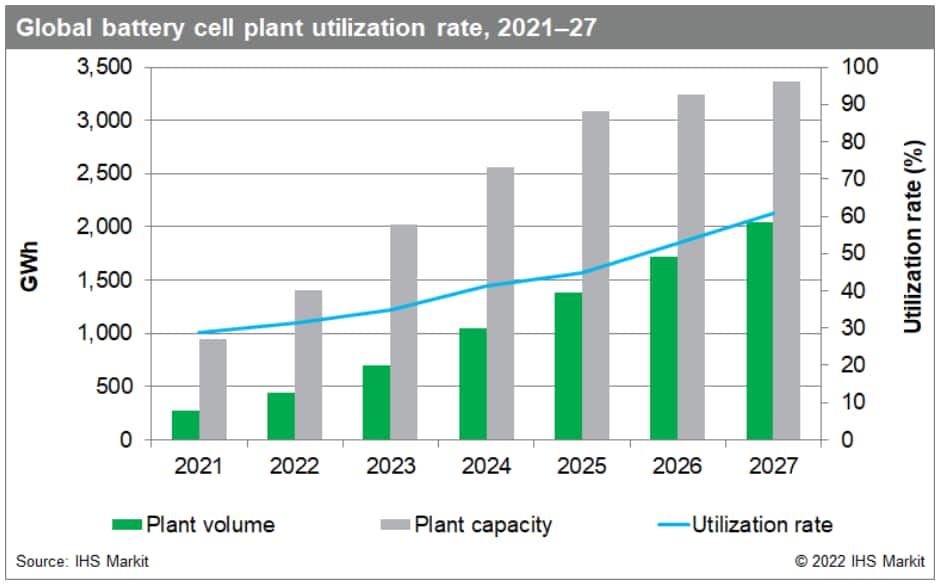
No, 12TWh of batteries is not feasible. The entire world produces about 400 GWh worth of batteries per year. And bear in mind that 12 TWh is a day's worth of electricity just for the US - the global figure is 60TWh. Furthermore, as transportation, heating, and industrial processes are electrified that's going to drive that 12TWh figure up even higher. Only about half our fossil fuel use is due to electricity production. And again, remember that electric vehicles are going to consume the lion's share of battery production,.
1.2 Twh of capacity but only ~400 GWh of actual production. Don't confuse figures on production capacity with figures on actual deliveries. Capacity is often 2-3x higher than actual production figures: https://cdn.ihsmarkit.com/www/images/0722/global-battery-cel...
Actual production figures are what determines the supply of batteries available, not what the factories hypothetically could produce if they had unlimited inputs. Your factory could make 1000 GWh of batteries per year, but if you only have enough input materials to build 500 GWh then that extra capacity is useless.
I don't think this paper completely refutes the commentor you responded to, since it does not include nuclear power (current or projected future capacity) in its analysis.
It is unclear if nuclear would fill the gap they calculated.
It's even simpler than that: solar, wind, existing hydro+nuclear, short term storage, and natural gas is enough to bring us to net zero.
Wait, you say, natural gas? But natural gas is dirty. Well, in the US if we could magically remove all other sources of greenhouse gas emissions except for the natural gas power plants, we'd be at net zero right now.
You might want to pause and re-read GP's comment. It seemed clear to me that GP was saying that solar and wind are winning over nuclear, because of the special challenges that nuclear represents. While I agree with many of your points, it doesn't strike me as crazy at all to say that wind and solar are winning v. nuclear. Of course, whether they should be is a totally different question.
Nuclear is the worst companion to Solar+Wind. Why? Because nuclear is limited in regulation capacity (you need to keep the output at at least 40%) and also extremely expensive when not running at high capacity.
Nuclear is a fine alternative to solar+wind but it is a poor complement since you need some dispatchable generation with either: solar+wind because they are intermittent; and nuclear because it is essentially constant baseload and demand varies throughout the day.
I think nuclear is cool tech but am doubtful it will play a big role in most countries since renewables are so much cheaper (1/3rd the price, so you can overbuild substantially) for getting to 90% emissions free generation.
>I think nuclear is cool tech but am doubtful it will play a big role in most countries since renewables are so much cheaper (1/3rd the price, so you can overbuild substantially) for getting to 90% emissions free generation.
Renewables (wind/solar) could be free and they wouldn't be able to support a modern economy - that's the problem. It's why wind/solar, today, do not even power a small city, much less a nation.
> Renewables (wind/solar) could be free and they wouldn't be able to support a modern economy - that's the problem. It's why wind/solar, today, do not even power a small city, much less a nation.
No energy source will support an entire modern economy, but like nuclear they can supply the majority of electricity for one.
>but like nuclear they can supply the majority of electricity for one.
OK ... If you want to claim that the future is wind + natural gas/coal - go ahead, but that's not what the public is being told. The public is told that wind/solar can replace fossil fuels, and they can't.
Here's the reality:
If you have nuclear, you don't need wind/solar - at all. In fact, you will not be able to use wind/solar, because nuclear can't be easily spun up and down to deal with the wind/solar intermittency. In your France example, wind/solar is pointless.
If you have hydro, and you have enough of it, you don't need wind/solar. If you don't have enough hydro, you need natural gas though you can optionally throw in wind/solar. Once you hit your geographic hydro capacity, the only way to increase is to build out your natural gas/coal infrastructure (regardless if you throw in wind/solar in there)
If you don't have nuclear, and you don't have hydroelectric, then wind/solar will not be able to replace fossil fuels. You will be forced to build out coal or natural gas infrastructure (or burn wooden pallets), as your Danish example shows.
- Portugal, which is blessed by geography that gives it access to hydro, but because they don't have enough, and they built out their wind infrastructure, need significant natural gas capability: https://ourworldindata.org/grapher/share-elec-by-source?coun...
I agree that wind/solar and nuclear are alternatives rather than complements. This is why I think little nuclear will end up being built outside countries like France which are all in on it.
As the cost of generating electricity from gas is mostly the cost of the gas its perfectly reasonable to have those gas plants built and operated 10% of the time so long as the total system cost is much lower than building nuclear.
There's an arguable case that for 100% carbon-free electricity (rather than 90% carbon free) the economics of nuclear are potentially viable, at least for places like northern Europe where you can't just build a huge amount of solar and 24 hours of battery storage.
But it seems far more important to decarbonise the grid as fast as we can and that means building lots of cheap renewables. Nuclear is simply too expensive and too slow to build. Which is a shame because it is cool tech!
Closing existing nuclear plants like Germany has done is an absolute disgrace. We should keep existing plants open for as long as possible.
And of course, if anyone can figure out how to build nuclear cheaply then build a bunch more. Then maybe they will replace the renewables currently being built as they end of their service lives.
> but if you have sunshine all year round it’s easily doable.
That sounds great for everyone living in Spain, Italy and Greece, as well as New Mexico, Arizona, Southern Cali Georgia, Florida, Mississippi and Alabama. I guess everyone who lives north of thst is just SOL then.
Lithium ion battery are far less destructive than the iron mining used to build the rest of a car that they go into, but good luck getting the concern trolls about supposed lithium mining problems to acknowledge what it takes to build the rest of the car...
Yeah it can provide for your household lighting, but what about all the energy expenditures that go into the house via material means? Can you produce aluminum at scale? Or fertilizer? How much energy is used to produce a computer? And in most mass processes a loss or reduction in power input is a huge deal and results in production shutdowns that require far more than just turning a switch back on to restart.
That battery is for load shifting from peak times to off-peak times and also to provide bridging power while other generators start up. If you want reliable purely green power, you need a lot more battery. For longer term storage, pumped hydro seems to be the only option for now.
I agree it's doable by some rich and Niche individuals, but it's not socially scalable, let alone efficient.
Of course with enough money you can put in three times the panels you need on average to account for winter days. Similarly, you could put in a week's storage battery in case a nasty storm comes through.
"no grid-scale battery technology to remove this fatal intermittency problem"
Where is the bottleneck with mass producing batteries, that don't need rare elements, like saltwater batteries?
Surely it is not cheap either, but it is working technology, cannot burn, nor contaminate entire landscapes if something goes wrong.
"Today there isn't even a small city anywhere in the world actually powered solely by solar/wind"
Because of economics and not really factoring in external costs, fossil fuels are simply cheaper. But it surely can be done with current tech. And El Hierro, a canarian island, is pretty close:
Hydroelectric energy storage is geographically limited and quite hard to develop. You need an elevated reservoir sitting next to a river or body of water in order to fill and drain it (look at the photo in your link, to see the kind of specific features required [1]). You can find academic articles proclaiming the vast potential of hydroelectric storage. But those are just running algorithms over terrain data, without consideration for accessibility to proximity to places with energy demand. Developing Tibet's hydroelectric potential isn't exactly feasible.
So when humanity eventually runs out of fossil fuels and uranium ores, we're just going to go back to the pre-industrial era?
You can build an entirely solar/wind-powered storage and distribution center capable of putting out 1 GW of power 24/7 with modern PV panels, wind turbines, battery storage, hydrogen storage, etc. It's entirely feasible, and although costs for such a system are high (comparable to that of a 1 GW nuclear power plant), those costs are steadily falling and the long-terms costs are much lower as you don't need to acquire uranium fuel or store the hot waste.
I think the point being made is that without grid scale storage, wind and solar are not full solutions and not comparable to nuclear energy. Grid scale storage capacity will come, but it's not here yet.
But we (well, some of us) have that. Norway has 87TWh of pumped hydro storage that discharges at a rate of 32GW - it would take 3,5 months to empty it completely.
> So when humanity eventually runs out of fossil fuels and uranium ores
Worrying about running out of uranium (and the subsequent plutonium) is on the same level of worrying about what to do when the sun goes supernova. Both are problems on century long timescales.



Solar and wind are winning not because they are cheaper or more balanced for the grid but because you can buy off the shelf components, install them quickly and make it to profitability sooner. There's just a whole lot less time and risk.