I've always disliked the monopolization aspect of unions. I think something like guilds would work much better where there are 5 or so that have to compete for employees. That way if the guild isn't working for you you can move to a different one or opt out all together.
Unions are labor monopolies, so there are a lot of missing positive incentives, while offering incentives for corruption. In the case of the UAW, it puts auto makers at a disadvantage because there's a single labor supplier they all buy from, so the supplier can play the automakers off each other. In the moment labor is currently having, you might argue that giving labor more power than business is good, but it's not; it's toxic to those businesses in the long term. You need balance between business and labor, and competing unions is a good way to solve this.
>
Unions are labor monopolies, so there are a lot of missing positive incentives, while offering incentives for corruption
My employer has a monopoly on providing me with a paycheck, with tons of incentives for mistreatment and corruption.
I'm told that if I dislike this, I should go find another job, or start my own company. Perhaps that could be the solution for someone who doesn't like their current job's union..?
> My employer has a monopoly on providing me with a paycheck
Unless you're an astronaut or something, no, they don't. Go interview somewhere else. Go drive an uber. There are lots of other places to get a paycheck.
I don't get your argument. In this perspective, the union has the same problem that you accuse the company of having, but worse, because an autoworker has competition vying for his labor. GM, Ford, Stellantis, John Deere, Caterpillar, and all the other machinery manufacturers compete for his labor. But the union has no competition. In fact it's specifically exempt from anti-trust legislation.
I get to vote on union policy, I don't get a vote in whatever idiotic policy-of-the-quarter some director five reporting levels above me decides to push, for his own self-serving interests.
Those decisions are never data-driven, and are always some unholy amalgamation of industry-trend-chasing and some insane personal-politics-games that he's playing against his peers.
My choices with a union are 'change it or take it, or leave it', my choices without a union are 'take it or leave it'. Flawed democracy versus flawed autocracy.
This is neither here nor there. We are talking about monopolies. The fact that a given monopoly allows member voting does not change the fact that it's a monopoly, and carries with it all sorts of monopoly baggage, making it prone to corruption, mal-incentives, rent-seeking and other antisocial behaviour.
In some countries you can, but that assumes that your employer is willing to negotiate with the union instead. In Denmark how it normally works is that unions are specific for a given profession and a single union negotiate on behalf the employees in that profession, regardless of them being a member or not. If the majority of the employees where to go to another union, the employers could switch to negotiating with that union instead.
For some professions people just negotiate their own salary, that is true of software developers for instance. Nurses on the other hand have their salary negotiated by the nurses union. It really depends on the type of work and how uniform it is or how poorly the employers behave.
The US unions seems, from the outside, pretty immature and amateurishly run. They are to small, to narrow in focus, to expensive and poorly organization.
The US unions are also plain weird. There shouldn't be a New York Times Tech Workers union, that makes zero sense. There needs to be a "software engineers union" or "Programmers Union", which covers employees from multiple companies. Part of the leverage a "normal" union would have is that if, say the New York Times, don't improve working conditions or act increasingly hostile, then the union can call on members in other similar companies to strike in order for their employer to put pressure on the New York Times.
The small hyper localized union are silly and I can't imagine that they work all that well. The membership cost is also insane, but I suspect that's because they are tiny. Ideally the members at a company the size of the New York Times could be on strike indefinitely, being supported by the members of thousands of other companies.
>There needs to be a "software engineers union" or "Programmers Union"
I honestly hate the idea of that. If you don't like Meta or Google, you don't have to work there. I know lots of people that don't like the "defense" industry because it contributes to building weapons, so they refuse to work at those companies.
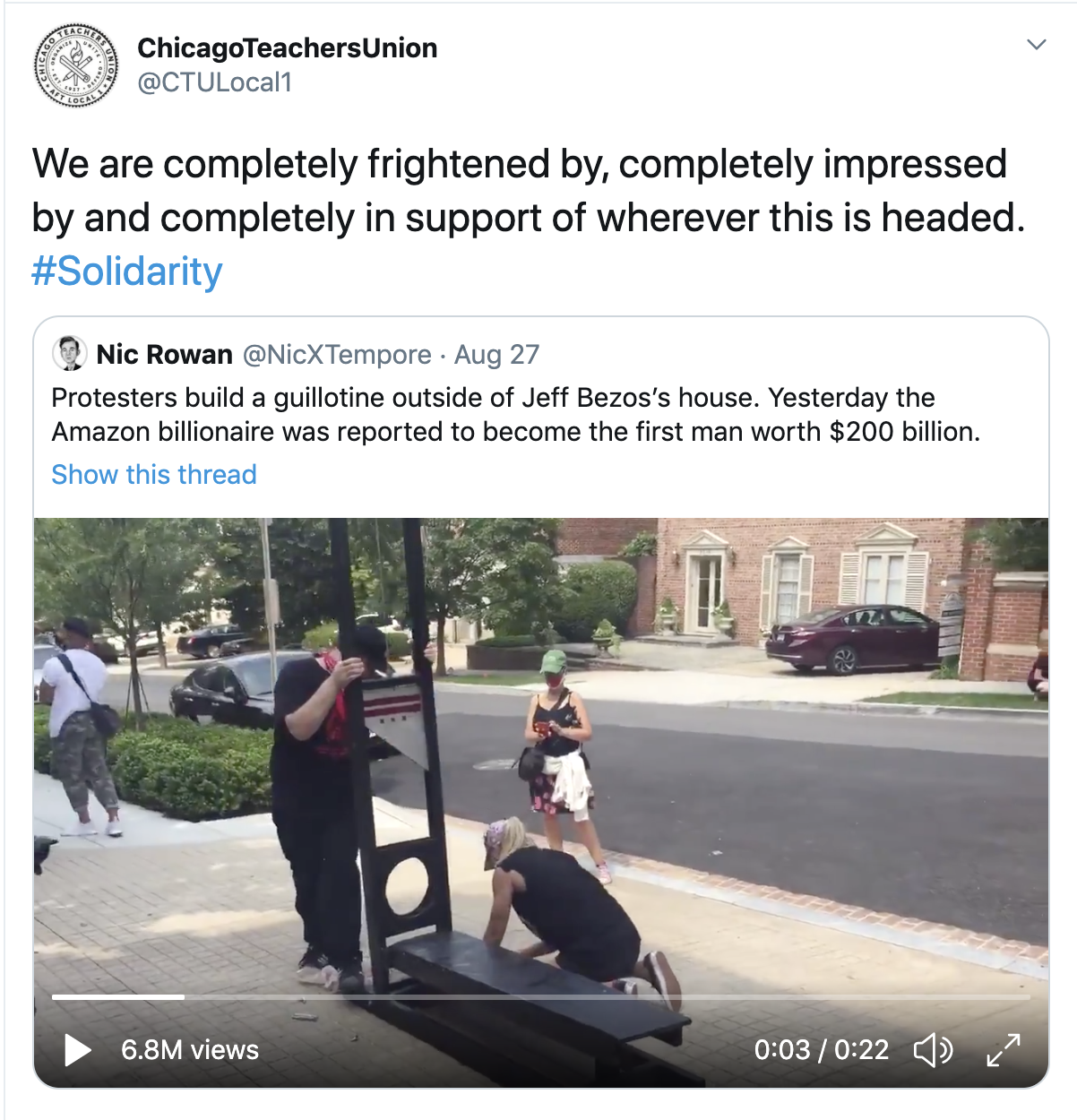
What recourse does an employee/member have if the union publicly supports setting up (mock) guillotines?
Ideally, your union is supposed to fight against your boss for you.
I can understand the reluctance to deal with another structure. But when you get to the day-to-day impact, aside from the legal protections and membership dues and so forth, how is dealing with a union any different from dealing with the ad hoc cliques or unofficial software guilds, employee groups, etc. that spring up in a workplace? Or just dealing with rival teams or orgs jockeying for influence and power? You want to escape politics at the workplace altogether, become a freelancer.
>Then changing workplaces is equivalent to moving.
For sure. And that's what you can do if you don't want to work for a company but have desired skills.
>Ideally, your union is supposed to fight against your boss for you.
For sure. So my question is why are so many unions on twitter advocating for every social cause under the sun and encouraging people to build guillotines? I realize this is an extreme example but its no secret that unions are very leftist and active.
>how is dealing with a union any different from dealing with the ad hoc cliques or unofficial software guilds, employee groups, etc. that spring up in a workplace?
If you don't like those things, you can work at another place. I know office culture is part of every business but every business has a different culture. You can work in software without ever touching a defense company. In a world where there's only one or two software unions, those structures would be inescapable.
You seem to be confusing social media chatter, not even necessarily from official union accounts or union spokespeople, with actual union activity and messaging.
> In a world where there's only one or two software unions, those structures would be inescapable.
The concept of unions in the U.S. tech industry is completely nascent and up in the air at this moment. If anything, the proliferation of "Google union", "NYT union", a Kickstarter United etc. seem to indicate that it is unlikely there will be only one or two software unions.
The idea that if (and it seems to be, as always, a very low-probability if) software unions do catch on, they will necessarily be identical to industrial unions of the past, seems fallacious to me. You would expect an industry that's all about innovation and experimentation to approach the problem of labor relations in a ways that's different from failed models of the past.
How am I supposed to know what is "actual activity and messaging?"
>You would expect an industry that's all about innovation and experimentation to approach the problem of labor relations in a ways that's different from failed models of the past.
That's fair. Intentions aren't consequences though. Some of the most well intentioned policies and regulations in Europe have the consequences of horrible tech salaries.
Where's the guillotine tweet? I can grant such imagery might be severe and perhaps distasteful to those of certain sensibilities, but I hardly find it any more extreme than say when unions have giant blow up "Scabby the Rat" balloon figures. And this is a public sector union, they are not straight up advocating for revolutionary class war for crying out loud.
> Intentions aren't consequences though. Some of the most well intentioned policies and regulations in Europe have the consequences of horrible tech salaries.
I just want to see some experimentation and innovation in an industry that has an avowed commitment to such values. If there are consequences, then we will at least have proven so empirically.
>And this is a public sector union, they are not straight up advocating for revolutionary class war for crying out loud
They say "we're terrified but completely in support of wherever this is going" when people set up a device used exclusively for beheading humans. Whatever it is, it is ridiculous and a prime example of how you'll have to fight a war on two fronts if you don't agree with the union.
>I just want to see some experimentation and innovation in an industry that has an avowed commitment to such values
Anyone is free to start a software co-op and or experiment with different methods. I could agree in theory, but in practice, experimentation isn't free. I have family from eastern Europe that are still recovering from the "experimentation" that went on in the USSR.
That tweet is very measured, mealy-mouthed millennial speak that's mildly approving. Social media account managers for activist groups have a tendency to amplify edginess, the heightening of passions is part of the job. But that sort of rhetoric is unlikely to be universal to all unions, and the point is if you don't like your union making such speak, you still have a voice to counteract it, just as you would if your company was engaged in a PR marketing campaign whose tenor you disagree with.
> I have family from eastern Europe that are still recovering from the "experimentation" that went on in the USSR.
We're talking about an industry that has been almost wholeheartedly scoffing at the idea of unions for decades. To suggest Kickstarter United is Finland Station is laughable.
Agreed that software co-ops are something that should be attempted more. In fact, the presence of FOSS projects, hacker collectives, and the like would suggest that programmer self-governance is already popular in this industry. There is a very bottom-up, autonomy-focused culture in many aspects of software. Even the idea of quitting your pointy-headed boss to build your own startup is arguably in the same spirit.
I'd go as far as saying that to attempt a software union is in the same spirit- as unionization has declined so much in the U.S. over past decades, let alone never been attempted in tech until recent years- it is an underdog, grassroots cause. Very far from the bureaucratic Kafka entity that anti-union critics like to invoke- this industry is so very far from such a leviathan!
And remember, it was a labor union that ended the USSR's grip on Poland, leading to sweeping changes across the Eastern Bloc...
>That's like very measured, mealy-mouthed millennial speak that's mildly approving
Ok, well, we've gone from;
"you're confused, that's not the actual messaging"
to
"they're only mildly approving of constructing a device to behead people they disagree with"
>you still have a voice to counteract it
I should not have to spend mental energy or time telling an (in your words) activist, edgy-millennial that encouraging people to build guillotines is not a good PR look and doesn't represent me.
>just as you would if your company was engaged in a PR marketing campaign whose tenor you disagree with
If you don't like your company you can leave. If there were only one or two unions for software devs, (like OP implies) then it would be inescapable.
I don't disagree with the idea of unions in principal. I just feel they would be detrimental to software. The only reason start ups get off the ground is because people put their blood, sweat and tears into it. What is there to motivate co-op founders to put their blood, sweat and tears into a new co-op?
Yes? The parameters of the discussion have shifted, so I am responding accordingly. This isn't a debate, let alone a sports game; there are no goalposts to shift, simply points to be addressed, not scored.
> I should not have to spend mental energy or time telling an (in your words) activist, edgy-millennial that encouraging people to build guillotines is not a good PR look and doesn't represent me.
I can understand it's an additional annoyance, and may be a dealbreaker in your book. I respect that. It is my position that it is a regrettable trifle and not all that different from when one's company PR, or even execs, make regrettable public statements. An overcomeable difficulty.
> If there were only one or two unions for software devs, (like OP implies) then it would be inescapable.
Sure, but it's such a different state of affairs from reality to seem positively absurd as a phantasm.
> What is there to motivate co-op founders to put their blood, sweat and tears into a new co-op?
I don't know, why don't you ask the founders of the Mondragon Corporation, or even the Arizmendi Bakery that bears the founder's name? Specific to software, what motivates those who start FOSS projects, or open hackerspaces or makerspaces, or create content for freeCodeCamp? Seems like there is precedence for autonomous, self-governing enterprises in tech, and I doubt that those behind them do not put in blood, sweat, and tears.
I guess that's one way to do it. I guess I optimistically believe we can do better than "Move to a dictator you like," either for town government or for employment.
>I guess that's one way to do it. I guess I optimistically believe we can do better than "Move to a dictator you like," either for town government or for employment.
In theory this is great. In practice, I realized there's just no way to compete with career politicians. I don't mean people like the Bushs or Clintons. I'm talking about spouses or people that can work 5-6 hours a day on local legislation when you are looking to just relax after your 9-5.
And I mean really, what can a old-school Republican (not me) do if they live in the Bay Area? Realistically the only way they can feel represented, for better or worse, is by moving. I don't think that's the worst thing in the world either.
> If you don't like Meta or Google, you don't have to work there.
What does that have to do with the unions? The unions negotiate with an industry as a whole, never individual companies, that makes no sense. So a programmers union would ensure that you have the same rights regardless of whether you work for Meta, Google or Carl's Discount Software.
> What recourse does an employee/member have if the union publicly supports setting up (mock) guillotines?
They vote in the next union election and vote out who ever approved of that idea. That's also how you change conduct and policies. The point of the union is collective bargaining, so there's bound to be something you don't like, but that's the cost of being a democracy. You're not forced to be a member to work in an industry, but at least parts of your benefits and minimum salary may be negotiated by the union regardless.
If there is just one "software engineer" union, if you work in software, you have to be part of that union.
>So a programmers union would ensure that you have the same rights regardless of whether you work for Meta, Google or Carl's Discount Software.
Exactly. That's the blessing and curse of monopoly. What if you feel the union isn't doing a good job of representing you?
>They vote in the next union election and vote out who ever approved of that idea.
So you're at the mercy of the 51%?
>The point of the union is collective bargaining
If that is all the unions did, I wouldn't be as weary. The problem is they do far more than that.
>You're not forced to be a member to work in an industry, but at least parts of your benefits and minimum salary may be negotiated by the union regardless.
>You're not forced to be a member to work in an industry
Maybe in theory but in a world where there is only one software union for FAANG, that won't be the case.
> Maybe in theory but in a world where there is only one software union for FAANG, that won't be the case.
Why would it? My wife works in a heavily unionized industry, but you're not forced to be a member, but your baseline benefits are negotiated by a union. You're free to negotiate directly better terms if you can, you just can't do worse. I do see your point, say you have some benefits that mostly favors people with children, which you'd happily give up for higher pay. That is a downside.
> So you're at the mercy of the 51%?
Welcome to democracy, unless you're in the US where you at the mercy of less that 50% of the population anyway. I was always taught that democracy is the rule of the majority, but with consideration for the minority. In a normal election it's not win takes all, say you elect 15 people to run the union, sure 51% could elect the exact same type of people, in normal elections that rarely happens. It happens with gerrymandering, but normally, you broadly get a reasonable representation of the members. That's not to say that there aren't a group of people that believe something entirely different, and yes, it sucks to be them. Saying that 2% or 5% should be able to get exactly what they want, even if that costs the remaining group what they want is really arguing against democracy and I'm not sure what you'd replace it with.
Still, you should always be free to leave a union that doesn't represent you, but that should prevent everyone else from benefiting. Maybe most agree with you and you start a new union.
>You're free to negotiate directly better terms if you can, you just can't do worse
Do you have sources for this? I'm not doubting you, its just I admit I'm not experienced with unions but from what I've gathered from friends/family, you have certain "steps" in salary/benefits. Are you negotiating with the union or with the company? Can you negotiate every year or only when you first start?
>Saying that 2% or 5% should be able to get exactly what they want
Well, IMO its not really about people getting exactly what they want, its about getting what is owed to each individual. I would love to be paid $1,000,000 to make CRUD apps all day but that's not possible (unless I owned the business or something). As it is now, when you take on a job you can negotiate salary and benefits. No use fighting over an orange when one person wants to eat it and the other wants the skin. I've negotiated tens of thousands of dollars in salary. Sometimes a business needs something done fast and has the money. Sometimes they have less money but can meet you on vacation/benefits. If a union establishes a higher floor, it will be at the expense of a ceiling, at least for software. I'm not saying unions are reason for the horribly low tech salaries in Europe... but the way employment there is handled is certainly a factor. Why take risks on people if you can't really get rid of them after you hire them?
>Welcome to democracy [...] I'm not sure what you'd replace it with
Right now, I can represent myself to my employer and I deal directly with my employer. A union would introduce a middleman that may or may not represent me well. Of course, a union would bring with it "leverage" of collective negotiation... but for me, that is not worth it to give up my ability to negotiate as an individual.
I do get your points though. Democracy is a pretty awful system but it is the "least-worst." I think direct representation to your employer is the "least-worst" for software engineering though.
I guess I'd rather have a vote over my compensation and working conditions rather than having to negotiate it or "vote with my feet". Different strokes for different folks. For what it's worth I'm against mandatory union participation, but would almost certainly participate if I had the option.
There doesn't necessarily need to be just one. You can have a few that cover an industry that are bigger than an employee specific one while still having competition between unions. For example I work for the NHS and there are multiple unions I could join, all of which are consulted on pay deals.
Your description of how you think it should work is how it actually does work. The Times Tech Guild is not a union in and of itself. It's chapter of The NewsGuild of New York (representing news workers in New York), which is a local of The NewsGuild (representing news workers nationally), which is a member of Communication Workers of America (aka CWA, which represents communications workers nationally).
I agree, but the issue is that the union really gains a lot of strength from controlling most/all the workers. If there were 5 equally popular guilds, a disagreement with one means only 20% of your workers stop, which isn't as big a deal as all of them being forced to stop work.
Or you can have a competitive market where you just take your skills to a different employer. You're essentially just describing making the union a middle man to what you could on your own if you have marketable skills.