> Two main factors are at play in driving temperatures to such extremes: their inexorable increase from burning fossil fuels and an El Niño event that is shaping up to be a strong one.
It would be quite educational to attribute in more detail the impact of these two factors. The degree of "El Nino" influence is presumably known, and if its strength is not related with global warming in complicated and unknown ways it would be good to overlay it as a distinct effect.
Being clear about what is happening and why (to the extend that it is known and understood) is important, on at least two counts:
There is already a segment of the population that drifts into panic and depression as a result of all the viral social media climate change echo chambers. Panic is not the way to address our sustainability challenges that are deep-seated and systemic. The flip side of short-term focused panic is switching off into apathy, or even cry-wolf type incredulity - if a few years down the line these extremes are temporarily subdued.
The other segment of the population that can be affected by a clear and well founded explanation of what is happening are those sitting on the fence about climate change or feeling skeptical for legitimate reasons. Obviously nothing will convince nut-cases or deeply compromised individuals that have large personal stake in the status-quo (and they are many).
The debate over exact causes has always felt misguided to me. The planet is extremely complex, human impact on the planet is largely based on estimates and modeling, and at the end of the day an understanding of why it's getting hotter isn't itself a course correction.
There are such obvious first steps we could take without a complete understanding of cause if we really cared. We could easily cut our use of fossil fuels if we weren't trying to balance that with an arbitrary GDP growth target. We could stop incentivizing people and companies to consume disposable products. We could stop subsidizing massive industrial farms and instead focus on eating locally and growing some of your own food.
The list goes on, but having spent decades watching people debate passionately over why the planet is warming all while going further down the same path my only conclusion is that we just don't give a damn. When push comes to shove we would rather buy new cloths imported from the other side of the world, throw resources at new construction and gut job renovations, and will happily fly around the world on vacation rather than stay home and enjoy the world around us.
Oh and don't forget about new tech. Machine learning rebranded as AI is so ground breaking that we have no choice but to produce as many GPUs as we can and throw all the power and water needed to run the damn things 24/7.
> There are such obvious first steps we could take without a complete understanding of cause if we really cared.
That's the issue, a lot of people just don't care or refuse to believe it. Questions like the one in the parent comment are starting to seriously annoy me because they're demanding an unachievable level of evidence before doing anything, a level that's never asked for in any other kind of intervention (for example, interest rate hikes).
Everyone leaves out a large cohort - people that believe it, but don't want the solutions you're selling. We typically put forth constructive solutions like nuclear, which get shouted down / laughed out of the room instantly.
Not really, I don't distinguish between the different ways to solve it. I wish that was the discussion, but I feel like any solution that has any costs of any kind is just ignored because a lot of people don't feel like this is serious enough to do anything serious about it, doesn't matter whether it's reducing consumption, massive switch to nuclear, or whatever.
An easier first step before nuclear is reducing our power requirements. This one gets laughed out of the room both because we don't think purple will accept it and because there's a direct correlation between GDP growth and energy consumption, we don't care enough about energy use to give up GDP.
Jevon's Paradox is a thought experiment focused on increased efficiency not decreased demand. History is full of examples where a decrease on demand didn't lead to an increase in ridiculous uses for the technology.
Unfortunately it's hard to tell the difference between people suggesting expensive and slow solutions because they're ill informed about the alternatives and the people suggesting expensive and slow solutions because they don't want to solve the problem.
And practically there's little difference, especially if the former are getting their information from the latter.
I think people are fine about solving the problem, positive even (right wingers love solar panels, after all). They're just not fine about being forced to sacrifice to solve the problem.
Without going to specifics, a large reason for that may be that among those who say this are a large number who loudly push for unrealistic ideas masquerading them as constructive. Some may be honestly ignorant about it, but it is also unfortunately quite an effective way to derail any discussion and delay progress. See for example any suggestion about real world hyperloops.
> The list goes on, but having spent decades watching people debate passionately over why the planet is warming all while going further down the same path my only conclusion is that we just don't give a damn. When push comes to shove we would rather buy new cloths imported from the other side of the world, throw resources at new construction and gut job renovations, and will happily fly around the world on vacation rather than stay home and enjoy the world around us.
Yes exactly.
You hit on something that I often say, though we come at "solutioning" from opposite angles and, from the sounds of your comment, will find little agreement. What we agree on is that understanding anthropogenic global warming and its causes is important and can inform solutions, but it does not tell us what the "right" solutions are since we have other complicating factors to consider. Such as things like human rights, standards of living, morality and the role+purpose and limitations of government.
For some of us the debate is not over whether AGW is a scientifically understood phenomenon that represents a problem (even a critical problem at that). The debate is over what the solutions ought to be, what tools are the right tools for the job and what course corrections are considerable given factors that we must also contend with that lie outside of our scientific understanding of the problem.
> Such as things like human rights, standards of living, morality and the role+purpose and limitations of government.
Unfortunately, the dustbins of history are full of civilizations that took disruptive events carefully and with grave dignity and solemnity and respected the rights of powerful stake-holders within their society.
That the people who make such arguments generally live in the places best positioned to weather out the situation, is also unfortunate. While people in well-pr tut about whether it's really proper for a government to take action to avoid calamity from befalling its citizens, other people will be literally dying.
It's a rather crass and callous/indifferent position you've staked out, you're kind of not coming off like a very good person here. Like it's literally "I guess you'll have to die, then, not like we're going to unwind the economy just for you" once again.
It is, as someone notes upthread, basically the same as masks during COVID. Some people will stroke their chin and pontificate about utilitarianism and the greater good, but that's not really comfort to anyone whose loved one dies from excess pollution or a transmissible disease. And of course the people taking this position are usually the most protected themselves - we all can WFH here if circumstances dictate, it's different if it's your wife stocking a grocery store, they care a lot less about the GDP impact and more about the direct personal impact than you do.
And the existence of this subgroup - such as yourself - fundamentally forestalls the ability of the other 70% of the society from being able to protect itself. Kind of a problem in general - the american system (and the EU and UN as well, but particularly the US) provides too many brakes on action and biases to inaction (via checks-and-balances) such that even supermajority level political control often is not enough unless it is single-party control of every single branch of government and lever of power.
You don't just need 50%, you don't just need 70%, you need 70% across every possible dimensionality that the US distributes political power over - essentially single-party control is the only way to rule if the minority does not consent, and we are talking about people who openly state that they will never consent.
It'll end in deaths sooner or later, whether that's from inaction, or from those whose deaths would be caused by inaction taking action themselves (which is why almost everyone is forecasting conflict and political instability from climate change to kick up majorly in the second half of the century). Again, the only disappointing part is that this too will be visited on the least-fortunate instead of the responsible parties (who will largely be fine, and we will probably even bail out florida and other affected areas anyway).
What happens when the unstoppable force of climate change meets the immovable object of modern political system's bias-to-inaction? Fireworks, basically - because unlike HN you can't just tone-police the discussion away in the real world, people won't just take "I guess you'll have to die so I can have the new xbox this year" lying down.
It's pretty objectively crass to ask people to die so that you can continue your consumption unabated. Just as it was with COVID.
Pretty much anyone who opens up with "the proper role of government" is guaranteed to using some self-insert version of the founding fathers as a debate-terminating cliche, and it's usually followed by some incredibly crass take like "you're going to have to die so that GDP and consumption can continue growing". Like, it's all just numbers, and it turns out the numbers are a lot more important than the lives of the affected individuals.
Does "I will never mask up, I don't care if a million front-line workers die, reopen the economy and let's get GDP back on track" make you a bad person? Well, it doesn't make you a good one. At best it makes you the edgy kid in your college debate club, but people tend not to like that "abstract, formal" argumentation when it's their lives you're debating.
It's not polite to say it here, of course. But treating a practical issue with real-world consequences as a boring dry debate club to score points over is kind of a shitty approach in general. And nobody else is obligated to play along with that and treat every possible position you might take as having inherent and equal merit, which is really the point of the tone-policing thing.
Taking a position that we should just let climate change happen (TFA announcing yet another "hottest month on record" and "hottest year on record", let's remember) because otherwise it would make your imaginary version of the founding fathers sad is not a position that deserves a whole lot of rhetorical merit or gravity. Of course it is "the role of government" to take action to mitigate dangers to its citizens - whether that's indian attack, or a socialized healthcare system for merchant sailors, or controlling an outbreak of smallpox, or climate change. And it's objectively silly to get hung up on what some 16th-century document thinks about it.
The debate-club stuff and the faux-neutrality doesn't really matter, and actually probably is offensive to the people whose lives you are debating. And again, that's an observation you are not really allowed to make here, that maybe this faux-debate-club schtick and enforced politeness around deadly issues isn't really healthy or right.
(I don't think anything I've said here is any more offensive than a PG essay - go read "haters", that's not an essay you could write on HN today, it's dismissive of people's opinions! it doesn't treat them as having inherent merit and deserving equal respect just because someone farted them out! but I expect to be tutted before too long anyway.)
Asking people to have less, experience less, and do less isn’t an argument that can ever win.
The winning argument is to show how you can consume more energy for less money by using sustainable technology. Cramped trains will rarely win politically but electric cars that go fast and look cool do win.
In essence I believe the only politically viable way to reduce carbon is to engineer and tech our way to systems that reliably do more for less and increase the amount of energy people can consume.
What you're describing is the path to inevitable collapse. If people will never be able to give up convenience or growth then we really are doomed, tech advantages only slow down that runaway train.
I don't actually think it's a fundamental blocker though. People sacraficed quite a bit at home during WWII to support the war effort, we could make similar sacrifices now if we saw our impact on the planet as a similarly existential threat.
To me it seems like the failure is in trying to analyze the problem so specifically that we can define the "right" path then logic people onto it. That will never work, mainly because the problem is so complex that there won't be a complete understanding to share. There will always be assumptions used in modeling and holes in the data allowing for alternative explanations that are then argued over even further.
We all know that using oil at this scale isn't a great idea. And we all know that we could actually use less oil without giving up much at all. If we spent less time arguing over how we got here we could find reasonable next steps that are hard to argue with when it isn't all backed by "science" and "fact" that can be debated endlessly.
WW2 only lasted 4-7 years depending on which country you were in. There was direct, visible progress along the way. As soon as the war was over, everything could go back to "normal" (at least for the winners).
What you're asking for is a permanent reduction in standards of living. While that might be the right thing to do, it's going to be difficult to convince average people to vote for that. Many of them are barely getting by as it is and don't think they are able to sacrifice more.
I was listening to "The Regrettable Century" podcast's episode on degrowth recently, and they made a couple of good points here. The first point is that degrowth as reduction-in-consumption only is really going to affect the global rich; everyone else can afford to come up a bit to a new lower average. The second point is that there's more to quality of life than quantity of consumption. Nobody is talking about, e.g., making modern medicine go away. It means more trains and fewer cars, fewer Funko Pops and more live music. It means shorter working hours and no commutes. Fewer treats but more leisure. It's only a permanent reduction in "standards of living" if by that you mean "amount of consumption" rather than "quality of life".
Defining standards of living in this way is very short term focused. If we reduce energy demand now but avoid a power grid collapse a decade down the road, is that better or worse for standard of living? And if we really are meant to believe that climate change is irreversible if we don't change course before 2030, who gives a damn about stander of lining for the next few years?
I disagree. There is more untapped energy and resources in this world than we could ever hope for, We just need to develop the tech to access it. Climate change too could be solved with tech. Theres no other choice.
How do we know these exist of we don't know how to access our use them? Without access we can only estimate the reserves, and without a way to use it we can't calculate the potential energy creation or storage.
We really are screwed off our only hope is blind faith that tech can save us. Technology can help, but we can't abandon the option of decisions that can already be made today.
Solar and wind are absolutely limited, both by environmental conditions that change the energy potential and by our ability to store energy. Neither can handle surge use as well either, we can't make more wind or sunshine when everyone turns on their suit conditioner.
Nuclear is at least a viable shirt term solution. Combine that with reducing our total energy demand and we're at least buying ourselves more time to figure things out, that's a much better sort term path for sure.
Young men have a genetic proclivity for getting their asses handed to them in war. It's surprisingly easy to order men to their deaths when they're convinced it's to protect their tribe from some other tribal threat. We've been doing it for longer than we've been human.
Nothing in our evolutionary history has prepared us for climate change. We have more trivial things to worry about.
That's the thing. No one can actually comprehend such things like geopolicits, global/national economy, climate change etc. The world is too big for our brains to understand.
Reason is slave to the passions. If it doesn't resonate at an emotional level we don't care. It doesn't matter if we understand. We also have to give a fuck, and clearly we don't.
People by and large understand and ask for and vote for solutions to this.
The various comments here blaming "people" are a mix of victim blaming and cover-up for the well organized forces that have held the democratic will back for decades and despite (or because of?) this, the agents of this tragedy are very popular around these parts.
>People by and large understand and ask for and vote for solutions to this.
They really haven't, no. Corporations don't want to take responsibility for their actions, governments don't want to, and big surprise: individuals don't want to either.
> The UK has some of the highest levels of concern regarding the climate emergency in the world with 81 per cent of people ‘believing’ in the climate emergency, with over three-quarters (77 per cent) saying we must do ‘everything necessary, urgently as a response’.
I've read those numbers, and my anecdotal experience more or less corresponds to them. I know plenty of people who acknowledge climate change and think it is serious.
They've all had their whole lives to make climate conscious lifestyle decisions, they could all stop eating meat tomorrow, but they ain't done squat. Not as individuals nor as a group. The few who have are weirdos who live at the margins.
Putting the burden on invididuals for averting the climate crisis is a form victim-blaming. It’s long been clear that only concerted collective action will be effective in producing real change.
This is why so many free-market, minimal-state absolutists are so prone to putting their fingers in their ears and pretending climate change is not a problem, or if it is, that individuals as free agents are responsible for creating it and therefore fixing it. They cannot accept the logical conclusion of the necessity of state action, as it contradicts their core beliefs.
Not acknowledging that the current predicament is caused by every single human being except maybe native tribes in remote islands is blindness. Saying that the vast majority (%99.9) of human beings is responsible and to be blamed for it is not victim-blaming, but not right either. The thing to blame is our beloved technology. Technology is the main force which shapes human society. We do things and don't do things because of our technology. It defines societies and the entire human civilization. The only choice there was was to oppose all technological progress, but that ship has sailed long ago, in 15th century or so. Back then, few people understood what technological progress will inevitably bring, no one had a time machine to see 21th and 22th centuries. We tout these people as religious backward luddites today, though the sentiment is changing.
The whole situation is as deterministic as two celestal bodies moving according to Newtonian physics. Technological progress was inevitable, and so was the resulting population bomb in the last century, and so is the nearing Collapse of the civilization in the coming decades, due to ecological overshoot. Read the Industrial Society and Its Future by Ted Kaczynski.
For even longer it's been clear that any collective (or state for that matter) is made up entirely of individuals. In this case millions of individuals who can't help but give tens of thousands of dollars to the fossil fuel industry each year. I'm really not apt to regard a bunch of people enjoying the fruits of their ill-gotten gains as victims.
> Asking people to have less, experience less, and do less isn’t an argument that can ever win.
What needs to be done is cost the damage from unrestricted emissions. You can't just look at the benefits.
Consider the original Clean Air Act. Economists estimate the value of reducing harmful pollution due to that act exceeded the cost of implementing the reductions by a factor of 40. FORTY! It's like picking up free money. And the same is going to be true of CO2 emissions reduction.
Now, it's not true for those personally benefiting, like oil companies. Well, screw them.
> Asking people to have less, experience less, and do less isn’t an argument that can ever win.
Yes and no. I agree that if your approach is to ask people to do this, you aren't going to win the argument.
But instead you can reframe the argument.
Does that $70,000 truck that you have to make payments on while you do back-breaking or soul-crushing work to afford it really make you happy? Do you really get use out of that or are people scamming you with clever marketing?
Do you really enjoy glamping or do you just like the idea and you sit around on your phone posting pictures about how much you like it while not really doing much. Are you honest with yourself?
Etc.
> Cramped trains will rarely win politically but electric cars that go fast and look cool do win.
We don't even have trains, let alone cramped trains. This one is funny though because everyone "loves how walkable XYZ area is" but then they get their mind completely wiped once they leave not realizing they can live like that too if they demanded it or if we had a good market mechanic in place that allows for choice.
For some bewildering reason we don't build more of the most loved homes and neighborhoods and transit experience like we do for every single other product.
The people that I know with those $70K trucks seem to really enjoy them and get a lot of use out of them. Especially for towing trailers they work really well.
If they didn't buy those trucks I don't think they would work any less. They would just spend the money on something else.
You can justify anything. I need a new iPhone every year. Why? Direct purpose and status symbol. I also need my home heated and cooled to exactly 70 degrees each year because it helps me be more comfortable while working from home. I also need to drive a new electric truck for common errands like going to the store to buy a bottle of wine from California or my asparagus from Argentina. All justifiable investments in my eyes.
Why would someone argue with you about what they like? You’re assuming that they are dumb and that you are smart. That’s a bad way to approach persuading people.
This whole "experience" thing is overrated. Tens of millions of people go to see Mona Lisa, what do they get out of it? Absolutely nothing IMO. Their travel created an awful amount of CO2. Had they sat at home and read about Renaissance art and history, they and the world would be much better off.
> Cramped trains will rarely win politically but electric cars that go fast and look cool do win.
That's unfortunate, since trains would surely be the more efficient form of transportation, at least when dealing with regular commute, like going to work and back. Over here, a train ticket costs a few Euros, you don't have to worry about driving or traffic jams, gas/charging, or parking. Of course, if you need to go to a specific rural area or transport some heavy items, then the equation changes, but that's not the majority of the cases.
I'm actually rather sad that they closed down a train route to a city next to my countryside residence, since buses aren't as comfortable in most cases. Either way, public transportation feels like an obvious necessity to me, though many might disagree.
> Asking people to have less, experience less, and do less isn’t an argument that can ever win.
I think that's setting the bar very low, and I don't think it's necessarily true.
Most of us learn how to manage a finite resource (our own income) and how to maximize results within those constraints. This is not some sort of alien situation that humans can't identify with. We face questions like "Do we really need this?" and "Can we afford it right now?" all the time.
We need to get better at organizing ourselves in large groups/structures to do this at the global level, and make people feel equity in the decision-making and that they can afford this equity, and I'm quite optimistic we can in principle get there.
Whether we can do it fast enough is the worrying bit.
This sounds like the argument someone in massive credit card debt would give when told to cut their spending. Sure I hope there are ways to solve climate change without lowering standard of living, but if there aren't we still have to do it or our standard of living is going to get lowered from the consequences of our civilizations actions.
I think the point is that we are not that civilized. If the stakes are as high as many claim, we would be waging war to stop climate emissions. Of course, we won't do that. And if we did, many more would wage war to continue emitting (and emit in the process). This is a one-way train unless and until there's a lower-cost, low emissions solution. Humans are humans, and politics are politics. The stakes are too high to "altruism" our way out.
So we take the notion of national parks to the extreme, and carve out parts of the planet dedicated to preservation, and dedicate other parts to supporting humans and their needs, and we learn the science we need to artificially protect against ecological collapse. Maybe the solution to our expanding technology is technological.
So because the fix is mildly inconvenient, better to just do nothing, keep making the problem worse, keep letting people die, and just hope that magic fixes everything?
Tech can't undo the physics of the greenhouse effect. You want a cooler earth, you have to reduce the radiation we receive or increase the radiation that leaves through the atmosphere. For hundreds of years we have been participating in a geoengineering experiment.
If your income directly depends on BAU, sure. But while there are those that would lose out initially to a rapid transition away from burning fossil fuels, including some that live at best a modest existence, I'm confident it'd be vastly cheaper to pay them to retrain etc. than to pay the costs of allowing the global temperature to keep climbing.
Unfortunately there are also those whose personal fortunes are directly dependent on our addiction to fossil fuels, and they're not willing to risk jeopardising their wealth and status, so it's pretty much guaranteed we'll keep on burning them for a long while yet. At this stage the best we can hope for is that thousands of climate scientists have somehow got it wrong and we'll be fine in planet that's 3 or 4 degrees warmer.
There are billions of people living in just such a "disrupted" state today. Says more about your attachment to convenience than about what humans can handle.
> Asking people to have less, experience less, and do less isn’t an argument that can ever win.
Asking people to eat less might never win... But when there is a famine, people have no choice but to eat less. It's not that there is no food available in a famine - it's just that prices go sky high.
Tomorrow the government could shut down the oil wells and say "nobody may emit any CO2 unless they pay $1000/ton of CO2 emitted.".
The population may revolt, like they do during famines. But with those oil wells blocked up, they probably wouldn't get what they were looking for.
Plastic production is an insanely small part of oil and gas usage, 4%. Anyone bringing up plastic as a reason to not stop using oil isn't being intellectually honest. We could literally decimate the oil industry and still produce way more oil than the plastic industry needs. It's just not a concern.
The proposal was to crank up the price of oil directly. You couldnt price-curve your way past a $1,000 per CO2 ton tax. While plastic does not drive oil production, it is definitely the case that oil prices determine plastic production costs.
Recycling can absorb much of that, but medical plastics cannot be made through recycling today.
You are taxing co2, not oil. A barrel of oil is about 400kg of carbon. That makes the price go up by at least $400 per barrel. It’s at about $80 right now. So the cost of materials for petroleum prodycts would go up by something like 6x.
In the US, this cost will get absorbed. But if you are in subsaharan Africa, 6x more expensive IV tubes and syringes is extremely consequential.
It doesn't necessarily have to be done through further government intervention. Simply removing government protections and subsidies for industry would go a long way.
That's definitely not a complete solution (if one exists), but that could be implemented over night if we wanted to do it.
So a government that violently suppresses dissent and only wealthy people can emit CO2? Yeah, sounds great! I don’t think eco-fascism is going to get broad support…
Not sure about that. Announce a climate emergency with huge implications I don't need to detail and you might get away with anything irrespective of support.
>Tomorrow the government could shut down the oil wells and say "nobody may emit any CO2 unless they pay $1000/ton of CO2 emitted.".
And it would not change anything at planet scale, because on the other side of the world China is going to "pick up any slack" of CO2 generation we may not do.
It shouldn't stop us from trying to increase efficiency, but panic and insane ideas of the sort of "no one can emit a ton of CO2 without paying $1k" are not the way to improve things. The biggest fight in the world today is not for "the climate", but for the freedom to live in a non-autocratic country. We would have to win the second to have the slightest shot at cooperating well enough to have a shot at mitigating the first for those of us in places that will be hit the worst.
Do you think a communist-by-name party of China (or Russian mafia-state) gives a damn about the climate and how it affects people in places like subsaharan Africa, Bangladesh etc? Not in the slightest, but they'll gladly use every bit of it to promote panic and industry killing policies in places like the US, EU while pretending to "be green". If we win the fight not to be ruled by corrupt dictators we can have a shot of improving the lives of people who will suffer due to climate change.
> And it would not change anything at planet scale, because on the other side of the world China is going to "pick up any slack" of CO2 generation we may not do.
Even if that was true in the short term (and reducing global supply by shutting down oil wells makes ir unlikely) the relative incentive for alternatives created here would lead to global improvements over the medium and longer term.
(That said, the time to apply solutions with medium-to-longer term payoff was 50 years ago.)
I may have posted this several times before, but China is not the problem. We know how to deal with that: international trade agreements.
The problem is that it requires the US to be on board with it. Each one alone couldn't, but the EU and US together would have the economic force required to solve this problem, if they acted with decisiveness.
What does the USA get out of it? The USA is the #1 producer of oil and the commodity is traded in her currency globally. This makes the USA energy independent and keeps demand for dollars extremely high.
The EU on the other hand has virtually no ability to produce oil and gas and is dependent on outside suppliers. So of course they have a lot of incentive to move off of it and that’s much easier if everyone else does too.
American hegemony is at stake if oil demand is dramatically reduced quickly. Where as the EU stands to gain influence. So again, why would the USA weaken herself to the benefit of the EU?
There's no way to know if this question is sarcasm or not; but it's a good one. The EU is not uniform in this. Some countries face the same question, the UK and Norway comes to mind. Our history era is pretty much defined by oil, both directly and indirectly, but we don't know how long this era is.
Perhaps it would make economic sense to squeeze the market to the last drop? This is also why peak oil is an important concept. The price will certainly increase over the long term and this is a tempting opportunity.
However, this is also how empires fall. There will be technological change, and it will decrease our dependency on oil, not increase it. The economic impetus for this change is clear. Companies resisting change will be irrelevant in the future and the same is true for whole countries. Economies which isn't dominated by oil will be the first to change and master the next economic era. Countries like Russia are not likely to keep up with the technological change, they are much too invested in the old system.
So the answer is that given a long enough outlook, economies gain from this transformation. The US specifically also should have every incentive to keep trade with China under control, given that geopolitical situation. Aligning with the EU would be a strategical move against China, while keeping the European trade partners close. It's a move that would make both economic and political sense.
That's separate from the moral reasons. We know what carbon dioxide concentration in the atmosphere leads to. Over geological time scales it is abundantly clear. We may not want that for our children, but that's unfortunately too late to change now. Economic and political reasons are what remains.
> And it would not change anything at planet scale, because on the other side of the world China is going to "pick up any slack" of CO2 generation we may not do.
We're still far better off decarbonising because
(rest of the world CO2 + China CO2) > China CO2.
And you believe any numbers that come out of China? If they are reporting half they are probably emitting 3x in reality. China has been approving a new coal fired power plant every 2 weeks for years.
I think the second half of your comment argues against the first.
You're right that people are unwilling to make the basic changes that are obviously needed. But we only know precisely that those changes would work to fight against climate change because we are able to say with certainty that those behaviors are contributing factors.
Any suggested actions have to have some level of scientific credibility to be taken seriously. Without it, they are easily dismissed by claiming that the planet is too complex to know if our actions will make a difference.
That, purely by coincidence, I'm sure, has been the exact argument used against making any changes, and against the fact that warming was happening in the first place, and against tobaccos cancer risk, and any other public policy proposal that goes against the interest of those profiting from the status quo.
I'm actually arguing the opposite. We don't know precisely that any of the suggested changes I listed would make a clear impact on climate change. My point is that, regardless of what happens with climate change, we could cut oil use with little to no impact on our daily lives.
We don't actually know the extent of impacts from either our oil use or potential cuts. We have modeling data that we extrapolate out, the issue I'm raising is that we get stuck in a loop of people debating whether the modeling data is accurate, complete, or predictive.
There are changes we can easily make without knowing those answers. If we can make simple changes that at a minimum wouldn't hurt the planet and almost certainly would help it, why don't we? My read is that we simply must not care. We don't need to buy as many things as we do, or to expert those costs overseas. We don't need to travel the world by plane. We don't need the latest iPhone made on the other side of the planet. We don't need LLMs. We do it because we like convenience and novelty more that we actually care about our impact on the planet. And we avoid implementing real solutions by first demanding that we have a complete understanding of the cause and blame.
If the "basic changes" are more extreme than the COVID lockdowns, which made the entire world miserable, brought unprecedented economic destruction we'll be dealing with forever, and which also didn't cool the planet at all despite massive decreases in CO2 emissions... no thanks.
I'll keep voting against anything that makes me poorer and more miserable.
I sincerely hope that we aren't at a point where most people's guiding principles are minimizing their own poorness or misery. Those should be a given and self interest is backed into us, but we're in for a world of hurt if those are the only deciding factors take into account.
Bullshit. Nobody can factually, concretely state that climate change will go a specific, certain way to cause a specific certain amount of misery over the next century. There are too many technological, social, economic, and extremely complex climate variables at play for that to be a concrete assertion.
This isn't to say that measures to reduce carbon emissions can't or shouldn't be taken, they can and they should, but with a mind towards exactly what you deride, preventing as many people as possible from falling into draconian economic and social misery. That at least is something we concretely know to be possible if governments adopt the wrong control measures in a heavy handed way. The pandemic showed it clearly and concretely in many forms.
We're not talking here about the impending, concrete impact of a large asteroid, or a super volcano eruption that's definitely imminent, where mass economic sacrifice for the sake of saving humanity would be understandable. Climate change is, despite all the political fanfare, something that has too many variables to clearly define as a cataclysm.
Given that, there is nothing selfish about wanting to avoid misery and "dying" for yourself and your children in the face of ambiguous predictions about future events. If you're so convinced that "some things are worth dying for", what stops you from applying your own advice instead of preaching sanctimoniously to others?
I think we may have a difference in degree when it comes to what we think may be coming. I don't expect the planet to burst into flames over night, but we have already done unimaginable damage to soil, water, and life on this planet. It can probably bounce back and maybe humans will even be here to see it, but in the nearer term I don't see it as a question of mitigating pain while the systems we have today continue to chug along.
I could very well be wrong, and if core systems don't break then I do understand the goal of just being less miserable today.
That and those that dominate the narrative around climate change are the ones who sabotaged nuclear power in the first place. We don't understand the problem/solution space enough so the most sensible is to invest in climate research and monitoring.
To what end? What will more data do when it's inevitably going to be incomplete and largely based on modeling?
We won't ever understand the problem space of the entire ecosystem well enough to make a complete solution. But there are easy things that can be done if we actually cared to, and we certainly don't need to keep piling on more things that almost certainly make things worse.
Sure, like stopping subsidies to fossil fuel industry but I don't think cutting CO2 emissions is easy as you paint. How would we do that in a short notice? Through government? I'm extremely pessimistic towards "solutions" that require bigger government or new taxes as politicians almost always follow perverse incentives and don't care about long term consequences. My government subsidizes the coal industry using taxpayer money while making it hard for citizens to generate their own clean energy through laws and taxes. Government isn't the savior.
> We won't ever understand the problem space of the entire ecosystem well enough to make a complete solution.
More data and better models does nothing to prevent the planet from warming but help us plan mitigation strategies ahead and give us more confidence towards the efficacy/consequences of interventions. Right now we clearly understand that the planet is warming and that we are somewhat close to a cascading failure but what else? I don't like the prospects of downing living standards to the stone age so we may delay global warming. This isn't a solution and is a big sacrifice.
There's a big gap between the amount of oilwwe use today and zero oil, we can reduce without stopping.
I think your point leads down the path of arguing that we have too many people on the planet though. If we can sustainably feed everyone without causing unknown amounts of damage to the environment, we will eventually hit a wall and run out of ways to dodge that fact.
It's basically impossible to convince someone to do all those things when they're fighting to stay alive, working terrible conditions and generally being fucked by society as a whole. Fixing economic inequalities and improving overall quality of life for everyone in the planet should be top of that list. Telling rich people to grow their own food won't make any difference.
I'd argue that an economy and society built on the framework of terrible economic inequality is fundamentally unable to fix said problems.
I expect we would have a lot of agreement related to fixing that system to better serve the average person. Even if we have different opinions on exact details, that core principle can go very, very far.
> We could easily cut our use of fossil fuels if we weren't trying to balance that with an arbitrary GDP growth target. We could stop incentivizing people and companies to consume disposable products. We could stop subsidizing massive industrial farms and instead focus on eating locally and growing some of your own food.
Then it's the small task of changing the economic model of the entire developed (and less developed, and exploited) world. The model that all of the richest and most powerful people depend on.
The economic model is going to change one way or another. A model designed around perpetual growth will always fail, and there are already plenty of cracks showing.
A major economic change sounds impossible, but we've done it in the US at least three times in the last century.
Creating the Federal Reserve was a fundamental change. Confiscating gold then pegging the US dollar to a gold-backed value was a fundamental change. Getting rid of the gold standard and going full fiat sad a fundamental change.
The economic model, monetary policy, and incentives of each system were completely different. We may not have renamed the currency or the country, but that doesn't change the fact that those were major economic shifts.
And just on cue there it is: “It is easier to imagine the end of the world than to imagine the end of Capitalism”, variously attributed to Frederic Jameson and Mark Fisher (amongst others).
There are issues with the quote, and Communist countries do pollute, but if the argument is (as avgcorrection stated):
> Then it's the small task of changing the economic model of the entire developed (and less developed, and exploited) world. The model that all of the richest and most powerful people depend on.
Then yes, you're talking specifically about Capitalism at this point; avgcorrection is saying that we can't make this change because it conflicts with Capitalism.
;) Unless you're trying to imply that Communism is the driving economic force behind the entire developed world, which I'm going to guess is not something you believe.
I do think it's reasonable to ask whether the problem of human exploitation and the tendency for entrenched powers to cement their own power at the expense of the world is perhaps broader than one economic system and whether that harmful instinct might show up in multiple places and systems beyond only Capitalism. One could very reasonably argue (and I would argue) that Capitalism showcases just one manifestation of a human instinct that corrupts multiple economic systems including Communism.
But avgcorrection's criticism (as far as I can tell) was that we can't shift off of fossil fuels because that shift is incompatible with the driving economic model of our time: Capitalism. So I don't think the quote is inappropriate. It's easier to imagine the end of the world than to imagine the system avgcorrection is referencing (Capitalism) even temporarily bending in order to prevent that end. Whatever solution is proposed is only likely to be adopted if it doesn't conflict with Capitalist ends because Capitalism is fully willing to look directly at an incoming catastrophe, shrug its shoulders, and do nothing if the solution would decrease immediate profits.
It's got nothing to do with imagination or ideology and everything to do with the material reality that the the most powerful forces that the world has ever seen will crush you if you try to change the existing system.
Sure, but that just sounds like you're agreeing with qubex?
Not sure if there's something I'm missing here, but I don't see a contradiction between "the most powerful forces the world has ever seen will crush you if you change the current system" and "it's easier to imagine the end of the world than the end of Capitalism." It sounds like you're both saying the same thing.
Again, I think it's reasonable to ask whether other economic systems if they were dominant would act the same way -- but... I mean, we are talking about Capitalism, that is the most dominant and most powerful economic system in the entire world and the status quo that the most powerful forces in the world see as the default system to preserve. And both you and qubex are saying that changing that system appears to be impossible even when faced with a global human catastrophe.
It’s not an observation about communism-vs-capitalism (or at least that’s not how I understand it): it’s about how we’re collectively as a society so fixated upon the inevitability of property rights and capitalism and return on investment and the primacy of profit that we cannot contemplate that we may need to abandon all these precepts in order to avert climatic disaster (or some other existential threat).
And how exactly would introducing communism avert climate disaster? How did the environment fare in Soviet. Which country is the largest CO2 emitter in the world? Do you even consider what you're writing before you post it?
If someone says "end of capitalism" and this is assumed to be "about communist countries", because it's binary, what else is there? Then this is precisely the dangerous failure of imagination being pointed to.
> We could easily cut our use of fossil fuels if we weren't trying to balance that with an arbitrary GDP growth target
Believe it or not, only a handful of people genuinely care about "GDP growth targets" and they have very little influence on environmental policy. The reason why politicians oppose sweeping regulation to stop climate change is because they'd lose their jobs if they intentionally caused gas prices to rise or cause a recession.
> Believe it or not, only a handful of people genuinely care about “GDP growth targets” and they have very little influence on environmental policy
A large number of people with vast influence on all government policy care about the returns of their investments in existing incumbent industries, which in aggregate correlate very strongly with GDP growth, though.
I would argue most people care about GDP growth targets but they just don't understand them that way. GDP growth is what leads to improvements in real human quality of life. It is your ability to get healthcare, housing, food and all the other things that make life a lot less painful.
I would rather live in a society with a higher GDP than less (all things considered) and so would most people (as evidenced by population shifts across the world). If the GDP does not grow to at least match the population changes, the society would be poorer and have worse outcomes overall.
No idea why your getting downvoted for such an obvious statement, there is very strong (But not perfect) correlation between GDP and standard of living.
Or entire system is based on predictable GDP growth. It impacts nearly every part of your life in some way.
Do you have any debt? Or use money? Or pay taxes?do you have a job? Did you know that oil consumption grows at the same rate as GDP? Do you save for retirement, or hold any investments? Do you have a bank account?
It's all directly connected to the economic system, which is driven by the goal of having steady and predictable rate of growth in GDP.
well there are easier solutions than "blaming consumers". stop it at the supply. Enforce regulations and demands of the companies importing those "new cloths" and make them responsible for the damage caused.
America loves to gaslit consumers but companies never EVER get the blame, even worse is the CEOs of the companies who make these decisions always get scot free.
Oh companies are absolutely to blame, but so are the politicians we'd need to actually regulate them.
Enforcing regulations requires quite a few steps first, from defining the scope and likely granting new authority to regulators to actually drafting regulations that are complete and not full of loop holes.
Your argument is also based on the premise that consumers aren't able to make the best choices for themselves and must be forced into it by regulators. I simply refuse to believe this, what are we even doing here if we think real reform can only come from all powerful authorities forcing it upon us?
That opens up a whole apndoras box of whether a reduction is approach can lead to a complete understanding of complex systems. I'll leave that for another thread, that's a deep rabbit whole full of mostly theoretical debate (though an interesting one IMO!)
Some of your proposed first steps are hardly obvious. Food transport is highly efficient and constitutes only a tiny fraction of CO2 emissions. Eating locally isn't going to help; it might even have the opposite effect in some places. Same for clothing.
In urban or suburban housing people don't have enough space or direct sunlight to grow a useful amount of food.
I always figured that if more liberal politicians enact all at once the grueling regime required for current climate deadlines that it might work for a while but then the citizenry will then just revolt and vote right wing and it will set back all progress that has been made the past couple of decades. I already see it in American politics.
> There are such obvious first steps we could take without a complete understanding of cause if we really cared.
Have you tried arguing people against eating meat? If we can't even talk them out of the main individual contributor to climate change, I don't think we have a good chance to make a positive impact on other areas that depend on conscious effort.
Yes, food is a significant portion of energy consumption, but typical transportation and housing (including heat/cool) easily dominate. Going from a daily mixed meat (chicken/fish/beef/eggs) eating diet to a vegan diet saves ~1 ton CO2 per year. Average is about 4-5 tons per year for a person living in a small apartment in temperate climate, who only uses public transportation, doesn't go on vacation, or buy any unnecessary consumer items. A more typical westerner who can afford meat every meal is about 10-20 tons per year.
Now, if you're eating 150g of beef every meal 3x every day, you could double your footprint (+20tons CO2). Eating only chicken, fish, and eggs gets you below 1ton/year for meat in meals. Vegan is about a third of that.
Food corresponds to 10~30% of individual carbon footprint. Dairy + meat amount to 3/4 of total emissions from food production. So going vegan should theoretically reduce from 7.5% to 22.5% total individual emissions[1]. It may not be the largest factor in every situation, but it is still a very important one.
> The degree of "El Nino" influence is presumably known, and if its strength is not related with global warming in complicated and unknown ways it would be good to overlay it as a distinct effect.
A brief web search suggests this presumption is incorrect and that climate change is having an effect on the cycle, rendering this division somewhat meaningless - the old El Nino is "gone," in a sense, and only the climate change effected one remains.
“No two El Niños or La Niñas are perfectly alike,” Capotondi said. “We’ve seen how diverse ENSO events can be. This diversity adds another degree of complexity for understanding how climate change will influence future ENSO events.”
So how are ENSO impacts likely to evolve in the coming decades?
“Extreme El Niño and La Niña events may increase in frequency from about one every 20 years to one every 10 years by the end of the 21st century under aggressive greenhouse gas emission scenarios,” McPhaden said. “The strongest events may also become even stronger than they are today.”
The chapter on "ENSO Diversity" seems the most relevant for this discussion but it is alas behind a paywall.
The available summary does not hint there is something conclusive yet on these interactions: "Current research seeks to determine whether such changes in ENSO characteristics were the result of anthropogenic greenhouse gas forcing or just a manifestation of natural variability, and whether and how climate change may affect ENSO diversity in the future."
> The other segment of the population that can be affected by a clear and well founded explanation of what is happening are those sitting on the fence about climate change or feeling skeptical for legitimate reasons.
I simply no longer believe these people really exist, that information has been around, it has been around for decades, and yet this argument comes up time and time again, I'm a reasonable person, persuade me. Nah.... it's been done time and time again.
One theory is that it's too early in the cycle to attribute the warming to El Nino (which will make things even worse), but that it's due to a reduction in SO2 in shipping fuels causing lower solar reflection and heating up the oceans faster.
Americans wear ignorance as a badge of honor, specifically, ignorance of math.
"Let's not get lost in the details", "Let's take a 30,000 foot view of the problem", etc. are common sayings in corporate America that boil down to "I'm not that confident in math, so can we stick to hard-to-prove-false qualitative claims only, please?"
I love this sentiment, I hope it takes off, but I gave up trying years ago.
Analysis done back in 2016, back when 2015 shattered records due to El Nino (and completely shattered the argument around a "pause" in global warming due to the El Nino spike back in 1998):
Seems wortwhile to update this. Maybe even have a running calculation that is updated on each data release? It provides an intersting context for understanding monthly and annual temperature anomalies.
I think most people consider it settled science/argument at this point. As a veteran of the 2005-2015 internet flamewars on climate science it definitely just bores the living shit out of me to even think about it again. And all the climate science sources from that period (Skeptical Science, Real Climate, Tamino's blog) also don't publish anywhere near the amount they used to.
If you disagree, then be the change you want to see in the world... Setup a website, pull the data, build your own model and publish it. Once you've got it going, I'd guess that Tamino would be more than willing to correct all your mistakes in your model.
> It would be quite educational to attribute in more detail the impact of these two factors. The degree of "El Nino" influence is presumably known, and if its strength is not related with global warming in complicated and unknown ways it would be good to overlay it as a distinct effect.
> It would be quite educational to attribute in more detail the impact of these two factors. The degree of "El Nino" influence is presumably known
Unfortunately, they aren't independent variables. The climate change effects of global warming have also altered the function of El Nino. You can't entirely subtract one variable out because they're interlinked.
If you really wanted to, you could squint and look at the trend lines of previous months and years and try to extrapolate a trajectory. It would still be going up.
Perhaps those drifting into panic and depression are doing so because we are now clearly seeing undeniable effects and yet denial persists while CO2 emissions creep up seemingly inexorably?
No, I'm drifting into panic because I've seen that rational discourse just doesn't change anything.
There's always a reason to not-do anything, to not-upset anything, because, you know, the GDP, the stock market, think of the all the people involved in oil, etc.
Meanwhile we've shifted from ridicule to denial through downplaying and the outright delusional "this could actually be good".
What is not happening are any meaningful steps towards reigning in even the worst excesses.
So, yeah. Maybe panic is not the worst state of mind regarding this challenge?
To paraphrase, dont get panicky, get even. This is a long-term marathon that will change all societies and economies one way or another. The objective is to make sure its eventually a better place. This transormation is not going to be the result of panic thinking or action. GDP, stocks etc are not eternal constructs, they were invented and adopted in a certain context. Well that context is falling apart. But the new constructs are not born yet.
There might be some easy, immediate "quick-wins" in change of behaviors or new technology, but they are not that many, or particularly impactful. Take for example coal. In various places they thought that eliminating it is a no brainer. Its dirty, lots of CO2 emissions etc. Well guess what. Many poorer countries only have access to coal and they are not particularly keen to remain energy poor to make up for the historical excesses or others.
Agreed. Panic is the rational reaction [edited from "response"] to a near term extinction level threat that not enough people are taking seriously.
People advocating half measures or not panicking are incredibly irrational. It's a human cognitive bias to try to arrive at intermediate outcomes between extremes (regardless of truth). Extremeness aversion.
Everyone should be rioting in the streets. If you are not scared for the lives of your children then you simply don't realize the severity of this problem.
Panic is never rational - it's an emotion. Giving into it can cloud what action should be taken, or, often, cause actions that make the situation worse.
The poster claimed panicing is rational, the other poster responded (correctly) that it's an emotion and therefore is not, definitionally, rational.
reasonable != rational.
But here's the thing.
If your house is on fire, do you want a firefighter who is panicing or one who isn't? panicing may be reasonable, but that doesn't make it the best course of action.
If you do not feel panic at the state of climate change, then you are in fact not processing information correctly, ie, not rational. It is not rational to drive a car off the rim of the Grand Canyon; it is rational to jump on the brakes immediately and not fall to ones death. It is rational to feel fear when in great danger.
This is a wrong take for various reasons. Panic is a response we developed for survival against predators and clear-and-present dangers. But look around, the only predator in sight is us. Can we panic against ouselves? Climate change and more general sustainability is above all a collective social/economic and political organization problem.
How we internalize and communicate about the predicament we brought ouselves into is important. You don't cry fire in the crowded room, you find ways to calmly evacuate.
Which brings to the second reason panic is hopeless: It is also objectively not possible for us to "flee" in a hurry (Except for Elon and his Mars escapists - good ridance). The crowded room is our planet and there is nowhere to go. We are doomed to "work it out", put down the fire. We have no option but accept the damage that will be inflicted in the mean time. The smarter and faster we "work it out", the less damage. Thats the equation and tradeof.
But nobody ever solved a tough problem in a state of panic.
Fear and panic are not the same thing. If your car is rolling towards the rim of the grand canyon and isn't slowing down, you would be afraid but ideally would quickly but calmly consider and try your options (emergency brake, steer away from edge, bail before it reaches edge, etc) rather than panicking.
What if you are the passenger and the driver has their foot down on the accelerator while refusing to believe that the cliff lies ahead? What is the appropriate emotion?
Still composure, and the appropriate course of action is still to evaluate your options and choose the best one, even if that's the best option out of a list of bad options.
Unless you think that panic will induce the driver to stop accelerating, I suppose. Though I think the closer analogy would be "you're a passenger in a car with a brick on the accelerator and no driver", because I don't think there's any person or coherent group of people who actually control the global economy (in the sense of "control" where they can make sweeping changes that go against local incentive gradients, and have those changes stick).
If nothing matters, in what sense is panic the "correct" response?
Also, it's useful to check whether you're absolutely doomed to lose everything you value, or only probably doomed to lose most of the things that you value, in situations where you appear to be doomed.
I don't think a panic response is generally helpful towards the goal of "make the best you can of a bad situation".
your chances of survival increase if you're not panicking.
This is well understood by everyone and only needs to be said because you feel the need to ask 20 questions in an attempt to imply there's a fault to the thinking (because you can't outright say it or the jig would be up).
Honestly I’m getting tired of the “thinkers” who are just _don’t panic_. That statement just comes across as so disconnected and also doesn’t actually accomplish something.
If someone is panicking, the correct solution here is to show that there’s a realistic attempt at solving the problem. Not dismissing their valid feelings of dread and panic.
Well the main issue is that no realistic attempt exists that would be able to solve the problem(s). Thus all that anyone can do inscribe "DON'T PANIC" in large friendly letters per HHGTTG's example, so society can continue to run normally for as long as it can while our planet gets demolished. Welcome to the decline, easiest thing to do is to accept it and have fun while we drive off the proverbial cliff.
I'm not sure why this is being downvoted. Yes, there are some realistic choices that could be made, or could have been made to seriously mitigate the issues. But so far we haven't pursued those, so there are not realistic attempts so far. We're pretending pouring money into renewables is enough, and it isn't. We're pretending that made up carbon credits will help, and they won't because people just use them to lie and steal. Some people pretend consumers aren't the problem, that it is "corporations". Well, those corporations exist only to funnel goods and services into the gaping maws of consumers. You can regulate corporations, and we must, but the idea that change will happen without our own personal sacrifices is foolish. You need to allow a nuclear plant to be built in your backyard, and then another one. You need to start taking the bus to work. You need to stop eating meat. These would be the beginnings of "realistic attempts" if all of society committed to such ideas and changed our collective ideas about what quality of life is.
If there is a potion of the population that is "sitting on the fence about climate change", it is highly unlikely that they "can be convinced by a clear and well founded explanation of what is happening"
Anybody capable of that, would either no longer be sitting on the fence, or are highly unlikely to be reading this article.
Also, the basic premise of your comment assumes that the effects on the monthly temperature can be cleanly broken down categorically into "fossil fuel related" and "El Nino related", which presupposes that a stronger and more frequent El Nino events are unrelated to the burning of fossil fuels.
The facts the human impact on climate change are overwhelming, both in their abundance and scope of impact. Pretending that they don't exist, or treating them as a tangential issue to be put aside so as to appeal to a skeptical and/or ignorant minority, serves no purpose other than to undercut the facts.
There are people who are "in principle" accepting climate change but skeptical about the urgency and magnitude of adaptation that is required. This includes critical segments of the business and political worlds who weigh any action against their vested interests. These people will never panic. But they may plot a "changing of stripes" strategy if the signals from experts and society are strong and persistent.
This is discussion is really about how the experts (and, subsequently, mass and social media) popularize the explanations of weather events and what effect this might have on various segments of the population.
> which presupposes that a stronger and more frequent El Nino events are unrelated to the burning of fossil fuels.
I didn't pressupose anything, I qualified my statement. In fact people posted various interesting recent pieces of research in the thread and I learned that there are both additional potential factors that may be currenty overlapping and that understanding of a potential climate change / El Nino link is still elusive.
But that is beside the point. Even if there was a known link it doesn't change my remark that better framing is required. You would simply condition on the dependence, show the growing El Nino "diversity" against the underlying trend and indicate how this may have created an outlier realization.
There's too much currently unknown for any honest person to speak with the confidence the other poster is and that makes many people (myself included) distrustful.
Or maybe they don't trust people like you, who can say things with so much confidence despite the scientific consensus not being _nearly_ as clear as you claim.
> population that drifts into panic and depression
vs
> feeling skeptical for legitimate reasons
I think it's just your bias showing. This is 2023, people who are "skeptical" of the climate change aren't there for legitimate reasons. And frankly I'm less and less convinced that we need to engage these people.
IMO there's an awful lot of necessary debate around climate policy. Skeptical can mean anything from thinking:
1) Battery storage for intermittent renewables is unsolved and therefore nuclear is a better solution (I think this is actually correct, if we could emulate France's historic budgets, timelines and safety)
2) The earth isn't warming at all and it's a Chinese conspiracy.
There's a lot of room between those two points, even thing's as basic as what's our current level of warming are harder to pin down than you would expect.
I would like to see solar activity included in the discussion as well. But anytime I bring it up I'm called a climate denialist. But we're seeing auroras very far south and those days it's no issue mentioning the sun is currently in an active phase. Why is that detail always omitted when it comes to global warming, sorry climate change?
I don't understand. Do you think there is scientific doubt about the greenhouse effect, or that CO2 is a greenhouse gas, or that for hundreds of thousands of years CO2 concentrations have correlated with average temperature? There isn't any doubt about the problems of greenhouse gases, and there isn't anything we can do about the sun's activity other than use it as an excuse to do nothing "until we understand".
This is the kind of responses I'm referring to. I'm not saying we shouldn't do anything as you assume, I'm wondering why solar activity isn't accounted for in the models. Maybe it can explain something? Trust the science and all that you know, being thorough.
I'm curious if the changes we see can be explained by the sun activity yes. I'm not qualified to assess which of the scientists are right and which aren't, and to what extent CO2 gases cause global warming. Instead of just asking me to take it for a fact when asking a question please use your expertise and explain it in a sense that I can understand and verify.
I'm asking out of curiosity and because I want to understand, to me this could all be because of the sun and an elaborate cash-grab, just as plausible. Because it's not about stopping it at all costs, some people can apparently buy the right to produce more? With these kind of hand-wavy responses from those who claim to have the knowledge where do you think me and other like me are turning for information?
I don't know if it's easier to build a giant sunscreen than to get the worlds population eating bugs because apparently cows fart too much? But we still keep exploiting the amazon, and doing everything we can to keep the endless growth economy we've built going. So how pressing can it really be? We're fighting wars over more resources, when maybe we should be fighting to stop consumerism?
I don't know. But I'm not taking anyones word for it, help me understand or move on. Don't tell me what to think.
> I'm wondering why solar activity isn't accounted for in the models
why do you work from the assumption that it's not? a trivial search turned up this article from 2011 which says that models already do include approximations of solar activity even at that time.
obviously it is something that is constantly being improved, like everything else in the model. but there aren't good direct historical proxies for solar output - you can't take a "core sample" and go back 1000 years of solar activity, so the datasets really only go back 60 or 70 years there, and even rough measurements of sunspot activity/etc will only probably go back less than 200 years. but over the last 15 years this is something that's been actively studied and addressed and they're trying to incorporate more detailed modeling.
again, this only affects between 7-30% of the total picture, according to most studies. so it's not like this is where global warming is coming from. contributing factor? sure, a small one.
but like, I don't know why everyone works from the assumption that they thought of one thing that all the scientists forgot about completely. One clever trick to explain global warming, climate scientists hate him.
which is why stuff like this is not really constructive or helpful. like if you don't know, why are you so sure about what is being incorporated or not? why isn't the question "how is this being incorporated"? Because it probably is.
> I don't know. But I'm not taking anyones word for it, help me understand or move on. Don't tell me what to think.
Much more constructive thank you. To be honest I haven't looked into it much in the last decade just going from the news and general discourse. I've noticed that we've been going into an active phase and it's mentioned a lot in other situations but never when it comes to the reasons behind climate change. Especially since it could make it worse I'd assume they'd push harder on it being more of a problem now. Feels like they're hiding something.
According to your first link we can track solar activity:
> Evidence of variations in solar activity on millennial timescales can
be found in the records of cosmogenic radionuclides in such long-lived
natural features as ice cores from large ice sheets, tree rings and ocean
sediments. Using careful statistical analysis it is now possible to
identify decadal and centennial signals of solar variability in climate data.
7% sounds low yes, but 30% is absolutely not a "small" factor. I'd think the direct effect of solar activity would be much easier to measure even on a micro level than CO2. A decade back a graph was popular where temperature and solar activity correlated almost 1:1.
I'm not trying to argue for emissions, I'd prefer no cars, fresh air and banned plastics. But an honest debate where I'm not a conspiracy nut for asking completely valid questions is not much to ask for (not directed at you just the general discourse).
If it really is serious then don't tell me we need to keep the economy going, that we have a demographic problem or try to sell me emission rights. We do or we don't, the next iphone or the next generation, that's the solution I expect to the level of threat they're telling me it is. Meanwhile they fly in private jets from summit to summit.
I'm not even trying to keep my way of living I'm already a hermit with a broken screen on my 4 year old phone, and rarely eat red meat. What they say and what they do doesn't seem to match.
I appreciate your tolerance and generous reading, it's just a frustration of mine. There are invariably a lot of smart people looking at any problem that is receiving widespread funding etc, and it's dismissive to be like "but what about !?!?" and like yeah they probably know. Usually it's more instructive to invert this and try to figure out what the open questions or the hot new approaches (and why they do it better) in an area is.
And yes, lowest emissions is the guy with a mattress on the floor and xbox who doesn't go anywhere but nobody's ready for that talk yet.
I think the Overton window needs to shift soon to include the idea that widespread government intervention will be required to avoid 800 million climate refugees
I don’t believe it’s possible to avoid anything anymore,
Merely the scale will be determined at best. It’s not just going to be 800 million refugees. I suspect it’s going to be actual deaths in that range. And with no real intervention as is the case now, likely in the billions. Given how the whole world handled the pandemic I have no confidence it’ll unfurl any other way. A sobering thought that keeps me awake for a bit every night.
I think some time in the next decade there will be a “perfect storm” heat wave combined with a power failure, and millions will die in days. This will jerk the Overton window and popular sentiment in an unpredictable direction, and no one knows what the world will look like on the other side of that.
Millions died in the pandemic - didn’t do much to affect any opinion really. Just see in the replies to my comment here. Deniers out to prove desperately that this is all going just fine.
Yeah it might be wise to invest into some backup solar and an inverter to run off-grid in a pickle, after all max heat will also typically mean max solar output at the same time.
Where in the world would this event take place? In the hottest parts of the US the temperature gets to 46ºC regularly during the summer and people have lived there for hundreds of years. Do people die of heat stoke? Sure, at a rate of hundreds per year. Elsewhere in the world there are places where people love in the same heat with less means of cooking and less access to water.
Millions of people may have to adapt. Fortunately, people are good at that.
People can survive amazingly hot temperatures, as long as they can sweat - once the wet bulb temp gets far above 31c people are in trouble - the theoretical maximum is 35c.
We won't hit these wet bulb temps in places like the US or even much of Europe, but built up China, India etc are at risk of approaching these in our lifetimes, potentially far sooner.
KSR's novel "The Ministry For the Future" starts with a graphic account of a 35C wet bulb event in India. The heat initially raises the demand for air conditioning, the demand for air conditioning over-stresses the electrical grid, the electrical grid fails so no one has air conditioning, millions die. I don't remember exactly when it's set; in the 2030s?
Thank you! It is really important to emphasize that heat and humidity have both to be taken into account. To quote a relevant passage from the article you linked:
> Concern often centres on the “threshold” or “critical” WBT for humans, the point at which a healthy person could survive for only six hours. This is usually considered to be 35C, approximately equivalent to an air temperature of 40C with a relative humidity of 75%. (At the UK’s 19 July peak temperature, relative humidity was approximately 25% and the wet-bulb temperature about 25C.)
Texas, maybe? If the power grid goes down because of excess AC usage?
Yes, I read that people have been living for 100s of years (pre-AC) through temps regularly hitting 46 degrees, but see also the response on wet-bulb temps and survivability. 46 degrees for 5 days straight without AC (as in, backup power is gone...) and I think we'll see some losses.
Europe regularly sees large deaths due to heat during summers already today, true mostly in elderly.
I'll bet you a thousand dollars there will be not even 10 million deaths over current level directly linked to climate change, like drought, heat stroke, etc.
In fact, I would go even further and predict that all cause mortality will be under baseline for countries most affected by climate change in the next 10 years vs 10 years prior, and life expectancy will go up. I absolutely believe that climate change is happening, I think tech and other improvements will outpace the damage it does. I'm very serious about betting on this.
You know, I'm semi interested in firming up this bet, only because I'll be fucking THRILLED to lose.
Make it a hundred, though, so I can defend it to my dependants better and you're on.
(I realize that even if I win, I lose, but whatever, I'm more interested in talking with someone who has significant hope, enough to put money on the line.)
The World Meteorological Organization estimates that in the 50 years from 1970 to 2019, deaths from climate dropped to one-third[0]. That's not one-third the rate; that's one-third of the absolute number of deaths, even as the world population more than doubled in that time period and atmospheric CO2 went from ~325ppm to ~410ppm.
In my opinion, this reduction in deaths is mostly due to the increasing ability of the developing world to better master their environment, enabled by technological advances powered largely by cheap energy from fossil fuels. If you have alternative explanations, I'm happy to hear it. But as the evidence stands, it would be more delusional to think climate change will cause rampant mass deaths.
All it takes is one wet bulb event in a city near the equator. The deaths will be among those that can’t access climate control powered by cheap fossil fuels.
And I'd happily bet that even with extra wet bulb events, death rate will be lower and life expectancy higher at the equator. And I would assign a .0001% chance of a single wet bulb event killing millions of people.
Yeah, we got a Pinker Thinker here. Dangerous temperature and humidity combined with failing infrastructure will kill millions rapidly, while two simultaneous crop failures in different parts of the world will throw the global food supply into shambles and kill even more people, slowly.
The one plausible thing I found in Ministry for the Future was a country in a large scale heat crisis, India, putting a lot more pollution in the air to short term delay the warming trend over India.
I would like to be an optimist and disagree with you but my optimism is being used with hoping that I don't end up stuck on the wrong side of the planet to my family when airlines have to start charging for the impact of the carbon released.
What about the portion of the US populace that wants to maintain/increase fossil fuel usage because they think it's the best option they have? Is that not a valid viewpoint?
It’s also uneducated to eliminate fossil fuels at the expense of all else. There is real impact to life by destroying economies[0]. This is not a one dimensional problem.
No one is demanding to get rid of "fossil fuels at the expense of all else". That's a bit of a straw man.
We're far away from getting to the point where we've gotten rid of fossil fuels at the expense of everything else. We've not actually really started to get rid of fossil fuels, yet.
I posit that any deliberate misinformation by the oil and gas lobby can and will be equally matched by deliberate misinformation by the wind and solar lobby. There's no reason to believe that the former is composed of evil people who mislead for the sake of profit, and the latter of good people who just want the best for everybody.
If there are "better and cheaper" alternatives available right now, market forces will assure their dominance. The oil and gas lobby is not so omnipotent that millions of people looking out for their own best interests, despite the imperfection of their knowledge, will stick to an obviously inferior means of achieving their goals.
In other words, very few people will actually "maintain/increase fossil fuel usage just to stick it to their perceived enemies", as the GP said, if it hurts their pocketbooks to do so.
> I posit that any deliberate misinformation by the oil and gas lobby can and will be equally matched
The economic and political power of the oil and gas lobby is magnitudes larger than the economic and political power of the wind and solar lobby. We're talking about entrenched interests here.
Also, wind and solar didn't spent more than fifty years spreading misinformation and denialism about an existential threat to our global human civilization, framing and defaming credible scientists.
If there's ever an existential threat to our global human civilization through wind and solar and the wind and solar lobby is found to spread misinformation, framing and defaming credible scientists, I'm willing to revisit the topic.
Until then I'm not playing this game "both-sideism". There's a real and actual culprit here.
> If there are "better and cheaper" alternatives available right now, market forces will assure their dominance.
That's the "free market" fallacy. But we don't have a free market. We have have trillions of yearly subsidies for oil and gas[0], we've had it for decades. We spent trillions building up oil and gas infrastructure. To expect wind and solar to compete on such an uneven playing field where even the rules of the game are written by the fossil fuel lobby is ludicrous[1].
Oh, by the way. Power generation through wind and solar has been lower then all and any fossil fuels, for years[2]. So much for "the market will solve it".
When discussing market forces and renewables keep in mind, Levelized cost of electricity is a largely useless metric because it doesn't take into account the prohibitively high costs of storage and redundant infrastructure needed for intermittent sources.
Yes, it's true that levelized cost is not giving the full picture. But that's not quite the point here. The point is to show that the "free market" is not the solution we're looking for and that waiting for the market to solve this will closely resemble Waiting for Godot.
So sure, that infrastructure needs to be built. But that was also the case for fossil fuels. Think of the massive infrastructure required to get gas to a power plant. Much of that infrastructure is subsidized, it's already there and thus any energy source trying to get into the market cannot just be slightly cheaper; the cost advantages of the established system is just to great.
So in a way, your statement supports my argument that the market will not able to fix this for us.
Before you read my detailed response below, my tl;dr point is not that wind and solar suck, or that we need to hold on to oil and gas forever. My most salient point is that proclaiming an "emergency" of an "existential threat" that requires centralized authority (held by decisionmakers who usually pay no cost for being wrong) is a playbook that's as old as history, and one that almost always resulted in great human toll.
I predict that more human misery will be generated by efforts to counter climate change that are predicated upon such centralized authority, than that generated by the status quo. Having said that:
> The economic and political power of the oil and gas lobby is magnitudes larger than the economic and political power of the wind and solar lobby. We're talking about entrenched interests here.
No arguments there from me, except I would like to add that the degree of entrenchment reflects how much modern society depends on oil and gas.
> If there's ever an existential threat to our global human civilization through wind and solar
You're presupposing that oil and gas is an existential threat to global human civilization. Evidence points the other way around, that humanity flourished more than ever with the usage of fossil fuels.
> We have have trillions of yearly subsidies for oil and gas[0], we've had it for decades.
$7T of subsidies around the world according to your source (including "implicit" subsidies; direct subsidies of $1.3T), out of a global GDP of ~$96T; a subsidy of around 7.3% for an energy source that comprises over 80% of the world's consumption[0]. I'd say that sounds like a good deal. I'm sure if and when wind and solar get to that level, they will have similarly vast subsidies behind them.
> where even the rules of the game are written by the fossil fuel lobby is ludicrous
I'm not sure if I understand the point of your source for this. It says that availing yourself of the legal system is somehow wrong, and accuses O&G of lobbying "with the goal of putting their profits and pay above all else" (some real objective stuff there).
Big Pharma spends over 3x the amount of money lobbying every year, and depending on the year there's 3-7 other industries that spend more than oil and gas. The largest producer of wind and solar energy in the country, NextEra Energy, spent $6.2M in lobbying in 2021, about the same as ExxonMobil or Chevron that year. Nobody likes lobbying, but it appears that everyone does it. It's not especially bad only when it comes from the O&G industry.
Out of S&P 500 companies, CEO pay for the energy industry is about the middle of the pack[1]. The "green & renewable energy" industry has a higher EBITDA to sales as well as a higher SG&A expense to sales ratios than either the "coal & related energy" industry or the various types of "oil/gas" industries[2]. So if anyone's putting "profit and pay above all else", it would appear it is the renewable energy execs.
> Power generation through wind and solar has been lower then all and any fossil fuels, for years
LCOE is useless without storage costs. LCOE with storage costs included is comparable between gas, wind, and solar[3]. It is currently infeasible to supply baseload power with purely wind and solar. Even the countries that have a plurality of their total electricity consumption come from wind and solar (like Denmark), they import a lot of electricity from neighbors with stable baseload sources.
If the all-in cost of providing electricity, including costs of intermittency and storage, to the grid is lower for wind and solar than all other sources, then good news: you can become a gazillionaire by taking advantage of that market failure.
Then please let me keep this topic focused on your most salient point. If you are interested, I'll happily also discuss your other points in other reply threads.
> My most salient point is that proclaiming an "emergency" of an "existential threat" that requires centralized authority (held by decisionmakers who usually pay no cost for being wrong) is a playbook that's as old as history, and one that almost always resulted in great human toll.
We've known for more than 100 years that there might be an impact on our global climate from our use of fossil fuels. We've known for almost 50 years that there is an impact from our use of fossil fuels. After years of stalling and ignoring the ever stronger signals that something is amiss, the world came together in 2015 and agreed to limit the warming of the climate to 1.5°C.
Now in 2023 we've blown through that self-imposed limit.
The list of likely and dreadful consequences is long and known. I won't repeat them here. Many of them have grave consequences to our global society, some of them are very threatening to social stability. This will have dire consequences.
Up to now we've not really been acting. And we should, because with every passing day, the potential outcome slowly but surely slides more and more into the direction of global systemic collapse.
For me this is not a "climate crisis". It's a climate crisis, period.
> I posit that any deliberate misinformation by the oil and gas lobby can and will be equally matched by deliberate misinformation by the wind and solar lobby. There's no reason to believe that the former is composed of evil people who mislead for the sake of profit
There is plenty of edvidence to the contrary. See e.g.
“Merchants of Doubt: How a Handful of Scientists Obscured the Truth on Issues from Tobacco Smoke to Global Warming”
As for the market argument, it is costly because all historical capacity is in fossil fuel based systems. This is a major cost advantage to fossil fuel based solutions. Waiting for the market to adjust might be too little to late, climate change is path dependent, you can’t simply undo it.
The oil and gas lobby literally masquerades as activists to torpedo wind and solar industries (see Trump's recent ramblings about wind farms hurting whales... there's almost zero evidence and the fishing industry is demonstrably worse).
They've been spreading false information for decades. I'm not sure there's ANY industry that has undercut competing industries to the extent that they have. This is especially damning considering the millions of gallons the oil industry has been responsible for dumping directly into the ocean. All this and they still get massive federal subsidies.
Worst I've seen solar and wind do is over-promise and support existing climate activists.
The solar and wind industries haven't even existed for as long as the oil and gas industries have been spreading misinformation. They're not even in the same league.
When "perceived enemies" don't care about this problem and exploit fossil fuel dependency to gain leverage over other countries it worsens the problem in realpolitik sense. It is unwise to just hand wave this aspect away.
The current alternatives suck. Renewables are unreliable and produce massive waste themselves. What we need is nuclear, but I only ever hear the same people complaining about fossil fuels, complaining about nuclear. It's extremely safe. Like it's not even close.
If we can maintain the status quo with better technology, it will be adopted. It's just not there yet. Hence, we stick to what we have.
The liberal position on these societal problems is "take things away until the problem is fixed" which I find incredibly ironic, while the other's is "free market drives innovation when it's overwhelmingly necessary."
Energy capex is fungible, and nuclear energy is the most expensive. It is also carries the highest risk of cost overruns and underestimation of decommissioning costs.
Why spend a penny on fission nuclear when renewables are cheaper, have shorter lead times by decades, and are vastly less financially risky?
I always find the framing of these discussions very sad.
Nuclear doesn't have to be expensive, there are many historic examples of safe reactors built for very reasonable costs. (French and earlier American reactors especially.)
Unfortunately there seems to be zero appetite to discuss let alone fix the killing of nuclear power though an absolutely crazy regulatory framework.
The French underestimated their decommissioning costs by a large factor. They will spend decades paying that down with no power being generated from the plants they are closing down.
We do need to urgently discuss the role of the first world towards massive third world calamities.
I'm a global warming believer, but I'm starting to question whether the planet warming won't actually be posivite for a lot of first world economies. More solar power, less money spent on heating, less dependent on foreign resources etc etc etc. Meanwhile, poor countries will take the brunt of the disasters due to geography and lack of own resources.
If the rich turn out richer and the poor poorer due to man-made global warming, I do believe we owe them help as a restitutive obligation.
> I'm starting to question whether the planet warming won't actually be posivite for a lot of first world economies
Well this is a fun new twist on climate denial.
I have a hard time understanding how you can believe this when we've already seen incredible and costly damage in the US caused by climate change in just the last few years. Insurers are pulling out of Florida because they can't afford the increased risk and the entire insurance industry is at risk of catastrophic failure if extreme events keep getting more extreme [0].
> More solar power, less money spent on heating, less dependent on foreign resources etc etc etc.
What? Climate change means less predictable weather, not more sunny days; I think people in Texas would have a hard time buying your argument for "less spent on heating"; less dependent on foreign resources is another way of say "reduced global trade" which has been and continues to be a major part of our economy.
> less dependent on foreign resources is another way of say "reduced global trade" which has been and continues to be a major part of our economy.
TBF I'm growing more and more apathetic to this whole "economy" thing. Unbounded growth is what led us to the present problem in the first place. What about we try to optimize for quality of life instead of quantity of made-up number?
>What about we try to optimize for quality of life instead of quantity of made-up number?
That's still economic growth. I don't know about you, but I would like there to be treatments for medical issues that aren't curable yet. I would also like to get improvements in life in general like better insulation, better water etc. The sum of all of that improvements is economic growth though.
You're right, but the current system is full of perverse incentives. Sure someone is looking for a cure to the cancer, but for every scientist/researcher there is a thousand cars each carrying a single person to work an office job they could've done from home, a hundred bitcoin mining rigs running off coal, a dozen private jets, etc.
Just look at the mean salary in US vs western EU, but compare healthcare, access to education, public transport. EU still has a very long way to go, but I think it's proof enough that "line go up" is very different from (even if correlated to) actual quality of life.
Even George Rombio agreed climate change is positive for northern climates. The desserts are retreating and the earth re-greening. The climate winners enjoy longer growing seasons and more arable land. If see levels rise, we can build sea walls and levies. But if you choose to rebuild after disasters, instead of relocating, which used to be the norm, then each time you rebuild you increase your risk from severe weather events. Naturally insurers take a dimm view of that. It is U.S. policy causing your biggest problems.
The term "global warming" being seen as interchangeable with "climate change" has really been troublesome, and I think has led a lot of people to think surface warming is the entirety of what "climate change" is.
The term "climate change" was literally created by conservative activist and Bush pollster Frank Luntz to confuse people about global warming and muddy the waters.
From his Wikipedia article:
> Although Luntz later tried to distance himself from the Bush administration policy, it was his idea that administration communications reframe global warming as climate change since "climate change" was thought to sound less severe.
The scientific use of both terms has been around since the 80s, and is pretty well-settled, with climate change evolving from "inadvertent climate modification" which was the go-to term in the 70s.
The memo you are referring to happened well over 20 years later. The term was not created by Frank Luntz.
>In the 1980s, the terms global warming and climate change became more common. Though the two terms are sometimes used interchangeably,[24] scientifically, global warming refers only to increased surface warming, while climate change describes the totality of changes to Earth's climate system
The entire biosphere (forests, forest-dwelling animals, ocean life, the crops we grow, us) as well as most human infrastructure rests on an equilibrium so precarious that a couple degrees in mean temperature change is going to have first, second and third order effects we can barely predict. No one and nowhere will be “sheltered” in any broad sense.
Like, increased heat is already causing rails to heat up, forcing railroad delays[1], which will eventually translate into more expensive shipping for everything. And if we start getting Wet Bulb 95 conditions[2] then an afternoon power outage in any American city will lead to a million dead (the homeless will die either way in these conditions).
> The entire biosphere (forests, forest-dwelling animals, ocean life, the crops
> we grow, us) as well as most human infrastructure rests on an equilibrium so
> precarious that a couple degrees in mean temperature change is going to have
> first, second and third order effects we can barely predict. No one and nowhere > will be “sheltered” in any broad sense.
This is complete speculation. And the annual variation in temperature of ~50 degrees C many places on earth, does not really support it.
Please read what you're replying to, before pressing reply.
"equilibrium so precarious that a couple degrees in mean temperature change" does not really mesh very well with having annual (and even daily) variation much larger.
If you never experienced a hot slide as a kid, maybe you were just coddled? Lots of the modern so-called environmentalism is driven by people having ridiculously little first hand experience with nature or even being outdoors.
>I'm a global warming believer, but I'm starting to question whether the planet warming won't actually be posivite for a lot of first world economies.
It's not about whether it will be good or bad to live in a warmer climate. Maybe it would be better. But the rate of change is the danger. If we were slowly warming over the course of millenia, it'd be a different story. But 2C of warming over less than 100 years is something the planet has never seen before, and that we are ill equipped to deal with.
This is hogwash, as the resolution of time in archaeological records are generally not this granular, and a lot of short-term trends are being smoothed.
Anyway, it's very likely that the younger dryas had a much sharper shift in temperature.
>the resolution of time in archaeological records are generally not this granular, and a lot of short-term trends are being smoothed.
We have precise records from antarctic core samples that can say with near absolute certainty what our climate looked like for hundreds of thousands of years. I won't argue any further about basic chemistry.
>very likely that the younger dryas had a much sharper shift in temperature.
...which was a catastrophic event for humanity that nearly wiped us out as a species. So yeah, point taken.
But furthermore, what exactly do you have to gain here by claiming that the sky isn't blue? That is the number one thing that confuses me about this idiocy. The earth is warming, and that will cause massive problems for society. It's a cut and dry fact of reality, regardless of your opinions.
> Wrong. We have precise records from antarctic core samples that can say with near absolute certainty what our climate looked like for hundreds of thousands of years.
Cool story, bro.
The antarctic ice cores contain valuable information, but they do definitely not tell a complete story of neither temperatures, nor anything else across the whole globe on a granular time scale.
> ...which was a catastrophic event for humanity, and led to the winnowing of our population to less than 100,000 individuals. So yeah, point taken.
Yes, it wasn't fun. But then again people seemed to die when temperatures went very quickly down, and thrive very well when they shortly after increased again.
Anyway, you just wrote that such temperature shifts had never happened before. And now you say that it did naturally, not so long ago.
What I've got to gain on calling out bad apocalyptic propaganda? I might just be able to avoid the cure for 2C temperature increase, which looks like it may very well make life completely miserable for almost everyone.
As they say, the cure for climate change is the disease it claims it's fighting.
>Explicitly what's wrong with listening to Joe Rogan?
Ehh, he's not particularly awful himself. I used to be a fan long ago, before the slide. It's just that his show now serves as the entry way to the crazy funnel of Jones, Peterson, Tate, et. al. for impressionable young men, which then leads to things like climate change denial and other (worse) conspiracy theories taking root.
Mostly it's just an indicator of poor critical thinking skills than anything else. Kind of like how it's been shown that the single most reliable indicator someone will believe in a given conspiracy theory is whether or not they believe in any others, even completely unrelated ones.
Have no idea what you mean. But if you refer to me being logically consistent and not contradicting myself every few sentences, I recommend that you not just continue looking, but also learn it.
The geological record can't state that the pace of warming we're seeing hasn't happened before. And our real-time measured data prior to digital electronics is laughably imprecise.
Yes, and absence of edvidence is not edvidence of absence.
Which is why you need to posit a causal mechanism.
To say current climate models are overly narrowing the problem domain as to exclude purely natural factors (assuming humanity is not part of nature, but that’s an ontological discussion) you would need to provide an alternative one which can predict past and future pathways.
It would also need to be at least as good and not rely on improbable assumptions… which is one reason climate scientists favor the anthropogenic models.
>Prove that the earth has never warmed faster than it has in the last 100 years. Obviously, you cannot, the data lacks that sort of granularity.
This is silly. We know the precise chemical makeup of earth's atmosphere, and by extension its' climate, going back hundreds of thousands of years through antarctic ice core samples, which can be dated to a resolution of less than a hundred years. We are in an absolutely unprecedented time of change right now in the entire history of our species existence.
> During the last glacial period, Greenland experienced a sequence of very fast warmings (see Fig. 5). The temperature increased by more than 10°C within a few decades. Other records show us that major changes in atmospheric circulation and climate were experienced all around the northern hemisphere. Antarctica and the Southern Ocean experienced a different pattern, consistent with the idea that these rapid jumps were caused by sudden changes in the transport of heat in the ocean.
So what you're seeing is not a 10-15 degree rise in global temperature, but an oversized effect on Greenland in one direction (while other parts of the world were experiencing different effects in different directions).a
The good news is that we can start helping right away, there is no need to wait for these long debates about the role of the first world towards the second and the third. That will take way too long. We can each pick 2 or three persons from the third world and send them money to aquire the means of surviving the coming crisis. How much have you thought donating monthly/yearly? I can put you in touch with people ready to act.
Global warming does not mean we get more solar power. It means we trap more of the Sun's energy in our atmosphere. Solar panels are not going to be getting more light.
I think you're right but I don't think the majority of the population in first world countries will be getting richer... so are the people who did get richer going to pay?
I also worry that hardening the infrastructure in first world countries is going to be very expensive. Especially if the developing countries are so badly affected that they can't provide the normal supplies of food, minerals, ores, etc.
I'm sure the wealthy coastal elite, rolling in the cash mountains of globalization arbitrage and extolling the virtues of humanitarianism, will be bending over backwards to build refugee camps and in turn permanent housing in their towns to accommodate mass migrations of third world climate refugees.
The same people that as of today [1] waived 26 Federal laws so they can begin building a border wall after dismantling and selling for pennies on the dollar the previous one that was being built.
It’s funny how something considered racist is now considered necessary now that the migrants are being dumped in their front yards.
If you're trying to make an argument that mass climate refugees will be resettled humanely and won't be turned away to die, then saying "look, cruelty to migrants is a bipartisan problem" is not really doing you any favors.
Can someone help me understand why when there’s a record cold month, there’s a convo like this
> non-believer: “see global warming doesn’t exist”
> believer: “you can’t measure this on a monthly scale, it’s too slow of a process”
But often when the case is reversed, it’s used as evidence of global warming? I know global warming is real and I am a firm believer in it but this duality seems to cause a lot of issues when discussing global warming.
It's not, taken in complete isolation, evidence for global warming. It's an example of it. When people call something evidence in this sense, they mean it colloquially - that it is an exemplar of an overall body of evidence that points in a particular direction. The record cold month is part of the same body of evidence that, overall, points to the existence of global warming, but it isn't an exemplar of that evidence, so it doesn't get called "evidence" colloquially.
Similarly, an individual fossil might be called evidence of evolution, but nobody thinks you should take this one fossil as a knockdown argument that evolution is real. On the other hand, when a strange fossil that's anomalous with the rest of the record is uncovered, a creationist might call this "evidence that evolution is false", but just as in the record cold month case, it's correct to point out that you shouldn't be looking at individual fossils.
So what's happening here is that people are using the word "evidence" in a rather casual manner. Properly, what we're talking about here is an example, and in this case it's a very pertinent example because people have been given a concrete picture of what the world might look like on a regular basis in the near future.
(Obviously there are some members of the public who really do think a single month is proof of global warming, or vice versa, but I'm trying not to strawman anyone here.)
> you can’t measure this on a monthly scale, it’s too slow of a process
You can somewhat measure global warming on a monthly scale. Just graph the last 100 years in average monthly temperatures and you will see a graph going steadily up. So it will be with a longer scale. In that sense, global warming is a longer process, yes. The problem with that is not that "you can't measure it". It's that explaining it to a non-believer does not fit on a tweet, and it counterdicts everything that they have been told from the media they consume.
A metaphor that can help is talking about overwheight.
If you have been gaining weight for years and then you do one of those "detox diets" and lose 2 kilograms in one month, but then you gain them back the next week, and another one the week after, you are not "losing weight". The curve went slightly downwards and then continued going up.
Similarly, if you have been steadily losing weight for years and then have some friends visit and you eat out a lot during that week and you gain some weight but you lose it again in the following weeks, you are still "losing weight". The curve went up a little bit but then it went down.
So the thing you are missing is the context we can talk about individual ups and downs, but they are meaningless without being put in the bigger context.
Has that kind of metaphor ever helped in a real case/conversation you know of?
The metaphor illustrates how what you're saying might be true and helps understand what you mean. Somebody who disagrees usually understands what you mean by "it's getting warmer". They just don't believe it. At least that's my experience.
Convincing someone in such matters is completely impossible unless there is a prior personal relationship of trust and respect. Even then it's very hard.
The reason this sometimes work is not because it objectively should. It's because it helps the other person relate.
It's way more difficult to convince someone of something if they already see you as "their ideological opposite". It's a chasm too wide to cross for most of us humans.
The "gaining weight" conversation is something that they understand, probably have experienced themselves, or have seen their spouse try. It's not something that can be perceived as coming from the "scientist caste" (this is a real term I have heard used). You are less of an opponent and more of a next-door-guy trying to explain something.
It's a bridge that you lay over the chasm. They still need to walk over it, though.
I'm sure there's some sports argument that can be laid out in a similar fashion.
Trying to convince someone opposite of something they really really believe in has a very low probability of success, you will just ground them more into their belief. There are different pathways, but they take empathy and patience, some traits a lot of people lack when communicating with counter parties.
You can convince people, but you can’t do it with a simple online post. Proselytism covers a wide range of tactics that convince people to change deeply held beliefs independent of how accurate what you’re trying to convince them is. Science has a major advantage here because you can provide actual evidence, but you don’t need to limit yourself to using evidence alone.
At the extreme end deprogramming the is often referred to in terms of ‘cult deprogramming’ but it’s more widely applicable and more effective than it has any right to be. Clearly unacceptable in this context, but worth understanding from a psychological perspective.
You can get centrists over to your side, or people with loosely held beliefs. You aren't getting 99% of the extremists.
Proselytization likely works most effectively on the above groups, and while it might be a big win to convert 1 X believer to a Y believer, you could probably just convert 10 non-believers into Y much more effectively.
Deprogramming sounds exactly the opposite of 'empathy and patience'.
I bring this stuff up to promote empathy and patience.
Yelling at the uneducated may be enjoyable but it’s not effective. On the other hand understanding why people come to these conclusions can help you minimize the number of people coming to wildly incorrect conclusions. Because the issue isn’t just climate change alone, we also need to deal with antibiotic resistance, corruption, infectious diseases, and all the other complex problems faced by modern societies.
Agreed! Depending on your definition of 'modern society', I would say that pretty much all of those complex problems have been around for as long as humans have found a way to organize.
Because almost everyone who remembers a global record cold month is dead. Compare to record global hot months where the only living people who don't remember several are young children.
Take a look at this NOAA report for August 2023 [1], and scroll down to the chart showing August temperature anomalies going back to 1850.
The last record low August was in 1911. We've had 45 consecutive Augusts that were above the 20th century average.
That's how it is for all months. E.g. for January the last record low was around 1895, and we've had 47 consecutive Januaries above the 20th century average.
We are currently up to 534 consecutive months above 20th century average.
The pattern is similar for years. The last global record cold year was 1904.
Do we ever record record cold months on a global scale?
My understanding is that globally, we keep seeing record warm months. Perhaps locally there are some record cold months but that's much less _news_ than the entre global average.
Thanks for the sourced data. It is amazing and saddening to see so much “I assume record colds happen all the time too, but we never hear about them, so that’s proof of some kind of bias, which makes me question global warming” in this thread.
Have there actually be any global record cold months in the 21st century? Sure, we have months that are cooler than our (elevated) average, but I don't think we're breaking any records.
On the other hand, "hottest month ever" is not uncommon to hear. That plus the fact that we are trending in the wrong direction might be cause for alarm.
Things were slightly cooler 1920s &30s as soot increased in the air, true warming began in the 1980s and has really taken off over the last 25 years. For reference we haven't béen above 380 ppm of CO2 in 100s of thousands of years. Last time the Earth was above 420 ppm (we are now over 425 ppm), global average temperature was 20 degrees hotter. Things are going to get crazy next few years. It won't be a slight warming, it will be devastating to our food supplies.
1. please a reference to these record cold months and related discussions? curious, iirc see them starting more go the other way round, always. (what I remember, actually when was the last one really? Cause I only remember local record cold ones).
2. it is a trend and usually never one example put up as evidence, but the trend/frequency is unfortunateley clear?
It's generally local events. I remember some time ago when the north pole got so warm that the polar vortex collapsed and ice cold polar weather spread south across the central US, leading to blizzards in Texas.
That may have been record cold in Texas, but it was caused by record heat on the north pole. But people experience local extremes much more than global extremes, which are generally just statistics. And more people live in Texas than on the North Pole.
The increase in global climate energy initially called 'warming' means putting more energy into a titanic chaotic system.
When you do that, BOTH extremes become more extreme, not just 'warm' ones. Though hot temperatures are dangerous, it's not just about heat spikes, it's about the consequences of the increased energy available to the chaotic system.
This energy can just as easily be expressed in a brutal, dangerous cold snap, or an unreasonably huge storm. The 'non-believer' is so fundamentally wrong that it's impossible to discuss with them, and the global climate is not subject to their primitive understanding of what 'warm' is.
If it makes you feel any better, this September may have been the hottest of the past 100 years, but it will probably be the coldest of the next 100 years.
It is not an one-off or local event. It is part of a trend and not an isolated event. All the previous months were pretty hot or directly record breaking, and the trend seem to be going to even higher extremes, specially at global scale.
Because the correct answer from the believer is "it's called climate change not global warming and it's expected to cause new extremes in both directions"
Well, sort of. It's still global warming, it just makes things weird enough that you'll see local extrema in either direction. Globally though, we're only seeing extremes in one direction.
One data point doesn't contradict a trend. It doesn't confirm the trend either, but does provide support for it.
Just look at the chart at the top of the article. The world isn't cooling down, and one slightly cooler month isn't any evidence that the trend will reverse itself, it just demonstrates that the trend isn't monotonic.
In June 2023, none of the Earth’s surface had record cold, year-to-date.
Tangent:
I have a very good source for this fact, however searching will not reveal it. The current state of search is horrible. I'm interested if anyone can find it. I'll link to it later this evening.
1. "In June" or "As of June" really makes a difference. I wouldn't expect record breaking lows northern hemisphere summer, where 2/3rds of the land is.
2. Is it typical to have a record-breaking cold every year? Why is this even notable?
I didn't find your source, but NOAA's June '23 climate report says "No state experienced a top-10 coldest June on record for this six-month period," so that's something, but it's just for the US. But it also says it was a pretty mixed bag: "Above-average temperatures were observed across much of the eastern contiguous U.S. and in parts of the Northwest. Near- to below-average temperatures were observed from the northern Plains to the West Coast."
While the refutations of this guy seem scientifically sound, they are tone deaf. He’s speaking to perceptions. There is a problem with how the issue is communicated in common parlance.
It’s hard to keep up with the climate change denial propaganda noise machine without stooping to their level. In the end motivated reasoning means people will value cheap hydrocarbon energy over global benefits of less climate change. Just look at the French gilet jaunes protests.
a. X claims he didn't have enough money to live well.
and
b. The only way for X to reach his workplace is to consume a more and more expensive resource.
"Change job", " work more", "live somewhere else" are not good advices because X is often unqualified, works already a lot and cannot afford a place inside the town where he works.
What should X do ?
The necessity of consumption is a bigger problem than "we consume to much hydrocarbon energy".
People don't value cheap hydrocarbon energy over the future of earth, but they value their own life, and no solution exists, for a lot of regions in france, to allow you to cease using your car.
In some places solutions are implemented in a weird manner, I personally had to take the bus at 5 am to go to " Lycée", where most of my courses began around 9-10am (if there were courses the morning) and then at 8pm to go back home (I was home at 9h30pm approximately, depending on the traffic).
Lycée was great, now if I had to do this before and after a day of work, it would highly resemble what I call "a boring life".
But still, while 3 hours or more in my life were dedicated to " transit" and a lot of time in the morning was dedicated to "wait", other people living in the city were just sleeping in the morning and probably reading their lessons or socializing.
Bus was taking a lot more time than cars to commute is these regions because there's a lot of villages to connect to the town. (My village was the last of the line). As of today, there is still only two bus that connects the village to the town, one in the morning at 5am, and one in the night, at 8pm.
X could first of all stop voting for people who scream "This isn't real" and start voting for people who say "We can do something about this"
But they won't do that, because X doesn't think the climate is actually changing from human actions because they have picked one of the several half-assed narratives that claim to "prove" it.
Right. When the society makes driving easy and alternatives hard people rationally choose to drive. Government sponsored roads and parking tip the scales heavily in favor of cars. The solution is to add infrastructure so less driving is necessary. More centrally located housing. Walkable distances between destinations thanks to a not spread out city layout. Sidewalks, safe ways to cross the street, safe bike lanes, frequently arriving buses and trains. This is exactly what 15 minute cities are about!
Daily (or even monthly) temperature variance doesn't allow you to see the slow but steady increase in the global average. People aware of the impact of the climate crisis probably tend to notice the above-average warm days more than they notice the below-average cold days.
Humans are not thinking machines. We're feeling machines. That's why we need hard data to make good decisions.
Not really. Post-modernism is kind of silly when it tries to deny reality. Good luck deconstructing narratives or whatever when you're starving due to crop failures from climate change.
AFAICS mc42 is arguing that we need more watertight arguments for why we need climate change mitigation, so that deniers can't use the holes in our arguments to deny climate change is happening (or anthropogenic)
> The poster was asking why certain things are omitted and only things the support an argument are surfaced
That's just not a helpful comment. It's like someone barging into a murder investigation and saying "Why are aliens being omitted? The narrative is omitting them!"
It was a lot of words to say “perception is more important than reality”, and delivered in an oblique way hinting at some unstated “narrative” going on, without either explicitly making that point or providing evidence. Kind of the HN equivalent of the angsty teen who will only say “that’s what YOU think” to everyone.
The poster was asking why certain things are omitted and only things the support an argument are surfaced. The reason is it tends to undermine a given narrative. People are convinced of things via narrative. Both good and bad things.
It’s not an oblique criticism of climate change. It’s a comment on why narratives don’t tend to be objective.
For the same reason that in the winter the weather people tell you the temperature, but then are sure to include the windchill factor (which makes it sound worse). In the summer they tell you the temperature and be sure to include the "real feel", which includes the heat index and makes it sound worse. Arguably, in the winter there's still a heat index and in the summer a wind chill, but that would make the news sound good, and mess up the whole strategy.
Bad news sells. Mostly it's totally made up BS. Global warming is another made up tragedy to distract us from real issues like wars, poverty, wealth disparity, care for the elderly and mentally ill, etc.
> Global warming is another made up tragedy to distract us from real issues like wars, poverty, wealth disparity, care for the elderly and mentally ill, etc.
Here I am contemplating whether to "waste" my time trying to tell someone on the Internet they're wrong, or just shake my head at the "deluded idiot" (my point of view, it could be wrong) and go on with my day. I wonder what the dangers are of people doing the latter and people walking around confidently with "false beliefs" (again, my point of view, could be wrong)
But you mention wars, don't you notice how weather has had a big effect? For example there was a bad Russian heatwave in 2010 which destroyed grain yields. Food prices all over the world went up, and in north African countries this contributed to the Arab Spring revolutions [1]. Is it just a freak weather event? Can we attribute it to climate change? Can't we accept digging up carbon/methane and burning it creates an atmosphere/planet that slowly becomes inhospitable to humans?
Well, I also want to talk about refugees fleeing crisis countries, but I'm too lazy to look up the citations right now. I contemplated just abandoning this reply because of that. This sounds obnoxious but consider it a gift that someone is still willing to tell you that you might be mistaken, rather than shake their head at what you wrote and walking away unnoticedly.
>Is it just a freak weather event? Can we attribute it to climate change? Can't we accept digging up carbon/methane and burning it creates an atmosphere/planet that slowly becomes inhospitable to humans?
I think it's all 3. The problem is that, like anything remotely political in our current environment, one side says it's 100% one source, and the other says it's 0%.
The transition is going to be very expensive, and normal people (hardly getting by) aren't willing to get even poorer when they can't be sure it will help in the grand scheme. Our leaders are doing nothing but talk, they're the worst individual offenders. And globally, there's a "tragedy of the commons issue" at the Nation level, where those who continue to burn fossil fuels are going to get ahead.
Until these things are addressed, telling us repeatedly that it's getting warmer falls on deaf ears.
People often claim this, but I don't think it's true. I think news organisations on average underplay the threat from climate change.
What actually sells is confirming people's world view. Telling people "everything's fine, look at these silly scientists panicking over nothing" seems very popular with a large segment of the population.
I haven't watched recently but at least in the USA, local news is always a parade of crimes, accidents and fires with sports and weather to round out the 22 minute run time, but as you write, climate change was non existent since it's hard to adapt to the few minutes of video and sentences each story got. One would get the impression that there is a lot of crime and fires in the local area from the sampling bias, and my understanding is this where a large percentage of old people and less educated get their news so it sort of reinforces a lack of urgency to these people about climate change.
There's an interesting theory that surface warming of the Earth is proceeding in a staircase fashion, due to modulation of fossil-fuel-forced warming by El Nino events:
The driving mechanism for this phenomena would be release of stored heat from the oceans (which have been steadily absorbing much of the energy being trapped by increased atmospheric IR-absorbing gases like CO2 and CH4) during El Nino events.
> "The oceans can at times soak up a lot of heat. Some goes into the deep oceans where it can stay for centuries. But heat absorbed closer to the surface can easily flow back into the air. That happened in 1998, which made it one of the hottest years on record. (Trenberth 2013, see above source)"
This forms a prediction of sorts: if there is an another strong ENSO event this year, another stepwise climb of the staircase should play out over the next decade.
Note that even if we eliminated fossil fuel use and deforestation in a year, due to the long-term buffering effect of the ocean, it would take at least a century for the Earth's surface temperature to stabilize (assuming we don't trigger some 'natural' effect like massive marine sediment methane destabilization, etc.). This means as much effort will need to be devoted to adaptation to new conditions as to elimination of fossil fuels from the energy mix, assuming that we all agree that civilizational stability is a desirable goal.
Not eliminating fossil fuels and continuing with business as usual for the next few decades (*the current plan of all fossil fuel producers and affiliated nation-states from the USA to Venezuela to Saudi Arabia to Russia) means that when we do eventually stop, we're in a worse long-term prognosis.
Not if that it requires me to reduce my conspicuous consumption by one cent! I've been trained all my life by media and advertisment to equate the acquisition of cheaply produced, low quality trash with freedom, and you can take it from my cold dead hands.
I need to continue buying all that useless crap to feel I have status!
A constant 18C-20C degrees in September here in The Netherlands is absolutely insane. Heck, it's now 18C in the first week of October and at this rate I believe Oktober may not dip below 10C and also set a new record.
And we go about our day as if nothing is happening.
Yet the people peaceful protesting against fossil fuel subsidy blocking a street (A12) are the crazy people and should be violently removed from the road.
This isn't going to end well because people will vote so they can cling to their comforts at the expense of others.
Not sure if I've told you before, but wanted to let you know that your solar-powered blog posts, in particular your DIY larger LiFePO4 battery, finally helped me understand some stuff about domestic solar that I'd previously failed to grasp.
I was just remarking to a friend in Budapest today that it's already October, but all of the trees are still green like it's the middle of July. Very bizzare.
Realise what you can change and what you can't. Whether you as an individual go vegan, walk instead of drive, or skip holidays, nothing is going to change. Enjoy life to the fullest because the only thing that can turn this ship around is drastic action by those in power and it's not really in their interest.
Also, don't buy into hysteria. You're probably not going to die because of climate change.
> Also, don't buy into hysteria. You're probably not going to die because of climate change
if you're here on HN meaning you are not one of the poorest on Earth. I mean, that's nice, but it's worth sparing a thought of the millions that are gonna die because of climate change within the average HNer lifetime.
I agree with your comment, but this is one of the time to understand our position of privilege, not that the problem doesn't exist.
The population is not predicted to decline until after it peaks at 10.4b in 2087. This is the WPP "Medium" model which has slightly underpredicted population growth in the past few years.
He is not stating that it will decline, he is implying that he wishes it's decline.
Population decline is bad for everyone. We need more human beings. The bigger the pool the more likely some "einsteins" will pop up and advance the human civilization.
I'm not sure about Stripe in particular but many financial institutions are tracking the top 10 global risks published by the World Economic Forum. The number one 10 year risk is "Failure to mitigate climate change". In total 6 of the top 10 are directly related to climate change and 3 are indirectly related e.g "Large scale involuntary migration" and "Erosion of social cohesion"
Large corporations who want to make decisions based on a sound understanding of the world around them will often employ skilled individuals who can give them contextualized information used to make business decisions.
In Stripe's case, they have a product called Climate that allows customers to redirect a portion of their revenue to fund carbon removal efforts.
If they did not have a climate scientist on staff to vet projects that would be a mistake.
It could be part of a clever marketing strategy. If enough people believe isn something they are likely to pay a premium for services that satisfy their beliefs.
I have a question; if some of the worlds trillionaires suddenly decided to dedicate massive amounts of funds to fighting climate change, would it work? Could we solve this problem simply by throwing money at it?
For example, nuclear power plants generally take a lot of resources and time to build. Is there enough money in the world to throw at the problem to build 1,000 nuclear power plants in the next 5 years? Or what if solar panels and household batteries became free to everyone on the planet? Would that solve the problem?
I know that changing people's minds and changing laws are hard to do, but is there enough money in the world to make it happen? Money makes laws all the time and giving people free stuff generally makes them compliant.
The exceedingly wealthy live lives that are most disconnected from hard reality. In a sense, they've abstracted themselves from concerns of a typical human being because they are very atypical, extreme outliers, in view of human history. Thanks to technological development.
If one wants to solve problems of the masses, find one of the masses who lives and breathes it
I think these sorts of headlines are intended to raise awareness of climate change, but I conjecture the effect they have for some (or many, or even most) people is to make them throw up their hands and say "well, what can I do about it?". I know that, after seeing so many of them, they've stopped shocking me. They just make me feel a little sad. I suspect in the future I'll be numb to them, and they'll have lost any supposed power to inspire action. While any individual instance of record temperatures is alarming, enough of them, one after another, creates a narrative of powerlessness or hopelessness that is redundant and unproductive.
Decades of optimism along the lines of "something bad is coming, but we can still fix it" did way too little.
Perhaps now that it's actually bad something might happen.
At this point, geo engineering is probably the safer option compared to letting the planet spiral into an uninhabitable waste land. Of course, it should be combined with cheap and abundant renewable/nuclear energy.
Now that things are bad, there might actually be popular support for this, though we may still have to wait for the current political class to retire.
I think we should start talking about geoengineering again. It seems clear that the pace of what we are doing will not be sufficient to avert a disaster at this point. I think there are enormous risks involved with, say, stratospheric aerosol release, but the status quo seems even worse at the moment.
Yet! September was the most anomalously hot month yet.
Jokes aside, and i know its only 1 small area, and the effect might not scale, but where I'm living the weather forecast is suggesting October is going to be worse, the next 2 weeks is expected to be 7 degrees celsius higher than average all day every day
people that point out these kind of messages are becoming the norm (hottest X ever) every month/year and are annoyed by this are _so close_ to get the problem.
It sure still feels like mid summer in a place where i normally have to wear a hoodie most days i have instead been racking up a nice AC bill this month.
[This is just data - I’m sure it was “abnormally hot” in many places, but NYC was not one of those places. Believe it or not, 2000 and 1960 were just randomly picked out of a hat and the only other dates I tried fwiw]
NYC will and nearby will hold on just a little longer as all the ice water from Greenland is holding our temps down some, more in the spring, early summer but even now in early Autumn. This won't last over the years. Ice takes lots of energy to melt, but it takes much less energy to warm water beyond that.
"The most anomalously hot month ever so far," to repurpose a quote from a certain yellow father.
I've been thinking about whether I should try to buy some Alaskan real estate while I have the chance. Sure, I have no plans to live there right now, but it might be real handy in a few decades...
In addition, you've evidently failed to notice that we're currently *not* in an ice age, which means that mean temperatures are near the peak estimated values over the last 800,000 years. Living in the Boston area, I've definitely noticed that my house isn't covered with a thousand feet of ice that's scraping it south towards Long Island...
Unfortunately in my area, it's consensus that this year sucked with how consistently cold and stormy it was. Summer felt like nothing, and fall wasted no time swooping in.
And yet none of it actualy makes a difference for climate change :)
You can tax people to death and still complain the weather is hot and its the end of days.
It's a scam and will always be.
My experience with climate change fearmongering. 'Most ever' turns out to be 'the last few decades'. Lets see shall we?
Headline: "September Was the Most Anomalously Hot Month Ever"
In the article: "September was the most anomalously warm month ever recorded."
So september was the most anomalously hot month ever 'recorded'? So what? The last 50 years? 100 years? Which isn't saying a lot. They always misrepresent and lie and fearmonger. But why?
Since the 90s, 'global warming' ( now climate change ) was supposed to have ended the earth and humanity a dozen times already. Yet we are all still here. Just like the same peak oil nonsense. Remember when oil was supposed to run out and civilization was supposed to collapse?
Please calm down and research deeper everything you said, for the preparation and thus wellbeing of yourself and your loved ones. I have no incentive to tell anyone that actual Collapse is the civilization is going on since 1971 (the first year Earth Overshoot Day happened) and will accelerate very soon in the future to cause billions of deaths. I have no incentive, it's a nasty, dark and grim topic, except the fact that I care about another human being's life and wellbeing.
Or maybe just look up Earth Overshoot Day. The Collapse is as inevitable as it gets.


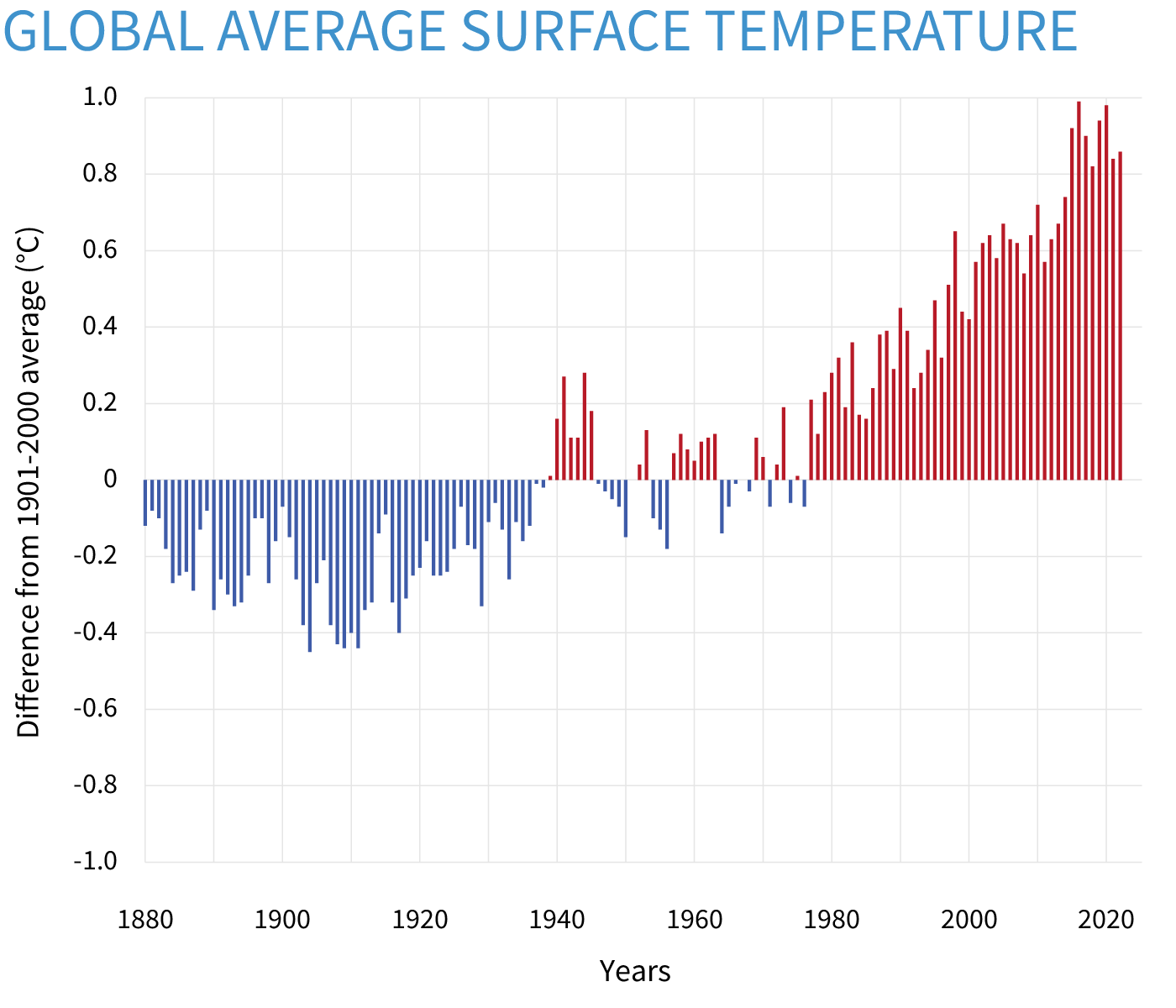

It would be quite educational to attribute in more detail the impact of these two factors. The degree of "El Nino" influence is presumably known, and if its strength is not related with global warming in complicated and unknown ways it would be good to overlay it as a distinct effect.
Being clear about what is happening and why (to the extend that it is known and understood) is important, on at least two counts:
There is already a segment of the population that drifts into panic and depression as a result of all the viral social media climate change echo chambers. Panic is not the way to address our sustainability challenges that are deep-seated and systemic. The flip side of short-term focused panic is switching off into apathy, or even cry-wolf type incredulity - if a few years down the line these extremes are temporarily subdued.
The other segment of the population that can be affected by a clear and well founded explanation of what is happening are those sitting on the fence about climate change or feeling skeptical for legitimate reasons. Obviously nothing will convince nut-cases or deeply compromised individuals that have large personal stake in the status-quo (and they are many).