> Instead, the battle of submarine silence has mostly revolved around obscure technical problems of fluid dynamics, since one of the loudest noises made by submarines is the cavitation around the screw.
Cavitation is loud, but usually only happens if they're running full out. What they're really listening for now are reactor plant noises.
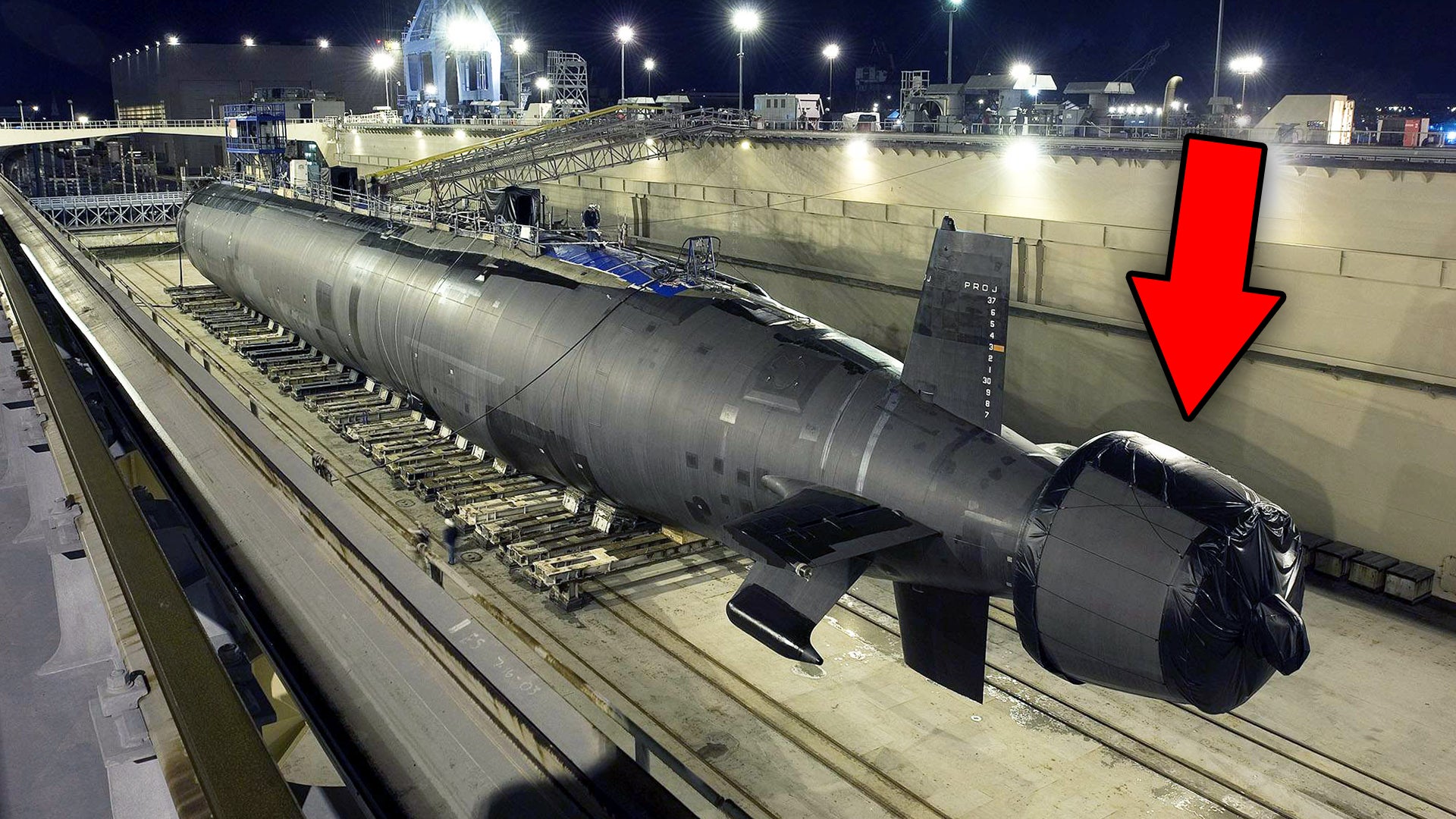
> I don't know if this is true today, but at least years ago the low-noise design of the screw on modern US submarines was classified, and so the screw was covered by a sheath whenever a submarine was out of the water.
Many US fast attack (Virginia, Seawolf) and the upcoming Columbia SSBN use some sort of external pump jet. I'm not sure if they cover those up out of water like they did with more 'traditional' screws.
Huh, I wouldn't classify any of those propulsion trains as pump-jets (and I never heard them called that aboard said vessels ;-P), but wikipedia seems to agree with you.
They're ducted propulsors, a direct evolution of the classic submarine prop that integrates a pressure-increasing shroud and stator vane assembly. A "pump jet" classically involves some sort of centrifugal pump element or at least a vectoring mechanism.
You typically wouldn't call a ducted fan (ex, on the X-22 [1]) a jet, but I guess in the water we do.
> What they're really listening for now are reactor plant noises.
Which is why old timey diesel electric submarines still sometimes have the edge over modern subs. No plant noises at all if they are running silent.
This leads to some hilarity in joint naval exercises every now and then. e.g. when HNLMS Walrus managed to "sink" among others the USS Theodore Roosevelt before getting away, to great consternation of the Americans.
It wasn't just a sunk craft. They sunk a carrier. That's painful. Your wikipedia entry is kind of weird, since it's about Australia and there are no Dutch ships in the list for the last century or so.
Australia has 'sunk' USS carriers in war games also - there are entire books written about how carriers are hard to defend in modern warfare - they're painful to lose but (shhh, don't tell anyone) relativey easy targets in all manner of ways.
The wikipedia entry is about 1400+ ships that were mostly Dutch - from the days of the Dutch East Indies and Spice trades.
It's of interest as that coast was one of the main drivers to develop "GPS 0.1" aka clocks capable of reliable determination of Longitude and one of the (relative to monetary value at the time) largest technology prizes offered.
They stopped stacking up on the West Australian coast once accurate navigation became commonplace but for a while there .. yep, Dutch ships sank themselves.
While your post is informative, it's kind of disingenuous to claim a link between two phenomena when there is none, seemingly because you needed to say something bad about Dutch ships in some way. It's a shame really, because it detracts from the quality of your other links.
> it's kind of disingenuous to claim a link between two phenomena
Which two phenomena?
Dutch ships heading to the Dutch East Indies sinking and the need to accurately measure longitude?
These are very much linked.
> needed to say something bad about Dutch ships
I felt no such need.
It's a simple fact that a comment about Netherland naval ships faux sinking US carriers prompted a remark about the large numbers of Dutch ships famously sunk off our coast here in W.Australia.
It has little to do with the quality of the ships and everything to do with the then inability to accurately reckon longitude.
Of technical interest to anyone with an interest in the evolution of surveying, navigation, timekeeping, colonial expansion, shipwrecks, treasure, etc.
> . What they're really listening for now are reactor plant noises.
Yep; a fanatical obsession with reducing plant noise is why US subs were so quiet compared to everyone else. The author knows fuck-all about what he's talking about going on about cavitation.
It's also why diesel hybrid subs from Sweden are nearly undetectable. There's virtually no plant noise - probably just a coolant pump or two - while running on battery. They are sometimes 'hired' by other navies for exercises because they're so incredibly quiet.
He's spouting pure bullshit about the Navy retroactively going back over their 'tapes'. He first explains that for decades the Navy has run computerized classification systems, but then we're supposed to believe that a highly sensitive listening array did not detect the extremely energetic implosion that would sound like nothing else?
Cameron said that buddies in the navy told him very quickly that they'd heard the implosion, but they were confirming what he already knew when he heard that telemetry was lost at the same time as comms; telemetry came from a completely separate external pressure vessel. It going silent means it was destroyed, and the only way that could have happened was the sub imploding.
The bit about it being unrecognizable as an implosion because of its unique construction is complete supposition.
This is what happens when you have an article about submarines written by a guy who checks is a github engineer who likes 80's and 90's phone technology.
> The bit about it being unrecognizable as an implosion because of its unique construction is complete supposition.
the theory that it would have been correctly classified by the trained system seems an even less likely complete supposition - the only arguments I've seen in favor of it are argument ad incredulity fallacies
Since you are appealing to qualifications, I am genuinely curious what your qualifications are. I have never heard of the author before but I have also never heard of you, so it would be interesting to get your technical background to compare.
Would like to hear more about this! Assuming the reaction itself is silent (?) what kinds of sounds is the reactor making and what are the challenges in quieting them?
In order to generate electricity from heat, one generally must transform the heat into mechanical energy first. This is most often done creating steam and using it to spin a turbine. I assume that this is the process that is noisy.


Cavitation is loud, but usually only happens if they're running full out. What they're really listening for now are reactor plant noises.
> I don't know if this is true today, but at least years ago the low-noise design of the screw on modern US submarines was classified, and so the screw was covered by a sheath whenever a submarine was out of the water.
Many US fast attack (Virginia, Seawolf) and the upcoming Columbia SSBN use some sort of external pump jet. I'm not sure if they cover those up out of water like they did with more 'traditional' screws.