Depending on the NAT implementation this can be incredibly naive. Many home routers will send ANY traffic incoming on a port to the NAT'd IP address, even if the sources don't line up.
So say Alice is behind a crappy NAT and wants to talk to Bob. Alice's router opens a port on its edge, lets say 1234, and sends traffic to Bob on port 80.
Let's say Charles knows Alice's IP address. Charles starts spamming Alice's router, eventually hitting port 1234 with bad data.
Alice's router is dumb. It sees traffic on port 1234, checks its NAT table, and sees that data is supposed to go to Alice. It happily rewrites that packet and passes it along to Alice. Now Alice is getting traffic from Bob *and* Charles. Uh oh!
Many game consoles are explicitly designed around this bad, broken behavior. You'll open a port to the matchmaking server and then the matchmaking server will tell people to connect to that IP address and port combination. Crappy home routers will happily route that data through its NAT configuration to the console despite the console never explicitly opening up traffic to those other parties. This is why some game consoles will complain about closed NAT versus open NAT.
> Alice's router is dumb. It sees traffic on port 1234, checks its NAT table, and sees that data is supposed to go to Alice.
While in principle that is possible, in practice almost all home routers are based on Linux, and Linux netfilter NAT implementation distinguish connections based on port and IP, not just port, so this would not work.
The poke a hole to outside world to a random server, log the port allocated to you by your router and have someone else use this to connect to you is the basis of STUN protocol.
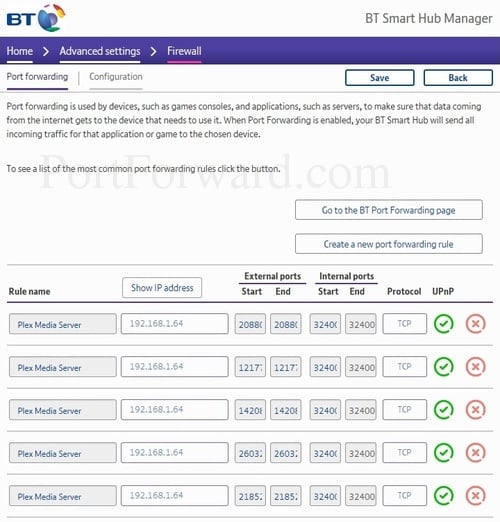
Home routers often greatly simplify the interface.
BT, one of the largest ISP's in the UK, only allow the configuration of destination IP and external/internal ports[0].
I've never expected my NAT to do anything other than map ports. I can see why the ability to map source IPs to different ports would be useful but relying on that as a security feature feels like a foot-gun. I wouldn't feel comfortable exposing an application that doesn't have some form of authentication and/or blacklisting.
I gave an example just a few comments above this. Alice never wanted Charles' traffic, the firewall should not have let it through. But because the NAT is dumb, and the firewall rules are often tied to the NAT on these crappy home routers, it's allowed. So now because Alice wanted to talk to Bob, she opened a port to the world that she never wanted opened as wide.


So say Alice is behind a crappy NAT and wants to talk to Bob. Alice's router opens a port on its edge, lets say 1234, and sends traffic to Bob on port 80.
Let's say Charles knows Alice's IP address. Charles starts spamming Alice's router, eventually hitting port 1234 with bad data.
Alice's router is dumb. It sees traffic on port 1234, checks its NAT table, and sees that data is supposed to go to Alice. It happily rewrites that packet and passes it along to Alice. Now Alice is getting traffic from Bob *and* Charles. Uh oh!
Many game consoles are explicitly designed around this bad, broken behavior. You'll open a port to the matchmaking server and then the matchmaking server will tell people to connect to that IP address and port combination. Crappy home routers will happily route that data through its NAT configuration to the console despite the console never explicitly opening up traffic to those other parties. This is why some game consoles will complain about closed NAT versus open NAT.