Before you get cosmic energy out of nuclear fusion fuel (usually isotopes of hydrogen), you have to put a bunch of energy into the fuel to get it into fusion conditions. Namely, you have to heat it up and compress it so the nuclei get close enough to fuse (after which they'll release energy).
There are a few milestones along the way to commercial fusion energy:
* Get more energy out of a fusion fuel than you put into it
* Get more energy out of fusion fuel that it took you to make the energy you put into it
* Build a way to capture the net gain energy and convert it into electricity
* Demonstrate the integrated power plant as a prototype system
* Build and operate the first commercial power plant
* Assuming good economic and technical performance, start building a fleet
Is commercial ICF realistic though? Each shot needs a carefully prepared fuel pellet. To get commercial power they'd have to fire a shot per second or so. That seems like a really expensive manufacturing operation to keep it going.
While obviously true, I think it's also useful to distinguish where items in category b fall on the spectrum from "this will be commercially viable with minor refinement" to "this is three orders of magnitude away from commercial viability and we don't even have a theoretical path to get there".
AFAIK energy generation with ICF is much closer to the latter than the former.
Not sure I agree. Fusion solves non of the problem of fission actually has.
- Will Capx be lower compared to a advanced fission plant. Almost certainty not.
- Will Fusion plan be significantly cheaper to fuel. Almost certainty not, uranium and thorium are available in waste quantities.
- Will it solve proliferation concerns? No, if you have a control of a fission reactors you have the potential to do all sorts of things.
- Will it solve the nuclear waste issue. Maybe slightly but advanced fission can produce waste that need to be stored for around 300 years and that is not actually that difficult.
And that is of course if you assume that the 100s of billions in investment required will not have be be paid back in any way. That is partly fair because fission didn't have to do that either, but there the investment is shared with nuclear weapons (for better or worse).
So I would say its closer to the second suggestion. I don't see a theoretical path of how a fusion reactor can be built cheaper then a comparable fission reactor.
But I'm not a expert on fission, I have heard of some fission that could be built very small but all actual real designs for suggestion of commercial fission I have seen do not fall into that category.
In one of Elon's video interviews with The Everyday Astronaut where they are staggered at the sheer scale of Starship, the booster and the launch/landing system, Elon said "We're not violating and laws of physics here... there's no reason this won't work".
Also: "Here at SpaceX we specialize in turning the impossible into just late".
Not to mention a tritium shortage [1?] -- assuming this is D-T fusion -- which it seems is going to be hard to get in the first place let alone throw it into a generator.
I don’t know if it’s all fusion reactors but General Fusion breeds tritium by surrounding the plasma with moving liquid lithium which breeds tritium and helium and they send the tritium back in. Seems sustainable.
I don’t know why their plan is to just vent helium given the shortage although I imagine that’s a second order problem they can solve later.
Thorium is something that is literally a waste product that falls out of refining of rare metals. And natural Uranium is also available in waste quantities. Without even trying we would have enough for the whole world.
And then compare to that the very complex and expensive process of process of breeding tritium.
How does that make any sense?
Sure, fusion is about 3 order of magnitude denser, but fission is already incredibly dense. The increase density doesn't really benefit you in any practical way unless maybe if you are trying to do interstellar flight or something.
Is there really enough lithium in the world to supply fusion reactors while also meeting the demand for its use in batteries over the next 1000 years? It will be interesting to see what the actual long term consequences are for building fusion reactors, as humans are notoriously bad at predicting what unforeseen circumstances arise from new technologies.
Maybe the Belters will mine lithium from asteroids and send them back to earth in exchange for air and water...
Fusion uses 6Li, which is only a minor fraction of natural lithium. The 7Li (93% of the element) can be used in batteries just fine.
At one point back in the 1960s some physicists were trying to make a neutron detector using lithium, and it wouldn't work. They eventually discovered the lithium they had purchased from a chemical supply company was nearly pure 7Li. It had been sold back into the chemical market from the waste stream of the government's lithium enrichment facility.
I think the general hostility is a reaction to the hype that "this breakthrough means we're closer to an infinite source of cheap, clean energy."
It clearly does not. I can understand the researchers feeling unable to tell the press, "Look, this is just basic research. Like the JWST." It might lead to a massive reaction that "well, then you have to just get in line for those basic research dollars, instead of being a top-priority thing we throw money at."
The JWST cost about 3 times as much as the NIF. The annual budget for the NIF is about the cost of 6 F-35s, which the US is acquiring 152 of in FY2022. It's not getting top-priority money.
OK, I don't think comparing research to the defense budget is at all useful, but comparing JWST research to fusion research IS. So I'll stand corrected on US money.
However, ITER is a global effort, so it isn't just the US budgets we have to consider, right?
Somewhere between the second and fourth bullet you need to significantly limit the process' energy overhead (almost certainly, heat) to something manageable at scale. If you can't do that, then a net gain is not good enough: If you can power a town but boil a lake's worth of water with the excess heat, that's not much of a viable process.
Would you mind answering a layman's question on where the energy comes from in fusion: my understanding is that the problem here is that energy has to be put in to overcome electromagnetic repulsion between atom nuclei so that the strong force can take over and combine them into a new nuclei, releasing energy at that time.
This is not the first time. But it’s the biggest net gain so far by a good wide margin.
Still a very long way to go before becoming similar to a fossil burning power plant. They got equivalent of 1 megawatt for a single second. A typical coal plant is hundreds of megawatts continuously.
Wait, are you suggesting that renewables will make energy too cheap to meter? I've been waiting for this moment.
While renewables are making increasingly cheap generators, the overall systems involved in delivering reliable energy from them are increasingly expensive at increasing scale. Check energy costs to customers e.g. in Germany.
Mining, energy storage, transmission, demand control, recycling, maintenance, land rights, etc. for any energy source at world scale will continue to cost well >$0. For nuclear fission, fuel cost is only 5% of the total cost. For renewables, fuel cost is 0%, but that doesn't mean there aren't costs.
The issue is rather that due to the unpredictable nature of renewables, sometimes the stars align so that the combined output of wind, solar, and hydro end up far beyond what the grid needs.
During those times, in some parts of Europe for example, renewable energy really is practically free. This is a problem for nuclear and fossil plants which lose money during those times. The renewable operators don't make much either but at least they don't have very high input costs.
Ah come on that wouldn't have been necessary... energy costs could be a lot lower if the path towards renewables hadn't been blocked and undermined for years, if something in the current situation is keeping it not from exploding more it is the renewables.
Please better check France for the often touted right way of going nucelar, with half of their overaged reactors taken off the grid due to failing safety regulations (which are not too hard but have been dangerously softened over ye years..), cracks and corrosion problems, and their unfolding catastrophe in regard to nonavailable cooling fluid, which is a problem that will only become much bigger in the future years.
Also don't distract and mix energy with energy, if something we have a heating and fuel problem, not electeicity. Secondly our gas reservoirs are already 75% filled again ahead of plan surprise surprise.. seems the lasts months panic had a little bit too much agenda involved.
If you ask me energy prices here are still much too low for what is upcoming and humanity should really focus on... this will make current debates so absurd and laughable, not getting it.
Why not look at some other examples who fully went renewables and doing it succesfully? Stop looking at a wanted or at least easily prevented politic, lobbyism and incompetence failure, that now leads to prices that are still much too cheap for what our wastage of resources should actually cost, lol.
I'm stating a simple concept, which is that if you put some wind and solar into a heavily-fossil powered grid, the first 30% wind and solar are easy, and the last 30% are harder.
But if you do 100% wind and solar, then you have to start spending money on things other than generators. The fraction of cost that is wind/solar generators vs. e.g. energy storage systems, transmission, recycling, etc. shifts from 1 to ~0 at scale.
If you look at the minimum cost of providing synthetic baseload in a 100% renewable scenario, the renewable inputs can be > 50% of the cost (the other parts being various kinds of storage). This is geographically variable, though.
By which you mean, of course, the least difficult part, and the part that is needed only after all the hard parts, the ones that actually produce energy in useful form, have been built out.
No, energy storage is a far more challenging task than generating it. To put this in perspective, the world uses 60TWh of energy per day. Most energy storage projects are in the hundreds of megawatt hour range, a few in the gigawatts. Estimated for a 100% renewable grid depends on the solar to wind ratio and degrees of overproduction, but they usually fall in the range of 12-24 hours for a 0 carbon grid. And that figure of 60 TWh is only going to grow as underdeveloped countries become more wealthy and want A/C and other amenities.
This is a colossal amount of storage, far outside the bounds of existing storage methods. Hence why plans for a renewable grid assume untested mechanisms like power to gas or compressed air will just scale to near-infinity.
In fact energy storage is a trivial matter of high-school-level physics.
Most existing storage, taking advantage of existing hydro-power dams, uses excess energy to force water up to the reservoir, which energy is later extracted by letting it flow out through a turbine. New pumped-hydro systems built just for storage will be radically cheaper than existing dams, and be practical in hundreds of times as many places: you just need a hilltop no one is using, and water to pump up to it. The reservoir may be much cheaper than a hydro power dam because it does not need to contain high pressure; an earthen dike suffices.
There are numerous other, equally simple methods, for places without enough hills or water. Synthetic fuels like hydrogen and ammonia are an attractive choice because tankage is cheap, and they are transportable and have myriad industrial uses, so after your tankage is full you can sell all further production.
Of course one only builds storage after there is excess energy to put in it. We will need a lot of it, in time, but it is all just construction and mechanics: ordinary civil engineering.
(If you have to lie about the practicality of storage in order to promote nukes, what does that really tell us about your nukes?)
Fusion is trivial high school level physics, too. We all learn about the physics that goes on in the sun's core.
You're right that hydroelectric offers lots of storage potential. But it's geographically limited. Great for countries like Norway that have lots of it. But countries that don't can't just summon dam-able mountain valleys.
You need more than just a hilltop to build pumped hydro. You need a hilltop, with access to a water source. It also needs to be close to a transportation network otherwise construction costs will be prohibitively expensive. Pumped hydro plants do indeed cost a lot: the biggest one in the US in Bath County cost $4 billion dollars for a capacity of 24 GWh.
Furthermore, it will get more expensive as it scales up: as the most accessible sites are developed, subsequent facilities have to be built in more and more suboptimal sites.
> The reservoir may be much cheaper than a hydro power dam because it does not need to contain high pressure; an earthen dike suffices
This makes absolutely no sense. I needs high pressure to generate electricity. Low pressure would mean there's hardly any potential energy to tap. If you're suggesting we have a tunnel leading out from under the reservoir, then those have to be built in exactly the right geography where there's an alpine lake with a height difference.
> There are numerous other, equally simple methods, for places without enough hills or water.
Yet, despite these methods purported simplicity you didn't actually specify them (Edit: you added a couple in an edit after I typed my reply). Because then you'd have to defend their viability.
Since you edited in hydrogen and ammonia:
* Power to hydrogen: electrolysis of water remains expensive, hence why most hydrogen is built with steam reformation. It's not just the electricity costs, but also maintaining the electrodes that perform the hydrolysis.
* Power to Ammonia: this needs a source of hydrogen, so it shares all of the above's issues. Ammonia is really just a storage mechanism for hydrogen, actually producing usable energy from ammonia is done by releasing the hydrogen from the ammonia and then running it through a fuel cell.
You're the one being overly optimistic about the practicality of storage. We've had excess production during peak renewable generation for close to a decade now. The excuse that we won't build storage until there's an excess of electricity isn't valid. Places like Hawaii and California already are saturating the energy market, but the storage is systems you propose aren't being built because they aren't feasible.
Intermittent sources are fine to chip away at fossil fuel use, or in places with widespread hydroelectric power. But we can't kid ourselves into thinking that storage will make it feasible every. Grid scale energy storage should be approached like fusion: maybe it'll be invented and change the energy landscape. But it's foolish to treat that possibility as a given.
Again, if you have to lie to make your case, what does that say about your case?
Pumped hydro storage does not, as I already pointed out, require river valleys. It does not, in fact, need those other things. You make clear that you know nothing about, even, pumped storage. (Maybe look up the word "penstock"?) Why would anyone trust you about others?
People often badly overspend on civil projects, but that does not give you honest numbers -- if indeed what you want is honest numbers. You make very clear that you do not want honest numbers.
Pretending that fuel synthesis depends on access to scarce raw materials (hydrogen, nitrogen? Really?) will not fool anyone. Neither will anyone be fooled by your insistence that its energy must be extracted via fuel cells.
I'm not the person you've been replying to, but I note that your replies in this chain are getting more and more acrimonious. If you're going to repeatedly accuse the other commenter of bad faith, it's probably best to stop replying.
I'm not a civil engineer, nor any kind of expert in grid-scale energy storage, so I can only note that in my amateur readings I've seen many different people (alleged experts) say the same things that Manuel_D is saying. That doesn't mean it's true, that's not my point. My point is that if you know something that all these other commentators don't, I and others would greatly appreciate it if you would explain that. But you'd need to actually explain it, not just accuse others of bad faith.
Literally no one with any expertise says that energy storage is an unsolved problem.
All do acknowledge that building out storage will be a project of a scale similar to that of building out renewables. Only the most dishonest would insist that the relatively small amount of storage already built demonstrates anything other than that capital is overwhelmingly better used, today, to build out new generating capacity. It would be obviously stupid to spend on building storage you have not generating capacity to charge up.
> Pumped hydro storage does not, as I already pointed out, require river valleys. It does not, in fact, need those other things. You make clear that you know nothing about, even, pumped storage. (Maybe look up the word "penstock"?) Why would anyone trust you about others?
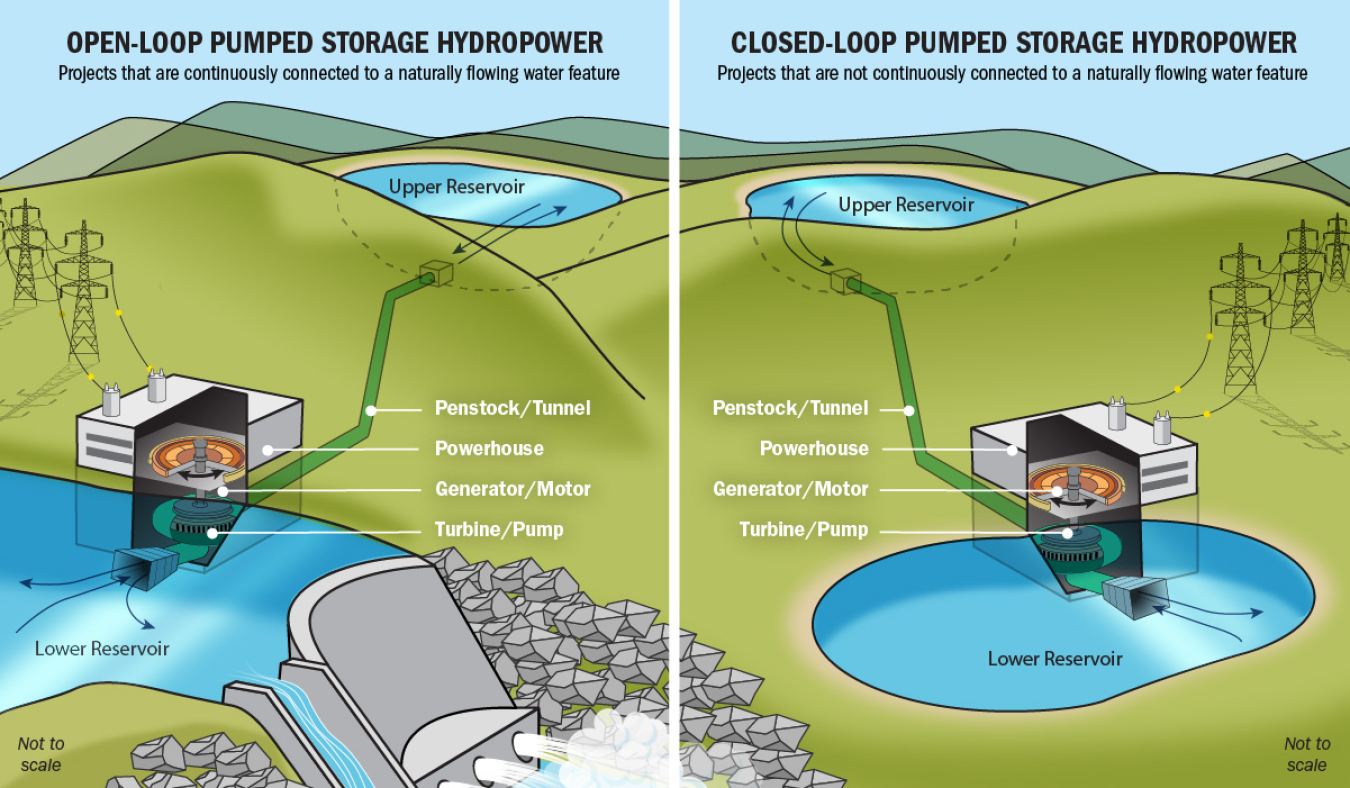
I'm well aware of what a penstock is. This [1] graphic shows how a penstock functions in pumped hydro storage. You see that "upper reservoir"? That's an alpine lake that forms the body of water that flows down through the penstock and drives the electric turbine.
You have to have the right geography to form that upper reservoir. If you tried to build a pumped hydro storage in Nebraska, you'd have to move massive amounts of earth to build that upper reservoir - essentially building an artificial alpine lake. This is prohibitively expensive to do, which is why hydroelectric storage is geographically limited.
> Pretending that fuel synthesis depends on access to scarce raw materials (hydrogen, nitrogen? Really?)
Hydrogen is almost entirely produced through steam reformation, which emits carbon dioxide. Effective hydrogen electrolysis needs expensive materials like titanium electrodes.
The graphic does not, in fact, portray an "alpine lake". It says, exactly, "Upper Reservoir". Did you hope people would not click through and see?
The place where water in the system is at high pressure is not in the upper reservoir, but only lower down, inside the penstock. Which you now claim you already knew, after lying about it.
> You see that "upper reservoir"? That's an alpine lake that forms the body of water that flows down through the penstock and drives the electric turbine.
The pressure is at the bottom of the penstock at the turbine. I'm not sure how you came to the conclusion that I wrote otherwise.
If the upper reservoir isn't raised - as in, an alpine lake - the there's no pressure in the penstock. Look at any picture of a hydroelectric storage facility:
If the upper reservoir isn't raised well above the river or lower reservoir, then there's no pressure to drive the turbines. If you didn't build the upper reservoir up high on a mountain forming an alpine lake, and instead built it on flat ground you'd just have a big useless pond. This is why geography is crucial for pumped hydroelectricity storage.
Pumped hydro requires an elevated reservoir ("news at 11!"). It does not, in fact, require an alpine lake. Nor does the upper reservoir need concrete construction, as the pressure on its dike, if in fact one is needed at all, is limited to the depth of the water in it.
You knew all of the above, but chose to lie about it.
If pumped hydro+renewables is so cheap, why have developing countries like Vietnam chosen to build coal plants instead? Which large country has been able to replace fossil generation with wind/solar & storage and keep prices down?
Countries where corruption is a big problem have difficulty responding to honest market signals. Autocracies are worst, this way, but the US's innovation of making corruption explicitly legal also slows response to market signals. Incumbents see plenty still to be raked off people locked into existing infrastructure.
Cost today? Or last year? Lithium prices have increased over 400% last year. If demand increases suddenly, price will increase as well. The demand for batteries has led to drastic increases in the cost of input materials: https://www.canarymedia.com/articles/batteries/chart-lithium...
This is the scaling problem: if you try to deploy batteries at scales relevant to the energy grid you outstrip the supply of inputs. In order to keep up with demand, extraction industries have to tap more and more inaccessible reserves thus driving up costs. Remember, global electricity usage is 60 TWh per day. And that's just electricity, total energy use is about twice that at 120 TWh per day. Even just 12 hours of storage is hundreds of times the annual battery output - most of which isn't going to grid storage but rather electric vehicles.
> if the path towards renewables hadn't been blocked and undermined for years
That's a pretty hilarious claim given the absurd amount of global investment in the last 30 years.
And lets be real here, nuclear has actually been blocked far more then renewables. In 1982 a green activists literally shot a french nuclear reactor with RPGs. Activists have surrounded nuclear plant and prevented them from being built, only for the state to build a coal plant in the same location. Research projects were canceled as soon as they hit slight issues because politicians did not want to stick their neck out.
Compare this with renewables despite 20 decades of green transition and huge cost in Germany the results are not that great. France in 2 decades basically turned its whole gird green, Germany in comparison is not very close and still operates waste coal plants.
Even project that were actually very successful and did show path for the future had to be killed of as was the case in France:
> A 1998 "Inquiry commission on Superphenix and fast neutrons reactor sector" [3] reported that "decision to close Superphénix was included in Jospin's program ... in the agreement between Socialist Party and Green Party". Also the same report says "despite many difficulties, the technical results are meaningful". In the explanation of vote at the end of the report, commission members says "give up on Superphenix has been a big error" and "Superphenix has to die because is a symbol".
France could have build multiple more of these, but of course instead of that they are building the same old PWRs.
And generally the transition to nuclear would have happened in the US for example if coal had not been cheaper. Just as the transition to renewables had not happened without the state pushing the technology. The difference is just that now states are willing to accept higher prices and higher spending to push the preferred technology and in the 70/80s that was a total non-starter.
> Please better check France for the often touted right way of going nucelar
You mean the country that had a essentially green grid for the last 40 years? Are you aware of the fact that CO2 not produced earlier is far better for the environment then CO2 not produced now?
Because the reality is France has done the whole world a major favor by running a large industrial economy with nuclear. The real failure in France is that they didn't double down on next generation nuclear and instead simply gave up and essentially stopped adding new capacity and instead relying on gas and German coal.
Had Germany gone with nuclear the way France did both Germany and the world we would be in a much better position now. The health effects of coal in Germany alone are staggering. And that doesn't just go for Germany, German coal ash is distributed overall all of Europe, including low countries, France and Switzerland.
So to say 'look France has a few issues with nuclear now what a failure of a strategy' is ridiculous when the country next to it burns huge amount of coal and gas.
The reality is, had the world moved to nuclear we wouldn't nearly have the problem we have now. The grid would be much greener both in terms of CO2 and other emissions. Based on that you also have a great strategy to push out carbon from home heating and replacing it with electric. The same goes for home cocking with gas.
Even for Deep Decarbonization of industry and transport nuclear provides solution. High temperature nuclear heat can be used to make hydrogen or provide heat for all kinds of other chemical process that currently use gas.
We could have even done things like moving to nuclear power synthetic fuel production and added increasingly more methanol into gas (this technology was available in the form of Flex-Fuel Vehicles and has been used in the US and Brazil for example). That would have been a way to reduce carbon emission in transportation before electric cars became possible (thanks to Li-Ion). These are all things that nuclear visionaries like Alvin Weinberg advocated and that would have been possible had we pushed forward nuclear technology.
Now non of it is to say that renewable now are bad, and since we have done the investment renewable are cheap and often make more sense then nuclear (given nuclear progress has been very limited). However to claim that the nuclear strategy was the wrong one is absurd given both the CO2 output and the general emissions produced by country that didn't have a strong nuclear strategy. The world made a huge mistake by not embracing nuclear.
As far as I understand, it means something more along the lines of "This laser hits the fuel with 1MJ of energy which ignites it, but it took us 100MJ of energy to make that happen, because the laser is inefficient/only 20% of the laser hits atoms/etc, etc." Step 1, in this case, is producing more than 1MJ, and Step 2 is producing more than 100.
By renewables I’m assuming you mean wind & solar because fusion is 100% renewable. Even fission is basically close enough in that there’s sufficient easily accessible resources to power human society for eons. Additionally, solar panels and batteries use rare earth metals, so they’re technically not as renewable as fusion / fission (although to be fair I don’t know what materials go into a fusion / fission reactor so those metals may be needed there).
Anyway, the cost of energy with solar / wind is obviously not 0. You have to produce the panels / windmills, perform maintenance, for solar you need to clean, etc. Additionally, the energy isn’t available always so you need energy reserves like batteries, pumped water, etc to store it for use which increases the cost further. Finally, there are energy demands that solar / windmills can’t meet where you need *really* hot temperatures.
That’s why fission repeatedly is shown as the only solution to reduce dependence on fossil fuels. Fusion is great but we should be building insane amounts of nuclear reactors right now to meaningfully decarbonize our energy generation.
* EDIT: Here’s a talk [1] by Michel Laverne CSO of General Fusion. He starts talking at the ~6 minute mark and explains why renewables will never see more than 10-20% market penetration.
> He starts talking at the ~6 minute mark and explains why renewables will never see more than 10-20% market penetration.
...and yet market penetration of wind and solar in the UK was 26.4% in July[0] and still climbing as we build more offshore wind. Plus 1.3% hydro (and 5.9% biomass if you count that as renewable).
I think the ~20% is how much it should take up if people are behaving rationally (and can also be an exaggeration, so it wasn’t intended to be something mathematically rigorous). The current regulatory environment and decades of divesting in fission construction coupled with continued investment in wind and solar makes those options look more attractive than they are economically and politically. Also important to note that there are regional differences that impact the cost benefit for a given type of tech and I don’t know if the UK has a particular geographic strength around wind like California does with solar.
There’s simply not enough battery capacity and physical land in the world for solar power plants and wind turbines to provide all the energy. Everyone always does the solar calculations ignoring the fact that energy has to be produced semi locally to where it’s used (long distance transmission is expensive and lossy). Additionally the calculations for energy capacity of renewables ignores the fact that energy that the capacity can’t be shifted to match load (without batteries).
Seriously. This is why the fossil fuel industry loves solar and wind. They’re not a serious enough threat to their business.
> Everyone always does the solar calculations ignoring the fact that energy has to be produced semi locally to where it’s used (long distance transmission is expensive and lossy).
This is untrue. They are building a solar farm in Australia to export electricity to Singapore 3,100 miles (5,000 km) away.
Even fission is renewable (i.e. can power 100% of primary energy until the sun burns out) using breeder reactors, which can run with huge EROI on just the uranium and thorium traces in average crustal granite. Conveniently, breeder reactors were first demonstrated in 1952 in Idaho at the Experimental Breeder Reactor 1.
The term "renewable" is such a poor word for 'long-term sustainable'. I wish we had something that didn't make everyone think we were violating the laws of energy conservation.
You know what was renewable, using whale oil. That's very renewable in fact, but somehow most people are against running the global economy on whale oil.
Fission is incredibly sustainable in the long term. In fact, even if we mined all the easily expressible thorium volcanic activity actually continuously brings up more.
There's a few reasons as I understand it, the power output can be on the same order as a nuclear fission plant. So a single plant taking relatively little real estate can output gigawatts of power to the grid. The fuel is abundant to the point of being practically unlimited. The fuel also needs little in the way of refinement and is not hazardous. A fusion core is naturally fail safe since energy and fuel need to be constantly applied, an accident might destroy a core or plant but not irradiate the surrounding countryside.
> The fuel is abundant to the point of being practically unlimited.
Well, only insofar as we have all the required elements on earth. You still have to go threw a considerably complex and expensive process to make that fuel.
You need to mine lithium and then expose it to plasma to breed tritium.
> A fusion core is naturally fail safe since energy and fuel need to be constantly applied
With a breeder reactor that can be consciously refueled you can also keep its access reactivity very low. And even better, if its fuel is a molten salt the dangerous elements are chemically bound in the fuel. So even if an explosion (terrorist planting C4) would happen in the power plant, and fuel would get spread but the dangerous elements would remain in the molten salt. The dangerous elements are never gaseous and thus never leave the safety boundary of the plant.
A fission reactor in comparsion when hit by C4 can actually release gaseous radioactive material. Just not very much.
So I am not saying fusion reactors are unsafe, but rather then fission reactors can be incredibly as safe.
For myself I would much rather sleep next to a molten salt breeder reactor rather then fusion reactor.
As with fission, most of the operating costs would have nothing to do with buying fuel. Solar and wind power suffer none of these costs, so fusion, like fission, would be wholly unable to produce power at a price anyone would pay without being forced to.
The fission plants still operating will find themselves increasingly unable to produce power at a price anyone will pay, so will be mothballed long short of their design life.
Generating electricity from sunlight and wind is anything but free. I prefer to pay $0.12/kWh for nuclear energy, as compared to $1.75/kWh for wind or solar, in fact.
I don’t follow. If anything, the nuclear energy electric rate I quoted is too high.
Regarding Diablo Canyon nuclear plant: “The plant produces electricity for about 6 cents per kWh, less than the average cost of 10.1 cents per kWh that PG&E paid for electricity from other suppliers in 2014.” https://en.m.wikipedia.org/wiki/Diablo_Canyon_Power_Plant#:~....
The reason I'm personally most excited is interplanetary or even (generation ship) interstellar travel. Fusion fuel is the only practical fuel we know of with enough energy density to provide enough "umph" for long-distance trajectories to be traveled along, at speeds faster than what the Voyager probes had to achieve using multi-year planetary slingshot trajectories.
The only fuels that could achieve better energy density than fusion fuel would be antimatter, or maybe some fanciful sci-fi thing we may discover down the line, such as quark fusion ( https://www.sciencealert.com/new-quark-fusion-releases-signi... ) or subatomic compression ( a concept from fiction that involves packing an immense amount of solid electrons together so tightly that the electrostatic repulsion functions as a compressed spring (perhaps using mutual gravitation almost but not quite strong enough to be a black hole as a way of preventing disastrous spontaneous decompression) ).
Prestige, social status, bragging rights, money (a $billion is table stakes for fusion reactors, so a lot of folks are getting fat cuts), and cool & cushy high-tech careers. Really expensive research has been going on for 50+ years now, with no sign of development - let alone deployment - of actual, practical power reactors.
Maybe seen to many sci-fi, but can a fusion reactor go out of control and fuse any atom it comes in contact with? I mean with more energy going out than in. Sounds a bit like a nuclear reactor.
The neutrons released by the fusion reaction can be captured by the atomic nuclei of other materials it encounters, in a sense fusion. This induces radioactivity in those materials, called neutron activation, but won't create a run-away reaction. Nuclear fission reactors also produce neutron radiation that behaves in the same way, except in nuclear fission fuel it does create a chain reaction.
> Sounds a bit like a nuclear reactor.
They are nuclear reactors. Nuclear fusion reactors, rather than nuclear fission reactors.
Fusion reactors and conventional nuclear (fission) reactors are very different. Only poorly designed fission reactors can meltdown and release large amounts of highly radioactive material into the environment. And no nuclear power reactor of any kind can explode into a giant fireball like a nuclear bomb; that only happens on TV shows.
Molten lithium (or Pb-Li) probably won't be used in magnetic fusion reactors, because the magnetic forces from induced currents in the flowing metal would cause unacceptable pressures to develop. There was hope that insulating coatings for metal structures could be developed to deal with this, but apparently even small cracks are too much.
There are some great videos on YouTube about how alkali metals behave in contact with air or, for extra amusement, water. Those don't generally present superheated, molten alkali metals.
Fusion reactor can, in theory, go out of control, but it won't "fuse any atom it comes in contact with". Somewhat simplified:
The failure mode for a regular (fission) reactor can be twofold. The better scenario is that by some kind of mechanical failure the radioactive materials escape the confinement, and instead of putting their energy into the electricity generation mechanisms, just start shooting it around, irradiating things, thus breaking them (including living organism's cells and DNA) and causing them to become secondary sources of radiation. The worse scenario is that that before that, radioactive materials become too close together, starting self-sustaining chain reaction, which outputs immense amounts of energy (essentially, like a nuclear bomb), inevitably leading to destruction of whatever container it is in (no container can survive it for long, too much energy) and spreading around, by which time we're back to the scenario above (since once the materials have spread around, the chain reaction would stop) only with much more material which is much more energetic and thus will spread around wider and do more mess.
The failure mode of fusion reactor, if it happens, would be different, since it does not contain fissile material. Instead, it contains some light elements (usually the mix of deuterium and tritium, both of which are just hydrogen with some extra neutrons) which are heated and compressed a lot to start forming helium. If something breaks, the elements would not have anything to contain them (since, unlike what happens in the Sun, they don't have nearly enough gravity in themselves to be able to counter the thermal forces taking them apart) so what you'd get is a lot of very hot gases (mostly hydrogen) flying around. It's no fun, especially given hydrogen likes to explosively combine with oxygen in the air under the right conditions, but there would be no radiation involved, and it won't be able to "fuse" with anything else because it won't have enough energy to initiate the fusion process (that why we needed to compress and heat it up in the first place). So if everything goes very wrong - which is not very likely, but we're assuming the absolutely worst case scenario - we will have an explosion but noting like fission reactor. The containment is absolutely necessary - at least in current fission reactors - to achieve more energy out than in - and if it fails, the energy output will stop. This is one of the reasons fusion reactors are supposed to be safer.
There still could be some radioactive contamination involved due to fusion causing neutrons to fly around, hit the surrounding materials and turn them radioactive, and these could be spread around by the explosion, but less than in the fission case.
Now you may ask how hydrogen bombs are so destructive then? The big difference they use a regular nuke to ignite the reaction. Unless somebody builds a fusion reactor inside an exploding nuke, that's not the scenario we'll be dealing with in the fusion reactor case.
Right now nobody has a functioning fusion reactor, so nobody knows how expensive it would be to run one. Hopefully, there would be some way to make it cost reasonable money - since it has many advantages over existing solutions - but I have no idea if it's feasible with current technology.
Nope, failure of containment simply means they fizzle out. Some massively hot plasma might go to areas immediately next to reactor, but it won't blow up. There isn't just enough temperature or pressure for fusion to continue.
There is lots of sci-fi where the reactors go in full overload. Startrek, Starwars, Stargate. Don’t quite recall where I got the idea exactly from to be honest.
Start Trek uses matter-antimatter reaction as power source. Provided we ever find out how to do that, if this reactor stores any substantial amount of anti-matter - which appears to be the case in Star Trek, with the confinement being achieved by usage of dilithium crystals - the failure mode would be loss of confinement, with the result of antimatter coming into contact with regular matter. This will lead to all anti-matter instantly converted to energy (taking the equivalent mass of matter with it) resulting in enormous explosion probably converting any matter in the vicinity into a superheated plasma cloud and enormous burst of high-energy radiation. Star Trek reactors are not very safe, as it looks from the descriptions.
Iron Man's "arc reactor" is explicitly supposed to be a fusion reactor and it blows up, taking a building with it, during the events of the first Iron Man movie.




Before you get cosmic energy out of nuclear fusion fuel (usually isotopes of hydrogen), you have to put a bunch of energy into the fuel to get it into fusion conditions. Namely, you have to heat it up and compress it so the nuclei get close enough to fuse (after which they'll release energy).
There are a few milestones along the way to commercial fusion energy:
* Get more energy out of a fusion fuel than you put into it
* Get more energy out of fusion fuel that it took you to make the energy you put into it
* Build a way to capture the net gain energy and convert it into electricity
* Demonstrate the integrated power plant as a prototype system
* Build and operate the first commercial power plant
* Assuming good economic and technical performance, start building a fleet
* Deal with fleet scaling issues
* Profit!
This is a celebration of the first bullet.