The whole 'preying on the vulnerable' thing kind of puts me off. But I want to respond to this:
> The items that you buy have absolutely no impact on gameplay and are just visuals
Cosmetic items are not just visual though. They are real elements in the game. Cosmetic items are interactive. They are unlockable, collectable, wearable items.
Further, visuals do impact the gameplay. You could argue about the difference between "gameplay" and "visuals" but each supports/influences the other and both are critical elements of almost every videogame. However you divide up the parts of a game, they all affect each other. Generally speaking, having all of the elements working together makes for a better game.
Monetisation strategies like microtransactions, loot boxes, etc. are also part of the game. However, the goal of such parts is not aligned with that of the others. The game is compromised by the introduction of the monetisation strategies.
> why are you surprised that some people want to look cool in a video game?
> Cosmetic items are not just visual though. They are real elements in the game.
Yes, I really hate this argument that cosmetics are not gameplay. Visuals are a huge part of what makes a game, no one would be happy if games shipped without textures and shaders and people would have to pay to unlock them.
> no one would be happy if games shipped without textures and shaders and people would have to pay to unlock them.
Not a meaningful comparison. A game without textures would be hardly playable at all. The same can't be said for skins or accessories to your character/vehicle. You don't get eye-cancer with the default skin. If you feel you need that virtual Louis Vuitton bag to fully enjoy the game then well be a sucker and pay for it and pretend the game was just a little more expensive. I've yet to encounter a game where I feel like I'm missing out on anything with the default player model/skin/car.
That's fine for you. A lot of these games are social experiences. Kids do get called names and bullied for having a default skin. Peer pressure drives a lot of the purchasing of cosmetics. That's why you'll rarely find paid cosmetics in games that don't also feature social aspects.
Yes but that's the point. That's all external and cannot be blamed on the game, or taken to mean the game is incomplete without. Extending on that, there should then also be a ban on fashion and luxury items in any shape or form IRL, as they do the same things to kids (and adults). And a ban on violence in videogames, as I'm sure there's someone out there who's been pushed over the edge by it and committed a crime they otherwise wouldn't have.
So where do we stop? This is just one more way, in addition to the thousands we already have, in which peer pressure and status symbols manifest.
The Rocket Pass is a pretty sweet deal if you play a fair amount. I think it's 10 bucks and you can earn enough credits to get the next season's Rocket Pass.
I don't really muss with my car too much anymore, instead I just click "Equip Now" every time I can and slowly modify it over time.
> Yes, I really hate this argument that cosmetics are not gameplay.
I don't disagree that they do add something, but theses ones are not something that I want, nor that I need.
> if games shipped without textures and shaders and people would have to pay to unlock them.
I do have to pay for the textures and shaders... I did pay for them as a matter of fact. I didn't pay for the one not included, as I didn't want them. Some did want them, and did pay for them individually. Just like I didn't pay for Elden Ring but plenty did...
Now, when you bought that game, if you were expecting a specific amount of content, and you didn't get that content without paying more, I agree completely, that would be false advertising and that would be definitely wrong.
False advertising is definitely an issue in video games, there's so much overpromising and under-delivering but IAP isn't the issue there (though it definitely can be the reason for your false advertising). Until that part is handled correctly, the market did alleviate most of the false advertising by having an abundant amount of reviews and to me that's a not so bad way to deal with this.
And just another example. Path of Exile is a game known for its visual clutter when you reach the end game. You have so many mobs and skills flying around it is very difficult to tell what is going on. You can buy cosmetics to make different skill gems appear different when they are cast, including mobs. Often, these alternative skill cosmetics create a greater visual clarity than their default. My point is that if there is a skill that can one-shot kill my character i'd like to see it as clear as day when it is coming. Paying money in Path of Exile gets me that.
The hitboxes are the same, so to any seasoned player the visuals really don't matter gameplay wise, as long as the model isn't too out of scale with it's hitbox.
Unless there have been changes in the game, different cars have different hitboxes so technically in this circumstance you might be wrong. Not that there any absolutely amazing car for hitboxes, but there are differences and they affect gameplay.
I assume you're still talking about Rocket League? All models in that game fall under 1 of 6 hitbox types [1], each of which are attainable without purchase
Back in the days we used mods and texture packs to remove (hardware) expensive textures from the game so we get more FPS. I'm not sure if your argument applies to all games. For many games there is a competitive scene that usually don't give a shit about visuals and would trade most visual features for more frames per second.
Iam not a real gamer anymore but in World Of warships there are serveral crossover skins (like from animes) that some people love and use and others hate them and are able to turn them off completely.
The reality is that they kinda do, people with expensive cosmetics are viewed as being better players by their teammates and opponents. The significance of this can be hard to measure, but in most games it's bigger than a small stat boost that would be immediately seen as p2w
So the less skilled players with expensive cosmetics get their abilities over-estimated while the skilled players in the base skins get their abilities under-estimated. That sounds like a win for the skilled players in the base skins to me. Better to be under-estimated than over-estimated.
While I get the impression that many of those visual bling payables available today seem to give more of a disadvantage than an advantage, back in the days of 1.6 CS I caught myself in real life considering the contrast between what I wore and the environment I was passing through. Not because I was expecting to get shot at (I certainly wasn't), but because at the time it was so much of a routine consideration for me. Yes, visuals can be a competitive factor.
Underlining this comment — Ubisoft games, such as Division or Breakpoint, allow purchase of national camo designs.
If these had no “gameplay” effect or “competitive advantage” based on environment, why do nation states spend money developing them and equip troops differently based on biome?
And why have some games had to patch their PvP to “outline” opposing players with a visibility border in the patches that follow certain “cosmetics”?
A more subtle advantage can arise from hitboxes in both hitscan and projectile games with customizers or cosmetics that change the mesh. There’s a reason some games are predominantly female characters in close fit gear.
Finally, even games that insist no gameplay or competitive advantage, are fully aware of “the meta”.
In Fallout 76, for example, PvP players learned to hotkey the “Nuka-Cola” drinks with special benefits. In a for money store, Bethesda allows you to purchase a robot junk collector that gathers Nuka-Colas for free. Rationale is it is just a QoL (quality of life) benefit, but in reality, it allows stockpiling a combat advantage to last longer in combat than the opponent. Same store also allows you to purchase “repair kits” for weapons and “bubble gum” that suppresses the survival mechanism around eating/drinking for an hour of game play.
Again, Bethesda’s claim is QoL not pay-to-win, but weapons repairable mid-battle away from one’s base certainly affects winning, and level of hunger/thirst affects damage multipliers and action point refresh (aka ‘mana’).
Look “good”? Come on. If not having the Pickle Rick decal for your car makes you play worse it has nothing to do with looking “good”. Perhaps look “like I own this exclusive cosmetic”, which applies to offline as well, don’t you think?
The real problem is that loot boxes are gambling, and are addictive, period. It triggers something in otherwise rational people, especially children, that makes it feel good to spend money on mostly non-gameplay-altering cosmetics.
At some level it probably does. Even in Rocket League, which is more cosmetic than most, if your teammates are passing to you more than they would have with the default skin, then you'll do better.
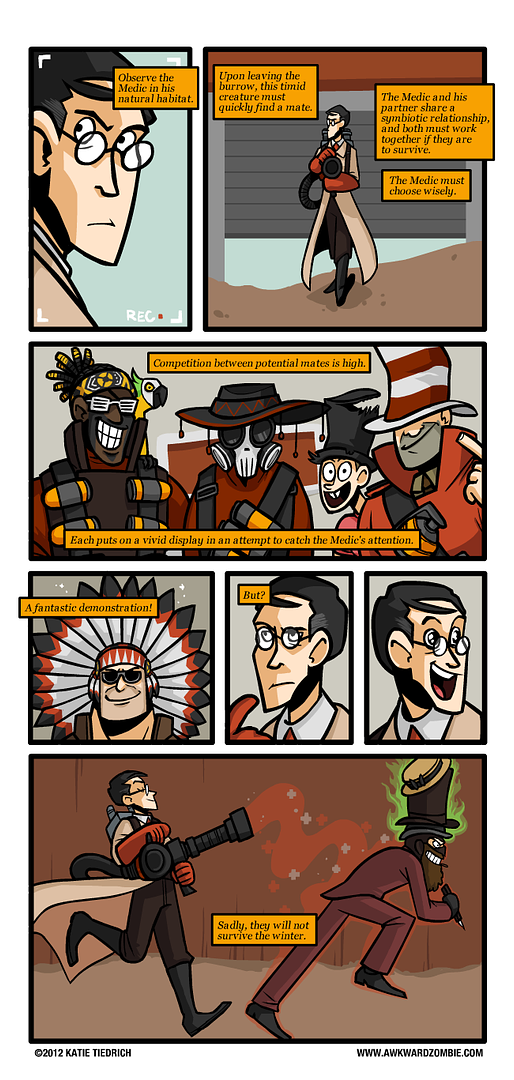
As a medic in team fortress 2, I usually pocket and ubercharge the players with cosmetics. It's an important team resource, and the odds of someone with a "default" skin making good use of it are fairly low. Much like plumage for a bird it's a reliable signal of "virility" - if you're invested enough in the game to own a $200 hat and a coordinated outfit then you've probably played it long enough for me to trust you sight-unseen.
If you're a pro player with the default skin, you're gonna have a bad fucking time, because you're last priority for heals, you're not getting an ubercharge, etc. That is gameplay-affecting even if the cosmetic itself is not.
This is the first really good example I've seen of cosmetics having a gameplay effect. I hate that it's true, but I really appreciate you mentioning it -- signalling of skill is super valuable, and if cosmetics are a reliable enough signal, that's interesting.
If you make all skins and cosmetics available to everyone then you're back to square 1 and people will use some other heuristic to decide who they should pass to. I think this is actually an argument for paid cosmetics, it would improve gameplay for the people who spend the most time playing the game by allowing them to identify other people who also dedicate a lot of time and money to the game.
Oh I totally agree that the system right now is majorly screwed up. Loot boxes are absolutely gambling (why else would the odds be legally required to be disclosed in some jurisdictions?)
And of course it's a vanity component (at least for me, though other posters have raised other factors). Everyone's different with different preferences and as long as there's not a problematic spending aspect I think it's fine...but this links back to the gambling issue. Personally I only buy cosmetics in a few games I play a lot and that don't use loot box mechanics.
Why? Why is competitive advantage the only thing that matters?
OP is just ranting about people who pay more getting a better experience, making paying such a central part of gaming. They just hate this, which I agree with, although I know others don't.
In a way, getting a better experience just for being able and willing to pay more is a basic feature of our society. Why should we expect videogames, being as expensive and lucrative, to be radically different from the rest of society?
I'll just continue appreciating those games who are, those who actually work more like art. If I ever decide to try a F2P loot-box generator-style game, it generally puts me off quickly.
> Why? Why is competitive advantage the only thing that matters?
Because it determines whether free players can still compete with paying customers.
There's no problem with a paid weapon skin that just looks cool since everyone is still on a level playing field. If that paid skin gives the user double damage then you've created 2 classes of players and one of them is superior. In such cases, the only reason free players even exist is to serve as fodder for your paying customers. They're there to get wrecked.
> Why? Why is competitive advantage the only thing that matters?
Because unlike the real world, we expect games to be inherently fair and meritocratic. In a competitive game, we expect that no matter how somebody looks or what they may say, the only thing that matters is their ability to perform. This is comparable to why people get upset about, say, the speed-enhancing swimwear for the Olympic games but don't have any problem with that swimwear existing.
One of the central functions of games is to level the playing field, or at least to reduce the dimensionality to such a degree that it is possible to be focused on all influencing factors in a game within the confines of that game. A closed-system, when we're usually all stuck playing in an open-system. Since all real-world closed-systems actually exist within an open-system, of course there could be external influences, but gamers generally have an expectation that attempts will be made to make a game as self-contained and closed as is possible. Pay-to-win games break this contract to make those unwilling to pay into unwitting tools for the enjoyment of the paying customer. They are open-systems under the guise of being closed-systems.
Granted, the category referred to as "Games" now includes many different things, including "Experiences" that aren't really games at all. And there are so many games today that it's pretty easy to find games that are actually games at their core. But there's also plenty of games that are marketed as games but turn out to be significantly about art / fashion to such a degree that they can no longer really be classified as games.
I've got call out Roblox for playing the meta-game here in a way that all gamers frustrated by pay-to-win will appreciate. It takes the idea of a closed system being broken into an open system, and makes that (making F2P games) into a closed system that breaks into an open system: you get to pay-to-win at creating pay-to-win games. A beautiful pyramid scheme that even your 11-yo child can enjoy being exploited within!
IMHO when a game centres around competitive play, and said game also allows you to buy competitive advantage for real money, that is a problem. A situation like this is called "pay to win" and is tempting enough for some game companies to ruin their game with.
I see it just as price discrimination and I'm fine with it. I can choose to play with "worse" visuals for a lower price. If I want "better" visuals I can pay for that as well. I'm just happy that I have the chance to play for a low cost (sometimes free). I let others who care more about that stuff fund the cost of development. I'm essentially a free-rider.
That of course assumes that the game isn't sold to me with these "better" visuals as included.
You're strawmanning, they don't ship Rocket League with all the graphics turned off and force you to pay for them. They sell silly hats and skins in addition to the already great graphics that they provide with the base model.
>Monetisation strategies like microtransactions, loot boxes, etc. are also part of the game. However, the goal of such parts is not aligned with that of the others. The game is compromised by the introduction of the monetisation strategies.
This is an interesting point. I think it begs the question, what _is_ the goal of a game? 10 years ago I would have said that broadly, the goal of a video game is to create an experience the player will enjoy. Perhaps now it's more simple though, maybe the goal of the vast majority of games today is to create a model in which money is willingly transferred from the player to the publisher.
That has always been true - not just from the days of Pong, but from the days of Pinball and Pachinko. It's not quite true these games are the equivalent of a bar scam - it's possible to genuinely enjoy a game for its own sake - but addictive rewards and behavioural reinforcements have been around a lot longer than computing has.
The reality is that commercial experience games - where the goal is trigger the imagination and guide the player to a rich experience - are much rarer than commercial extraction games, where the goal is to create addictive engagement and spending patterns which can be monetised.
This isn't nearly as true for tangible commercial board games, especially those that promote strategic and imaginative thinking. You can get started in chess with a chess board and a rule book. You do not have to keep spending money on nicer-looking pieces, and your board will not be monetised with pop-up ads. (Chess sites may be, but chess kept developing for hundreds of years without them.)
D&D and more obscure games like Carcassone are similar. You can spend extra on expansion packs, but even if you buy everything the expansion space is small and bounded. The physical costs of board game dev and distribution keep that true.
Electronic games have a virtually infinite potential expansion space, so the economics are drastically different. The temptation to turn every last thing into a monetisation engine is hard to avoid - to the extent that monetisation design has become a meta-game in its own right.
Not only that, sometimes they can affect the basic mechanics too. For example, some guns in Destiny 2 the range is measured from the end of the weapon model, and some skins extend the model out so the gun is further from the player. This in a one v. one scenario can give you a slight edge on one shot kill distance if you have the skin, so you can shoot earlier than an opponent without it.
you and everyone else concerned about the preying on vulnerable thing should be aware that we have literally no evidence that such a thing is happening. the absolute worst thing we know off in practice are extreme edge cases (i.e. not applying to 99% of people even within the whale demographic) of above average earners spending their money on waifu shit instead of buying themselves a car they don't need.
the more regularly occuring thing is probably that parent's don't properly set up their kids phones and then they buy a few hundred or worse thousands bucks of something they shouldn't. but again those occurances are rare and don't cause really cause any actual damage, especially since you can get refunds for this stuff if it gets expensive very easily. kids regularly do stuff a lot more expensive than that. in fact kids themselves are a lot more expensive than that as a baseline.
the supposed exploitation of things like loot boxes has literally zero evidence behind it. all you will find are a few genuinely bottom of the barrel studies (as in that australian government study from some years ago, should literally be taken as an example in a book of how not to run a study).
and the constant comparison to gambling is really tiresome, because it's obviously not the same. people play themselves out of all their belongigs regularly with actual gambling, because their goal is to make a profit with gambling and their last gamble will surely turn it around. such a thing isn't possible even in the few online gaming markets remaining where you can resell your items for real money because its a big hazzle to liquidize all your assets.
People often contrast loot boxes with Magic the Gathering: "At least you can resell your cards", but this makes it more like gambling, not less! CS:Go has far greater potential for economic harm & fraud--due to resale--than the much hated Star Wars loot boxes.
> Monetisation strategies like microtransactions, loot boxes, etc. are also part of the game. However, the goal of such parts is not aligned with that of the others. The game is compromised by the introduction of the monetisation strategies.
Yup, I think this gets lost in the "visual-only cosmetics are fine/gameplay-affecting is bad" position. The problem is that in most cases, even if the cosmetic is purely visual, games are now being designed around "how do we incorporate cosmetics" which is constraining the types of experiences that are being made and the mechanics they allow.
Battlefield 2042 is an example of a game that completely upended its traditional mechanics to pull in the concept of "operators" (like R6: Siege) because they knew they could make more money selling operators. And at some level that's gameplay affecting, maybe not the ideal picture of what happens when MTX gets involved, but that's always the temptation - "we'll make it gameplay-affecting, but it'll be fair". Once you bring money into the picture you are reliant on developers to take the high road - not just today, but for as long as the game is active/you're interested.
Its predecessor, BFV, was skin-based and it was still controversial not just that you had random Fortnite-style nazi characters running around the Pacific Theater or Japanese Rambo Lady running around Norway, but because they started to introduce tons of animations so that players could at least see the skins they paid $20 a pop for - and that is a basic game-design thing that affects everyone regardless of whether you yourself pay up or not.
At a more basic level, the single-player RPG is essentially dead because it's the most difficult to introduce MTX mechanics into those genre of games. And sure you can point to Elden Ring but even then they are using "cooperative" or "inter-session" mechanics that fundamentally exist as a way to get an "always-online" server system into the picture as a platform for MTX. You've got forced Denuvo on everything. Etc etc.
And again, even when it's done right, there is still an incentive to make the "free" mechanisms grindy so that players feel the urge to pay IRL money. LOTR: Shadow of War was an example of that where the game could technically be finished without MTX, but at a certain point the game ramped the difficulty so hard that it was virtually impossible, certainly impossible without suddenly turning the game into a second job. Many games similarly force hundreds of hours of grinding or... you can just pay and go play with your friends! You can get bait-and-switched once you are into the game and emotionally attached - and that can even occur after release/after reviews have been written, or even just so far into the game that most reviewers don't reach it in their 5 hours of gameplay on their pre-release copy.
Those MTX mechanism are still shaping gameplay mechanics even if they are "purely cosmetic" - and in many cases they are not, they are definitely gameplay-affecting by design (in major AAA/e-sports titles even, this isn't just random mobile crapware, R6:Siege is one of the most popular e-sports titles, LOTR is a mega-IP, etc). Games being designed around "how do we pump the player for cash most efficiently and with the least ability for them to hack around us" is itself a problem either way though, that's a corrosive mindset for game design as a whole that is enabled and encouraged by allowing MTX at all. Either you keep that camel out nose and all, or as soon as that nose is under the tent it's always going to be an insidious urge, and in many cases an explicit mandate from publishers to the studio.
Also, yes, in anything where you interact with another player, your interactions are shaped by the other player's responses to you, which is determined by your cosmetics. I posted this deeper in the thread but to bring it back here:
> As a medic in team fortress 2, I usually pocket and ubercharge the players with cosmetics. It's an important team resource, and the odds of someone with a "default" skin making good use of it are fairly low. Much like plumage for a bird it's a reliable signal of "virility" - if you're invested enough in the game to own a $200 hat and a coordinated outfit then you've probably played it long enough for me to trust you sight-unseen.
> If you're a pro player with the default skin, you're gonna have a bad fucking time, because you're last priority for heals, you're not getting an ubercharge, etc. That is gameplay-affecting even if the cosmetic itself is not.
(I should add that as medic, I had a golden medigun for a while too, and that was an extremely bad time for me, because every single roamer was absolutely gunning for the medic with the $100 item. Sometimes it pays to have some restraint in your plumage when you happen to be a particularly delicious and defenseless target...)
I have such mixed feelings about TF2, because it was such a fantastic game, but it pioneered all these exploitative MTX mechanisms. The game itself was actually one of the better examples of how to do MTX properly (cosmetic only, tradeable by players, etc) but it immediately showed there was a lot more money in MTX than in making games, and opened the door to other actors to exploit much more heavily (compare the Overwatch model and its non-tradeability/gacha mechanics, R6:S with its gameplay-affecting operators, etc). It's also disgusting the way they've just continued to let the game rot without even basic bugfixes, it's been completely overwhelmed by hackers for 4 or 5 years now because they just won't patch their shit. Nor will they let the community patch their shit, like Team Comtress 2...
> you can point to Elden Ring but even then they are introducing "cooperative" mechanics that fundamentally exist as a way to get an "always-online" server system into the picture as a platform for MTX.
What? Co-op/PvP has been a major part of From Software's souls games going back to Demon's Souls in 2009. They can also be played entirely offline if you wish and have zero microtransactions or Denuvo.
> At a more basic level, the single-player RPG is essentially dead because it's the most difficult to introduce MTX mechanics into those genre of games. And sure you can point to Elden Ring but even then they are using "cooperative" or "inter-session" mechanics that fundamentally exist as a way to get an "always-online" server system into the picture as a platform for MTX. You've got forced Denuvo on everything. Etc etc.
Have you ever heard of thing called fashion souls? A lot of times I wear armour (pick and choose pieces) because it looks cool not because it have bigger numbers.
If you're at the pro-level, then why does cosmetic choice matter? If it's actually a competitive environment, with people of similar skill levels, then you should be able to have some amount of trust in the skills of other players.
If I were on an actual team of people, I'd expect cosmetics to only matter for at-a-glance identification of a specific player.
because tf2 largely isn't centered around the "pro experience" even if the players are at the top of the playerbase. Comp is its own thing with its own rules, and "casual" gameplay is what the game is designed and balanced around. Comp usually bans about half or 2/3rds of the weapons in the game and imposes additional rules (class limits, no weapons pickups, etc). It's a completely different thing that happens to run on the same engine.
Most games you will play with 23 other randoms who you will never see again after a couple hours. And that is actually the problem - on an actual competitive team your entire team would be decent and everyone would be there to play seriously and get stuff done. But in public games you need some kind of fitness signal to figure out which players are going to be a waste of a team's scarcest resource. How do you tell that from a bunch of players jumping around a spawn room like monkeys for a minute during the setup countdown? Cosmetics. Plumage.
(and actually Valve have gone out of their way over the years to remove other potential signals, like sprays and chat...)
Plumage evolved in nature for a reason, it's still functional and important even though it's "cosmetic-only". Games are a social phenomenon and plumage is still important to them too and that still affects your gameplay too.
In something like TF2, I'd probably rely more on the player's name than what they were wearing. If I recognize the name (even if only in the context of the one match), and know roughly how good they are, I can have my mental preference of who I prioritize.
I usually play Deep Rock Galactic, which has some non-cosmetic ways to judge people's experience. Promotion(like prestige) of a class is indicated by a border color and number of stars, and indicates someone has played a character for promotion25 levels. Bronze stars are okay, silver stars should be decent.
'Blue Levels' are also present. They serve as an indicator of how many times that player has leveled up any* character. So, someone with blue level 100 and only one promotion star should still be considered experienced in terms of game sense, but not necessarily an expert on their character.
Someone with low 'blue levels' and no stars is just a greenbeard, and should not be expected to be great.
The TF2 player base is too big to recognize by name outside of smaller community servers (it's still about 100k peak and this is a fraction of what it was 10 years ago at its historical peak). Sometimes you may see one or two repeat players but mostly it's ships passing in the night and that's OK! There is something to be said for games that everyone is competitive for an hour and then everyone goes home.
There is a similar player level mechanism in TF2 but not tied to classes at all, just a blue level type thing. That works in the starter room, but it's not a solution for the "I have two seconds to choose which of these players to uber before that soldier finishes bombing me"/"I need to pick one of these players to pocket to try and stay alive to keep the uber up for the team".
Plumage works, you can instantly make a call that this is a default player and that one has cosmetics, or recognize the cosmetics of a person who has played well previously/who you gave a chance and they did something antisocial/stupid. Trying to identify a player name, finding them on the scoreboard, and then re-syncing with what has happened in the game in the last 5 seconds just isn't practical.
Like, TF2 has been f2p for 10+ years now, random HNers aren't going to come up with the magic solution here, this is how the game plays regardless of whether you think it should be. It's not a problem, and it's actually one of the least-exploitative MTX mechanisms on the market, but you can't eliminate the effects of cosmetics on gameplay in many situations because plumage is such an important social cue.
If you want an example of cosmetics that don't affect anything - Battlefield 1 has a fixed selection of guns and then each gun has some skins. Nobody else can really see the particular skin at range anyway so no real gameplay effect. This was done deliberately to allow the character design to be visually distinctive - a british medic runs around with crutches on their back for example, and the british scout wears a cape. Can't have that with cosmetics unless they're so trivial that nobody can tell they're there (BF1), or you go to great efforts to preserve character silhouettes (TF2). In BFV it's much much more difficult to tell the classes apart - any class can run around with a medic hat on for example! An elite skin can be any class - you have to visually identify what guns and items they're carrying, which is more challenging even if it's "just cosmetic" - a mere cosmetic gives you a tactical advantage, you know what your enemy is carrying and they have to guess about you.
And that's obviously because BFV was much more oriented around MTX sales, while BF1 focused on an "expansion pack" model.
So MTX clearly affects that aspect of game design even if it's "only cosmetic".
I feel like your arguments on plumage could equally be applied to lower-cost cosmetics, to the point where being able to recognize that someone is 'that specific Heavy', is more important than 'a Heavy with the limited-release Sandvich Holster', and probably easier/faster.
The holster is rare, and maybe you recognize that it's rare, but they could have just gotten it out of a drop and kept it. The Heavy with the funny flip-flops and sunglasses is probable more recognizable at-a-glance, but could have bought a bunch of cheap cosmetics for a few dollars on the market.
And in the case of keeping an uber ready, won't you have to stay pocketed long enough to learn if someone is a good or less-good choice? Even if it's raining hell on your position, you'd have a rough view of the Heavy and a kill feed that highlights the assists you're getting from them. What more is there to look for?
As for the Battlefield games you mention, my biggest issue in 5 was that all of the player models seemed to blend into the background. Most of the time, I wasn't able to spend brainpower trying to figure out who is which type of class, simply because I was too busy trying to figure out if some dull, misshapen blob was part of the map or trying to kill me. Combined with the general feel of the game (poor, imo), I was never motivated to spend enough time on it to get into anything serious. Haven't bought another Battlefield game since, and BF5 was on a steep sale at the time.


> The items that you buy have absolutely no impact on gameplay and are just visuals
Cosmetic items are not just visual though. They are real elements in the game. Cosmetic items are interactive. They are unlockable, collectable, wearable items.
Further, visuals do impact the gameplay. You could argue about the difference between "gameplay" and "visuals" but each supports/influences the other and both are critical elements of almost every videogame. However you divide up the parts of a game, they all affect each other. Generally speaking, having all of the elements working together makes for a better game.
Monetisation strategies like microtransactions, loot boxes, etc. are also part of the game. However, the goal of such parts is not aligned with that of the others. The game is compromised by the introduction of the monetisation strategies.
> why are you surprised that some people want to look cool in a video game?
Nobody is surprised by this.