The research about napping is conflicted. If you like napping don't worry about it too much. Do what works for you.
We know there are many factors here. Maybe older people who nap more have less hobbies and use their brain less (e.g., if you still work or volunteer daily you don't have time to nap). Maybe they take more pills and have other health issues that make them more sleep during the day. Who knows. Too many possibilities.
A drug called Alprazolam or better known as Xanax drives the patient who takes it to sleep excessively during daytime. I've got two acquaintances, who take those pills and they sleep quite often during the day.
It's interesting and is something that crosses my mind when considering any kind of medication. what are the long term consequences of taking this?
I haven't taken xanax but I guess present day quality of life (for some) may be more important than unforseen long term consequences. It would be nice to know for sure though.
> what are the long term consequences of taking (alprazolam)?
Drug dependence and an inability to cope with stress/anxiety without the drug. Benzodiazepines are useful to alleviate panic attacks, but they’re not a great way to manage general anxiety, due to the drawbacks.
Making lifestyle/personal/environmental changes and removing stressors is the key to managing long term anxiety for most people, not drugs.
This isn't new, a decade ago I read that Alzheimers patients sleep quite a bit more than normal. I suspect this is the brain trying to rid itself of what is causing the Alzheimers.
Wondering this myself. I remember reading ( not too long ago ) that europeans lived longer and had better mental health because they napped more than americans. Wasn't it even encouraged to take naps at work for better mental function.
Not many people use their siesta to actually nap though anymore: maybe in august when it is 40+ Celcius it goes up but that is a few weeks a year and tourists basically pass out then too from too much booze and food around siesta time.
If you are napping during the day, it's probable that you didn't sleep well or enough the night before. We know that, amongst other things, sleep is absolutely necessary to clear out toxins that build up in the brain during one's waking hours, and we know that people who get less than 7 hours of sleep per night are themselves at a significantly heightened risk of neurodegenerative diseases. The studies behind that particular stat strongly suggest causality - I don't have the paper handy atm but they've done experimental studies where they've taken the experimental group of rats and prevented them from sleeping, as opposed to this study which is simply observational. With the group of rats that are chronically sleep deprived by the researchers, they are significantly more likely to develop neurodegenerative disease.
I wouldn't draw much from this paper, aside from being astounded that a team of scientists wrote and published it without apparently seriously considering the basic and frankly obvious causality issue that an average first year science student would be expected to notice.
>We know that, amongst other things, sleep is absolutely necessary to clear out toxins that build up in the brain during one's waking hours, and we know that people who get less than 7 hours of sleep per night are themselves at a significantly heightened risk of neurodegenerative diseases.
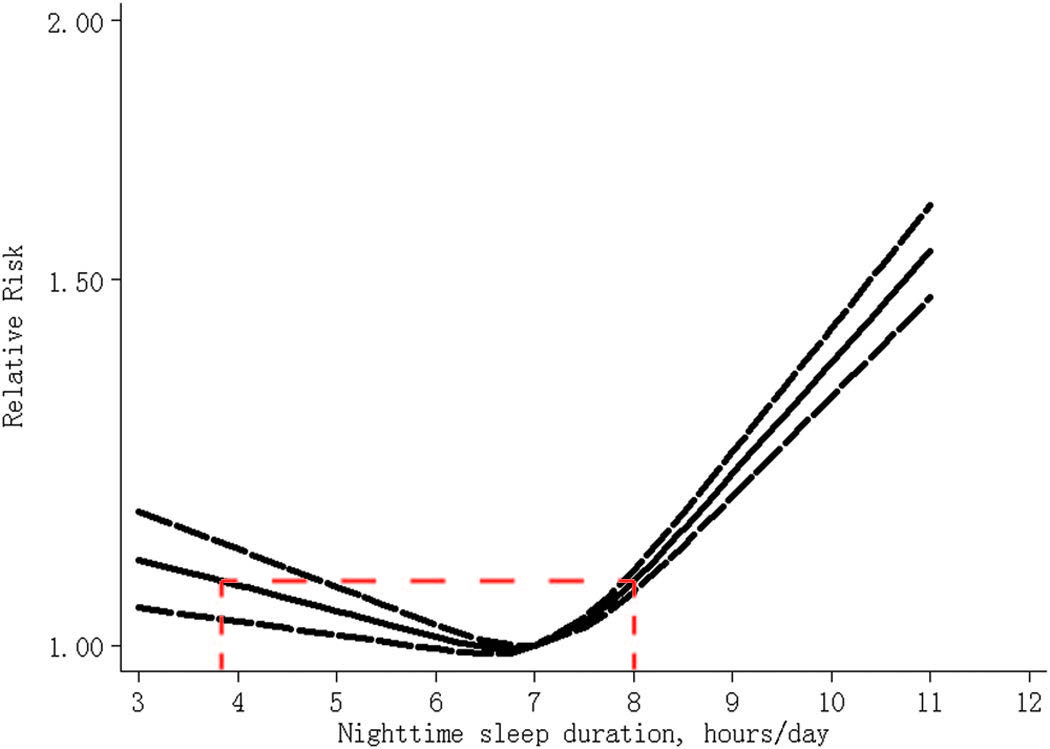
We know that? Because meta-analyses suggest that at even 6 hours you have less all-cause mortality than at 8 hours of sleep[0] and I'm yet to see systematic reviews/meta-analyses suggest that going under 7 hours is as bad as pop science claims.
0. https://guzey.com/files/books/why-we-sleep/shen2016.jpg from Shen X, Wu Y, Zhang D. Nighttime sleep duration, 24-hour sleep duration and risk of all-cause mortality among adults: a meta-analysis of prospective cohort studies. Scientific Reports. 2016 Feb 22;6:21480
> that at even 6 hours you have less all-cause mortality than at 8 hours of sleep[0]
Well, yeah; if you're sleeping more than 7 hours of sleep per night, it's likely because you're unhealthy somehow, such that your CNS takes longer than normal to clear out a sufficient amount of gunk for you to feel rested.
The real stat is "if you sleep less than you need to feel rested, you're at heightened risk of neurodegenerative diseases"; it's just hard to turn that into quantitative statistics.
>you sleep less than you need to feel rested, you're at heightened risk of neurodegenerative diseases
Do you have anything corroborating that? Eating less than you need to not feel hungry doesn't seem to be damaging (up to a point) so a priori I don't see a reason to believe sleeping somewhat less than you subjectively want to has big negative outcomes without evidence.
Why do you believe that those two processes are in any way analogous?
Hunger is an explicit suite of hormonal control-system signals (leptin + ghrelin) evolved as an "instinct" to direct food motivation toward medium-term calorie caching in a seasonal feast-or-famine environment. You get "more hungry than you need" because your body is actively/intentionally trying to acquire "extra" calories to use to build fat stores.
Tiredness isn't an intentional conscious signal; it's rather the experiential qualia of a direct physiological problem — the gradual degradation of the brain's ability to function. Well-restedness is just the feeling of not being tired — of not having the inflammatory processes, brain fog, confusion, etc. that stem from said brain-function degradation. Sleep clearly rewinds this degradative process; getting little sleep results in impaired recovery. People (when not being woken up by an alarm) tend to sleep until the degradation is fully fixed, however long that takes. People who have harmed their brain in other ways — e.g. with alcohol, with hypoxia, with a concussion, etc. — take longer to naturally awaken from sleep, because their brain is recovering from a deeper state of degradation.
I'm not claiming anything here about the mechanism by which sleep enables recovery from the gradual brain-function degradation caused by being awake for a long time; but it's pretty clear that sleep does have that effect.
What makes you think that the scientists didn't consider the possibility that poor sleep at night was the actual causative factor driving the progression of mild cognitive impairment (MCI) and Alzheimer's dementia?
From the paper:
>Nighttime sleep disturbances are known risk factors for developing cognitive impairment or dementia. We found that the association between excessive daytime napping and incident Alzheimer's dementia remained with similar effect sizes after adjustment of covariates for nighttime sleep quantity and quality including sleep duration, sleep fragmentation, and WASO, implying a role of daytime napping independent from changes in these nighttime sleep-related characteristics. We further note that we did not observe direct associations between these nighttime sleep measures and incident Alzheimer's dementia. Therefore, it is unlikely that the increased duration and frequency of daytime napping were simply to compensate nighttime sleep loss; there might be other underlying disorders that affect, for example, the wake-promoting network that leads to lengthened sleep during both daytime and nighttime.
I saw that paragraph and clearly it's intended as some sort of advertence to the correlation/causation thing, but the thing is - if they're coming out and saying that there's merely an association here, so what? No shit? That's like somebody coming out with a study that says that there's a correlation between being alive and dying - of course there is, but it isn't an interesting question nor is it an interesting scientific relationship (in my opinion at least).
I can remember taking a neuroscience unit in my first year of uni and spending a few weeks on how important sleep is for both acute cognitive function, and longer term maintenance that is needed to deal with all the metabolites and waste products that result from such an energetic organ like the brain. This was more than 5 years ago, and yet even then it had been demonstrated that if you take mice and subject them to sleep deprivation, they will develop neurodegenerative diseases at much higher rates, and much earlier, than controls. So what exactly is this study doing? Taking longitudinal data that shows a relationship between poor sleep and neurodegenerative diseases. 2015 called and it wants its conclusions back.
Basically I'd want to see an actual experimental study where they aren't asking participants qualitative questions about their sleep quality, quantity, etc, as if individuals in the early throes of Alzheimer's could even be expected to give accurate answers. I mean honestly: Imagine asking a person with dementia to rate the previous night's sleep amount and quality on a scale of 1-10. It's laughable.
Most longitudinal studies are lazy, and to me this paper is just publishing something to publish it (welcome to modern academic life) - I cannot see how this furthers our understanding of anything.
To me the study is interesting in that it found an association between the duration of daytime napping and the progression of dementia and that those two feed into each other. While it's true that there have been studies that linked poor sleep to cognitive decline, the study being discussed here, in my opinion, offers a new insight that should not be dismissed out of hand.
My father snored loudly all my life and as he grew elderly (and sleep apnea awareness/treatments increased) it became glaringly obvious he suffered from sleep apnea and would literally choke himself awake repeatedly throughout the night. Of course he had a tendency to fall asleep watching tv for lack of any restful sleep overnight.
I think it goes without saying there was a psychological effect, it's too complicated with many factors I don't even attempt to link specific effects. But I'm confident the sleep situation wasn't doing him (and his family) any favors.
You should email the authors of this paper about correlation and causation, I bet they'd appreciate hearing about a concept they didn't consider when writing this article.
> If you are napping during the day, it's probable that you didn't sleep well or enough the night before.
This is a very parochial look at things. There are plenty of cultures that value an afternoon nap, and it is unrelated to lack of sleep the night before.
Forget cultures, can't you tell from this guy's tone that he really knows what's up, while you and the authors don't?
Clearly, depriving lab creatures of sleep and observing the negative effects is enough to conclude everyone is the same and needs 8 hours of sleep. No more, no less. It's a hard number because it's science.
I guess my body telling me it's good for me that I take a nap after lunch is wrong.
It is more complex than that. Drowsiness is most often caused by a sleep debt which is commonly accumulated over a period of insufficient sleeping. Renowned sleep researcher William Dement did a big study on this which figured prominently in a modern analysis of the subject here: https://www.ncbi.nlm.nih.gov/labs/pmc/articles/PMC2391074/
This study does not focus on drowsiness specifically, but rather measuring the amount of daytime sleeping and looking for increases. Under most circumstances daytime naps are short whether driven by drowsiness or the cultural standard of siestas.


We know there are many factors here. Maybe older people who nap more have less hobbies and use their brain less (e.g., if you still work or volunteer daily you don't have time to nap). Maybe they take more pills and have other health issues that make them more sleep during the day. Who knows. Too many possibilities.