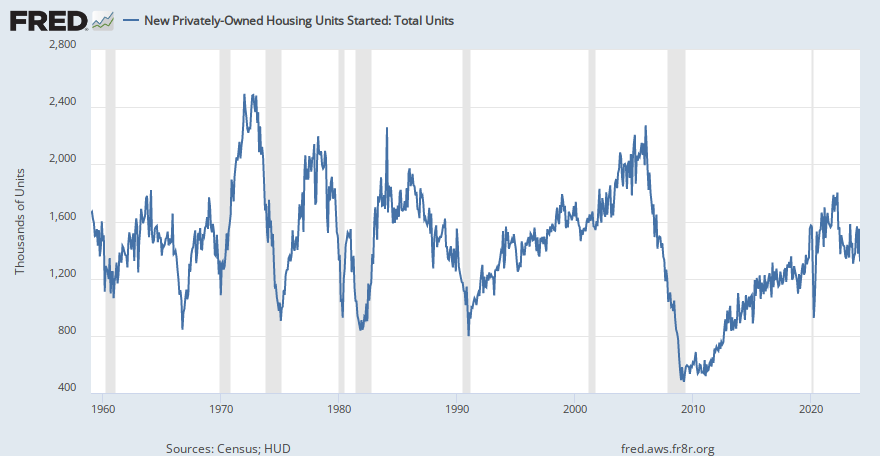
There's been a pretty huge drop in living standards over the last 40 to 50 years. One interview with a person who lived through the 60s said, back then a painter could own a home, support a non working wife and six kids. These days, that same painter would have a hard time supporting himself, let alone a wife and six kids and house.
one of the biggest drivers of wealth reduction is all the regulation that prevents more housing from being built, and how it's built. this leads to higher land costs, higher costs of labor, higher regulatory costs. Not to mention, we've kept adding more and more people to this country but haven't added more land or more material inputs. so of course living standards have to come down as everything gets split up per capita. to be sure, there's a ton of empty land out there, but no one's allowed to use it. and companies have moved jobs to areas where people can't live. meanwhile gov regulates the s** out of the housing dev market and yet let's job creators go nuts in an area that can't grow due to local NIMBYism.
Yeah we should be able to have cheap lead paint and asbestos and get rid of fire codes. Kids these days have too many IQ points.
No regulation is not a viable solution unless we want a return to pea soup smog in LA and other areas, rivers that go on fire, and more lead poisoned children.
Getting the balance of regulations is hard but it would be a lot easier if companies didn’t have to be forced to do it. But it’s unrealistic to think it’s viable for them to behave responsibly due to adverse selection.
But in any serious discussion, one has to fully embrace the fact that regulations are good and necessary. If the debating parties don’t admit that then it’s not sincere. Equally it must be admitted that regulations and a burden and should be the minimal necessary to stop unacceptable abuse.
Houston does not have zoning, and the sky has not fallen there. What we have in the rest of the country is an incentive structure that is firmly on the side of rent-seeking and NIMBYism.
It is literally built into our tax code, with the mortgage interest deduction and California’s subsidy of the boomer Generation with the drastic reduction of real estate taxes.
It is ridiculously easy to solve the housing problem in SF, just tear down the single family homes and replace with high rise apartments at HK-level density. But the entrenched interests don’t want to do that.
Your explanation doesn’t check out. First of all, construction hasn’t necessarily slowed down. Second, jobs were always in cities. That hasn’t changed. Third, new construction trends follow economic trends[0] and that has always been the case, since the dawn of the industrial era. It would be one thing if you were arguing that rising wealth inequality is a result of no new homes being built, but you’d still have to account for all the people who live in homes but don’t own them.
This simply doesn't check out. Land prices even in countries with low barriers to construction are skyrocketing.
The simple fact is that private ownership of land leads to the value of the land capturing the value of its inhabitants. It's an inevitable trend, housing prices will increase until people start moving out in a free market. There is no purely free market solution that doesn't simply delay this.
It’s not always corporations. The people often capture regulatory powers too.
A good chunk if not the majority of wealth creation for most US households has been the value of their house. Older people own houses and have captured the upside of price increases over the decade. The young people are having a harder and harder time buying the exact same houses going up in price. If you go to any sort of planning meeting for a new development you’ll always run into cranky homeowners complaining that it will ruin the price of their property.
Where I live (Australia), the biggest issue is the massive bubble in property prices. Housing affordability has gotten a lot worse over the last few decades. Arguably it has produced a massive wealth transfer from the younger to older generations. I guess inevitably that is going to be partially reversed when those older generations pass on, and leave some of their accumulated wealth to their children. But inheritance is a very uneven process – some people have more children than others, some people spend a lot more in their retirement than others, some people live a lot longer than others (which can lead to much of their accumulated wealth being spent on aged care), etc.
However I do feel like we are transitioning from a society in which each generation was expected to make it mostly on their own (with at best a little bit of help from their parents), to one with a much greater emphasis on inherited wealth. I think as well as property bubbles, another factor is shrinking family sizes. When the average family had 5+ kids, the children couldn't expect to inherit that much. Families with only 1 or 2 kids, the child can inherit a lot more. And even prior to inheritance, it is much easier to extend financial support to your children (such as helping them to buy a home in their 20s) when you only have 1 or 2 instead of 4, 5, 6, 7...
I lack your optimism; when they pass on, their houses will be transferred to small- and big-time rental companies, who will rent their houses to young people for more than a mortgage would cost.
The only hope, in my opinion, is a giant, propaganda-driven cultural movement away from money and towards societal stability.
In Australia, the tax system favours private individual ownership of residential properties over corporate ownership.
Property developers are allowed to keep ownership of new developments (so-called "build-to-rent"), or sell the new development (on a single title) to an investment trust. But corporations buying pre-existing house stock, without plans to redevelop it, are at a tax disadvantage compared to individual owners.
I don't think corporations are quite as powerful as you think. Certainly not in Australia. At the end of the day, individuals vote, corporations can't. Governments win elections by appealing to voters, not appealing to corporations. Indeed, almost all of the negative aspects of Australia's housing policies have come about through appealing to individual voters–the older generations who own a lot of property, the "aspirational middle class" who want to own a lot of property too, the "Mum & Dad investors", the professional class (property investment is popular with doctors and lawyers and I believe even software engineers), the small business owner class, etc–rather than being driven by corporate interests.
What's also interesting is that transportation & communication are very much easier than they were for past generations. This is also combined with shorter times that a worker stays at a single job before moving on for another opportunity. Put all this together and nobody wants to stay in a single house for 10+ years, or even in the same city for that length of time: at this point, buying a house would be counterproductive -- even if you could afford it -- because the transaction costs eat you alive.
For these reasons, a lot of us younger generation folks actually value a high-quality rental property more than buying exactly that same house. [Yes, sure, you buy the house and you'll eventually pay it off, but you'd be surprised how many people don't believe they will be able to afford to retire at all, much less accumulate any wealth whatsoever.]
> Put all this together and nobody wants to stay in a single house for 10+ years, or even in the same city for that length of time
It can change when (and if) you have kids.
Uprooting our kids to move somewhere else is going to be a burden on them. I experienced that burden as a child, I don’t want to visit it on my own children unless it is (in other ways) a really compelling proposition. Especially as parent of a child with a neurodevelopmental disorder, who I know would find the disruption harder than the average child would
> I guess inevitably that is going to be partially reversed when those older generations pass on, and leave some of their accumulated wealth to their children
By being tied up in property the timing of this is hardly ideal though. The costs in housing was paid when I was young, the transfer back will be after my mortgage is paid off and my main use of this transfer will be to fund my retirement. In turn I'll be relying on these investments to fund retirement and if I live long enough the next generation won't get any of my wealth until they're older and don't need it so much.
What would be a better way (other than cash) to transfer some of this wealth when the next generation is younger and need it more?
> What would be a better way (other than cash) to transfer some of this wealth when the next generation is younger and need it more?
Some parents give guarantees to their children's mortgages, or buy property jointly with their children. I think it comes down to a couple of factors (1) the wealthier you are, and the fewer children you have, the more sustainable this is; (2) cultural attitudes differ between different families (and between cultural/ethnic groups) in terms of whether parents ought to do this, or instead leave their adult children to fend for themselves.