My dad's family is Swiss. Three things I've picked up visiting them: 1) various members are affiliated with different parties across the political spectrum and there's a lot of interesting, productive conversation (over wine) about domestic policy, in a way most US families couldn't manage 2) even the most conservative family members (SVP supporters) find the US Republican Party completely, unabashedly insane (esp. regarding the need for social services and market regulations) 3) they are perplexed by gun violence... while there's a very strong culture of gun ownership (tied to (generally?) compulsory military service) I get the feeling they'd ban them in an instant if they had incidents in schools
I'm Swiss. US pro-gun people (ab)use our liberal gun rights to proof their point.
But there are huge differences:
1. Concealed and unconcealed carrying is not allowed. You have to transport your weapon in a very specific way, without ammo etc. Also anyone with a gun in public would trigger a police intervention within minutes.
2. Active military personnel are allowed to stored their gun at home, but almost nobody does that. Those who do get 5 bullets, in a sealed box. They're not allowed to open it, except in war. The seal gets checked every time you go back for service.
3. Storage of legal weapons at home is very strictly regulated. Loaded guns are basically forbidden, ammunition has to be stored separately etc.
4. If you don't have a very clean history, it's almost impossible to get the right to buy guns.
5. Automatic weapons are illegal.
PS: Those "facts" are from my memory, as I don't live in Switzerland anymore. Fellow Swiss users, if there's anything wrong please correct me.
I'd like to add what I think is the most important contributing factor; a sane gun culture.
In Switzerland, every gun enthusiast expected to be a member of one local Schützenverein. While you get to meet some really crazy nuts there, these Schützenvereins are very much interested that there is a space for guns in Switzerland's culture, so they are very considerate about training of handling of weapons, maintenance and gun safety.
This creates an environment where it's save to be enthusiastic about gun while still being aware that these are weapons and not just and toy.
When I was a teenager, the only gun safety and hunter training classes in my area were organized by the NRA. They were the only classes most ranges and hunting groups would accept, so we all took them. I'm not sure they'd be recognizable by anyone in today's NRA. A lot of emphasis was placed on proper use, and one of those "improper" uses was a gun for intimidation.
My instructor, in a deeply-conservative area of a deeply-conservative state state, was appalled at the idea of "open carry," and our instructional material warned against it as a bad idea. I wanted to look him up a few years ago when people were getting all bothered about Starbucks' firearms policy to see what he thought but he'd passed away a year before.
The NRA is the most recognized name in firearms training. A lot of states only recognize their training courses. A lot of the US gun community is unhappy with this since when we look at the history of the NRA (Negotiating our Rights Away) we see an entity that continually shows no attempt to stop the gross encroachment of 2nd amendment.
In the US there is a good, quick test to determine if a gun range is 'up to snuff'. Such tests are very important, as you don't want to be shooting with wackos or idiots. It tests the range master and their discipline and attentiveness to range users too. It's also important that it's a quick test, so you know to get out of there fast. If the test is failed, you leave and never come back. The test is as such:
Go up to the firing line, turn around, and look for any bullet holes/marks.
I've found all but two ranges of 15 near me that pass this test.
I mostly agree, except for some details. Back when I was of military age, some 25 years ago, it was not unusual to see military rifles carried openly, because each reservist had to attend mandatory target practice once a year, you had to transport your rifle to the shooting range, and many people used public transportation to do so.
Carrying a loaded rifle was illegal, but how would the public know one way or the other?
Back then, storing your army rifle at home was mandatory, and, while those rifles had automatic mode disabled by default, converting them back to automatic took 5 minutes and a screwdriver, with an official, documented, procedure.
Some of this has changed in the meantime. Rifles are not necessarily stored at home anymore, and it's been years since I've seen anybody but uniformed military or police carrying openly.
Your right, you carried the rifle with the mechanism intakt, just cold-storing them without (thieves etc) BUT you where not allowed to put the magazin in, and if the military police catcht you with live ammo (exept the sealed notfallmunition) your in for some lonely days/weeks in prison or even out of the mil-service (and then you had to pay...probably with some prison days/weeks too)
2. Most active military personnel store their guns at home. The sealed ammunition box doesn't exists anymore so most don't posses bullets at home. Nonetheless, it is not that hard to buy ammunition.
1. A Sturmgewehr doesnt' trigger police intervention. I see sometimes people carrying the military assault rifle on a bike or in the tram. Probably tourists/foreigners are shocked but no Swiss would call the police.
3. Not really. Swiss are generally responsible people but the truth is nobody checks this. In Germany, the police comes and checks if you store it in a weapon safe. I have guns and nobody has showed up. However, I store the ammunition in a safe.
In Switzerland, people are properly trained. My father showed me how to use guns (he was a border guard), went to a club and I did military service. It's not as easy as in the US to get a gun (i.e. without paper) but if you take the time and do the paper work, have a clean record you can get a gun without a problem.
> A Sturmgewehr doesnt' trigger police intervention. I see sometimes people carrying the military assault rifle on a bike or in the tram.
While carrying around the government-issued rifle in public under certain conditions (IIRC it's only permitted when you're travelling to/from duty) is perfectly normal, I think what your parent comment was referring to was someone carrying a gun "to exercise their rights", as might be normal in America.
> it's only permitted when you're travelling to/from duty
Or from/to Shootingplace, the law infact say, if you have todo something with you rifle/gun (let's say repair your private one) you have to got strait to that place and strait back home after repair (no coffee break allowed)
Machine guns are actually quite rare in the US. All new machine guns were banned for civilian ownership in 1983, meaning that if you want to get one it has to be one of a small number of pre-1983 registered examples. They also come with some pretty intense storage, transit, and transfer requirements that wouldn’t surprise most Europeans. The end result is that legal machine guns are a rare collectors item, with examples starting at about $5,000 for a low quality sub-machine gun, with automatic rifles costing more than $20,0000.
I’d actually argue that the regulation of machine guns, suppressors, and short barreled rifles has been extremely effective, as it’s extremely rare to hear about any of these items being used criminally.
These differences are real but most probably don't make the difference you expect.
For example, concealed carry holders in the USA (about 5% of adults) are much less likely than the general population to be involved in a crime of any kind, and much less likely to be involved in a shooting.
Fully automatic weapons in the US are certainly more widespread than in other countries, and there are even privately owned artillery pieces and grenade launchers; but these weapons are never used to kill anyone. Eliminating or regulating them further serves no public safety purpose at all.
> even the most conservative family members (SVP supporters) find the US Republican Party completely, unabashedly insane
This cuts both ways. I live in Switzerland and I find some conservative Swiss policies unabashedly insane in their xenophobia to a degree that the US Republican party wouldn't dare consider, by my estimation. Very loosely speaking, US conservativism seems to be skewed fiscally and religiously while Swiss conservatism is generally skewed socially.
There are a few towns in Switzerland that have actually banned asylum seekers (who are legally in Switzerland) access to public places such as public libraries or pools. [1]
About the gun part: I grew up in a gun owning family. On the other hand my dad wouldn't even let is have toy guns or water guns as he was afraid of us picking up the habit of pointing guns at fellow humans.
Much of my childhood I also shared house with an actual (full auto, large caliber) assault rifle, but my dad was always very careful to point out that war was not cool.
In fact, from my childhood, the gun owning part of the family were simultaneously the mild mannered, book reading part of the family.
My Swiss friend in town told me as far as he knew Switzerland still people keep fully functional assault rifles at home but those who have them need to show up for three weeks of training each year and show up at a shooting range twice a year. (He left a few years ago so anyone actually living there now should feel free to correct this.)
My conclusion has always been that the gun violence problems in US is largely a culture problem.
"My conclusion has always been that the gun violence problems in US is largely a culture problem."
I would strongly argue against this. Swiss gun law is very different from US, please read my five points above. Do you think US gun violence would decrease if they adopted those points? In my opinion yes.
In my opinion the conservatives, nationalists and the National Rifle Association fight against any tighter regulations that would probably save thousands of lives.
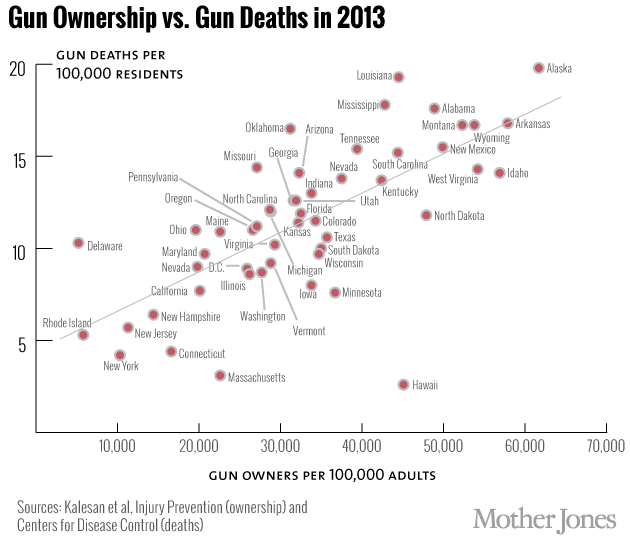
How do you square that opinion with the observation that some of the places with the loosest gun regulations (Oregon, Idaho) also have some of the lowest homicide rates? In Idaho, something like 60%+ of households own guns. But the homicide rate in the capital city of Boise is at Scandinavian levels, 1/10 of the US average. Utah also has high gun ownership and low gun homicides. (Note that this way of looking at the data gets around the notion that you can’t draw conclusions from homicide rates in cities with high control because guns freely flow into them from elsewhere.)
If your statistics are correct, that lends credence to the old saw, "An armed society is a polite society." But that's likely predicated on everything thinking that everyone else is armed (which in high gun control areas would not be the case). Sort of like nuclear weapons' "mutually assured destruction."
> How do you square that opinion with the observation that some of the places with the loosest gun regulations (Oregon, Idaho) also have some of the lowest homicide rates?
Eye-balling this 2015 chart, there seems like there's a pretty good correlation between per capita ownership and per capita deaths (homicide+suicide):
RAND did a (meta-)analysis and found that some policies are more effective than others, specifically: safe storage, waiting periods, background checks, domestic violence history restrictions:
Stand-your-ground laws seem to lead to not-good things happening (nothing about castle doctrine though).
Good laws / regulations can counter high numbers though, it appears. Canada has one of the highest per capita ownership rates, and yet has quite low firearm-related death rate (lower than Finland, the Swiss, France, Austria):
Injecting suicide rates into the discussion is a motte-and-bailey tactic. People make their legal case for regulation by invoking the right not to be murdered as outweighing the right go bear arms, but when confronted with the fact that gun control doesn’t appear to reduce homicides within the US, they shift the goalposts by citing numbers that lump in suicides. But the legal and moral justification for regulating guns to reduce suicides is very different than for homicides.
> There is no correlation between ownership rates and homicide rates:
So?
> Injecting suicide rates into the discussion is a motte-and-bailey tactic.
Or it's simply the fact that I don't want people dying unnecessarily, whether at their own hand or another's. Why should we only worry about homicides? What is your intent in removing suicide from the equation?
Most law-abiding gun owners do not end up misusing them. Aside from sensationalized media coverage, much of the gun violence in our most violent cities (Boston, Chicago, NYC, etc) would not go down with new laws, because many of the crimes are perpetrated by people who are already violating gun laws (not allowed to posses them, illegal modifications, etc).
Unfortunately, with police departments being defunded or restricted, illegal gun ownership and use will only rise over time.
Per capita, that is true. I mostly picked cities off the top of my head by how they are reported in the media, since we are discussing people's perceptions of gun violence.
Also, I think I meant to write Baltimore instead of Boston, but I think the point stands regardless.
Murder has generally always been illegal, yet it hasn't stopped murders from happening. Making new gun laws about how many bullets you get from your military service or how you can transport them won't stop criminals from using them to commit further crimes.
As someone else pointed out, you can still buy ammunition in Switzerland. There's plenty of access to guns. The difference is absolutely one of culture, which is what my point was.
And in a lot of jurisdictions in the US all you need to get a gun in the first place is a pulse, which isn't much of a filter in determining whether a person can actually safely handle one. I'd be curious to know the survey results of owners who could recite Jeff Cooper's Four Rules:
> that would probably save even more lives, but I don't see that happening either.
Your examples strengthen the point I was trying to make: The numbers on drunk driving over the decades, and auto safety in general, are an example of what government regulation with societal support can achieve. Perhaps some day firearm regulation and licensing will achieve the advances that the automobile has seen.
But remember: the US is what it is. There is an insane amount of guns floating around already.
My suggestion is the "Norwegian model" from now on and going forward: to get anything except a manually reloaded rifle or a (max 2 cartridge) shotgun you need a clean record with the police + (and here comes the interesting part:) you need a recommendation from a local shooting club. Oh, and before buying any hunting gun at all there's a mandatory 50 hours training.
I'd recommend trying something similar in the US: tell NRA "we want you to help us".
Parts of HN might hate NRA all they want but my understanding is a good chunk of the people in NRA would love to keep weapons out of the hands of crazy people as every criminal shooting hurts peaceful owners as well.
I very likely agree with you on every gun ppoint, but i do have a question / counter often raised to me - that i don't have to answer to:
How would tight regulations like that look in a large country already flooded with weapons of all shapes and sizes?
I know multiple pro-gun people who seem to compose a large percentage of their pro-gun belief system around the foundation of the inability to remove them. Ie any bad guy who ever wants a gun will always have it (because there's so many), so give more guns to the good people.
What are your thoughts there? I don't really have a counter.
- Refuse sales of ammunition without proof of gun purchase and registration.
- Refuse gun purchase for specific gun types and if a person already has a certain number of guns.
- Mandate and enforce training before gun purchases, with obligatory re-training every X years. Checked at every purchase of ammo and guns. No training, no sale.
- Mandatory licensing for open carry. Mandatory army-level training for concealed carry. With mandatory re-training.
- Buyback and exchange plans for existing weapons.
- Huge fines (not jail time, fines) for non-compliance. Money is a much bigger deterrent than jail time.
CA has most of these already. They just instituted a requirement for a background check for ammo purchases.
One of the biggest problems is your last point - non-compliance isn’t really enforced. If you ask your friend to buy a gun for you because you’re not eligible, the dealer might stop the transaction, but there is a very low likelihood there will be any police follow up.
It is a federal law and occasionally they prosecute the most egregious examples, but I've heard from many gun dealers that when they suspect a straw purchase and report it, the ATF follows up maybe 1% of the time.
Jeeze, they even went after a former police officer? Not saying former cops should get a pass, but you’d think they’d try and make an example out of someone involved in a criminal operation.
The ATF/DOJ loves to make examples out of people even when the case is pretty weak.
You do all this and then find out that gun violence didn't decrease. Everyone will say it worked, but upon closer inspection it is mostly massaged stats. You'll find things like suicides being counted in the statistics for gun violence.
Then what? Do you think anyone would be willing to roll back something like this?
The first point is the key one, but I’d go further, no ammunition sales without passing the new regulations on gun ownership. You can keep your gun, and any ammo you have now, but no reloads until you’re properly authenticated.
All of that is repugnant to the constitution and our natural rights. It will also do nothing to stop violence.
One comment regarding the term "Buyback", the government never owned them they can not "buy" them back. It is simply a euphemism for confiscation. Moreover, you can go to pretty much any gun shop or pawnshop to sell a gun you do not want.
The bad people only need guns because the good people carry them around? How often does having a gun out and about save lives? Not prevent a robbery but save a life? How many times does it escalate a situation?
A sibling comment has already posted a link to Wikipedia.
I couldn't see it mentioned immediately on Wikipedia and it kind of falls outside of the scope of that article too so I'll mention that in addition to people directly preventing crime by pulling a gun IIRC there also seems to be less attempts at crime in areas were there are lots of legal guns.
I think rayiner hints at/mentions that somewhere above.
I honestly don’t like U.S. gun culture at all, but I grew up across from Michigan in Canada and this argument always seemed true. It’s just such a hard problem because of the huge number of guns plus the number of owners the seem to indicate you’d have to kill them to take their guns. It seems like a blood bath waiting to happen unfortunately. I hope I’m wrong.
Compare the level of violence in the (religiously-motivated) swiss Civil War (mid nineteenth century) with the level of violence in the (slavery-motivated) US Civil War (mid nineteenth century). That's part of my argument for culture.
US gun violence probably would decrease if they adopted the swiss system, but good luck getting people who think a two-day hunting license course infringes their 2A rights to agree to a two-year process involving written, oral, and practical tests.
One of the talking points of the NRA is that the US has many gun laws that aren’t really enforced all that well.
The NRA agrees that you shouldn’t be able to buy a guy if you have mental problems, drug problems, aren’t in the US legally, criminal history, etc.
The only one restriction that is strongly enforced is the criminal history because it’s easy to do a check. But the system for mental health checks is a patchwork across states.
And to layer on, if someone does violate these laws, there is often no punishment. Straw purchases are a good example - it usually falls on the dealer to stop the transaction, but there is rarely any police follow-up.
True. They certainly do prosecute some straw purchases.
But I guess my point would be - if they actually followed up on all straw purchase attempts (even just a call from the ATF saying “yeah, that’s illegal, don’t do that”) you could at least say the law is being enforced.
Right now the most likely outcome is the dealer just refusing the sale. You’re free to tighten up your game and try another dealer.
"My Swiss friend in town told me as far as he knew Switzerland still people keep fully functional assault rifles at home but those who have them need to show up for three weeks of training each year and show up at a shooting range twice a year. (He left a few years ago so anyone actually living there now should feel free to correct this.)"
That's new law due to Schengen. If you had a gun before, you don't need to do this. Three weeks is probably the compulsory military service.
I would say that most social problems are cultural. The culture is what defines what kinds of options people think that have in their life. When something isn't part of your culture you're less likely to think of it. Ie gun violence being very common somewhere means that people are more likely to resort to gun violence. We observe this effect with suicide too. I believe that gun violence, stabbings, acid attacks, bombings, terror attacks with cars etc are all like this.
Also, if the army thinks someone is getting a bit extreme, they will say "congratulations! you don't need to pass the shooting test next year ... and, by the way, please return your service rifle."
You are spot on. Swiss males having gone through military training at the age of 18, are used to guns. Though they keep their weapons in the basement or under their beds they do not treat it like a toy. When soldiers go for their training it is common to see a bunch of fairly young men boarding trains with heavy backpacks and a gun. A certain amount of respect for guns is drilled into them: you do not use a weapon carelessly.
I don't think there is any chance in hell that the US adopts and of the mechanisms described in the article, but the one thing we could adopt is a culture that discusses politics. Of course our politics are such shit when no one discusses them. Three months away from a presidential election and still no issues have been discussed by the candidates. Come to think of it, we don't actually have issues to discuss. We have a ton of problems but no one wants to discuss solving them. The problems don't become issues. They just stay perpetual problems. It's just vote for this one guy who won't address your issues and maybe won't fuck shit up too badly or vote for another guy who won't address your issues and will try to make life as miserable as possible for almost everyone.
It's taboo to discuss issues, in fact, so it's no wonder things only get worse. The people have so little power, it's really just theatre. Issues with 60%, 70%, or more public support routinely get ignored by the so called representatives. And as a culture we don't use the one tool we do have: discussion of issues. I suppose it fits in nicely with our tendency to have theoretical rights that only exist on paper. What good is the first amendment when there's nothing to discuss and no one willing to discuss things even if there was?
Folks on opposite sides of the pond have caricatured ideas about each other, because their impressions are based on anecdotal media representations. Compounding that is the fact that “parties” are very different things in the US system versus the parliamentary system. Parties in Europe have a lot of control over who runs under their banner. American parties do not. If the Republican Party operated like European parties, where the leadership selects candidates, the 2016 candidate would have been Jeb Bush of Marco Rubio, not Trump. But in an objective analysis, the Republican Party is solidly to the left of the SVP: https://www.nytimes.com/interactive/2019/06/26/opinion/sunda.... It’s on the right edge of the mass of European center-right parties. (I would argue that this analysis somewhat overstates how far right the Republican Party is. As the article notes: “The Republican platform does not include the same bigoted policies, and its score is pushed to the right because of its emphasis on traditional morality and a ‘national way of life.’” Americans are by far the most religious developed country. In France, arguing for the maintenance of traditional French social norms is something you can do in a secular framework. Under the analysis of this survey, that doesn’t count as right wing. But there is really no way to express that same idea in the American framework while leaving religion out of it. But in this analysis, that counts as right wing.)
I’ll add that Americans are in a different stage of the same overall trend we’re seeing in the developed world. Even right-wing platforms in France or Germany have never needed to call for adherence to traditional French or German values, because it was taken for granted. 80% of Germany is still ethnic Germans. Another 10% are other kinds of Europeans. In the United States in the United States only 60% is of European ancestry, and even among those people you’ve got a mix of British, Germans, Italians, Irish, etc. European countries aren’t really multi-cultural the way America is, so there is no need even for right wing parties to make culture an issues. French being the national language of France has overwhelming acceptance (90%+). There was never a reason for right wing parties to even bring it up. But in America, making English the national language is a right-wing talking point, because Americans don’t take it for granted.
But taking culture for granted is something that is rapidly changing in Europe. Le Pen got 30% in the last French election. Now she’s polling at 45% in a head-to-head with Macron. The dominant CDU in Germany is bleeding members to AfD. The new leader of the CDU is significantly further right than Merkel: she opposes abortion and gay marriage, and declared the 2015 acceptance of refugees as “a mistake” that they’ve “learnt from and won’t repeat.”
I don't think the rise of the AfD in Germany has much to do with a reduction in ethnic or cultural 'purity'.
The general political consensus position in Germany has shifted considerably to the left over the last 30 or so years. This has alienated some people and the AfD is the recepticle.
Much of the rethoric employed by the AfD could have been found in the CDU just 10 or so years ago, including appeals to German culture as you mentioned. "Leitkultur" was one famous topic of debate. Other classics include "Kinder statt Inder", and "Das boot ist voll".
The influx of immigrants tends to precipitate disagreements within parties that to date were theoretical up to that point. That's what happened with the Republican Party. The George W. Bush/Romney/Jeb Bush wing courted Hispanic voters, with W. winning 40% in 2004, and Jeb carrying 60% in his Florida gubernatorial election. Then, the more nativist elements upset the applecart in 2016 by nominating Trump, who was opposed by the Republican establishment. Those nativist elements were always there--but the undocumented immigrant population increased 40% during Bush's tenure and changed the internal dynamics significantly.
So would you predict a correlation between number of immigrants in a county/state/country and nativist electoral success? I don't think that is the case.
I get that immigration is a hotly debated culture war topic, but I am not convinced by the argument that immigration is the thing that is causing the culture war.
I'm not really talking about electoral results. I'm talking about the NYT articled I linked to, which measures "how right wing" a party is by looking at what's mentioned in the platform. But what's mentioned in party platforms is a product of what debates are happening in society. In places without much immigration, immigration isn't a focus of politics and won't warrant merit on party platforms, even if the members of the party would have strong nativist views if there was actually a significant amount of immigration.
For example, in the United States, "making English the official language" was a hot-button political issue for a long time (before even Republicans gave up on it). In France it wasn't, because nobody disagreed that French should be the official language (and it was). So if you read party platforms to gauge right-wing views, you might conclude that the French aren't right wing on this point, because party platforms don't mention it. But in reality, it's not mentioned because it's not something that's even up for debate.
It's not necessarily as nativist as you'd think, because « la francophonie » is more inclusive than those who can say « nos ancêtres les Gaulois » with a straight face.
> The one that got so unpopular that she's already announced her resignation earlier this year?
AKK's resignation was not due to her conservative views, but rather because CDU cooperated with AfD in Thungria to keep a left candidate from being elected, which is taboo within CDU. She was seen as being unable to maintain party discipline. The current front-runner appears to be Markus Söder, from CDU's even-more-conservative Bavarian sister party. Söder has taken hard-line immigration positions, ordered public buildings in Bavaria to display Christian crosses, and oh showed up to a party a few years ago dressed up like Ghandi in full brown face: https://www.independent.co.uk/news/world/europe/markus-soede...
> There was then a sharp decline in her popularity following gaffes and electoral defeats for the Christian Democrats in several elections. As of February 2020, she is one of the least popular German politicians
It's even on wikipedia, but still you make some definite conclusion.
> But AKK had to fend off an unexpectedly strong challenge from the ambitious Friedrich Merz, who is favoured by the CDU's most conservative wing.
> AKK initially sought to carve out her own profile in a party thirsty for change after years of Merkel's moderate course in a loveless coalition with the centre-left Social Democrats.
> She notably championed a tougher stance on asylum seekers and floated the idea of reintroducing compulsory military service. She also spoke out against gay marriage.
> AKK was badly weakened by a string of bruising election results, particularly in eastern Germany's former communist states, where the CDU bled support to the anti-immigrant AfD.
All that just reinforces my point about German politics becoming more right-wing: "The new leader of the CDU is significantly further right than Merkel: she opposes abortion and gay marriage, and declared the 2015 acceptance of refugees as 'a mistake' that they’ve 'learnt from and won’t repeat.'"
People aren't leaving CDU for SDP. They're going to AfD. AKK walked back Merkel's acceptance of refugees, but the leading contenders to replace AKK look like they'll be even more right-wing. So I'm not sure what you're disagreeing with me about?
> So I'm not sure what you're disagreeing with me about?
That you're trying to spin a narrative where the US Republicans are not considerably more to the right than even the right-wing parties of Europe.
AKK was even considered to be on the economic left-wing of the CDU? Sure, she had socially conservatives idea based on religion which is a shame but even the CDU's "family centered politics" would be considered a Bernie Sanders welfare state by the US conservatives.
People aren't necessarily full blown reactionaries like the US Republican party just because they have cherry-picked conservative ideas.