About 25% of the country lives in abject poverty, despite the fact that the country is doing over $10 billion in profits on $30 billion of revenues for oil.
Before I analyze, let me lay my cards on the table here philosophically - I'm a classical liberal, but I'm kind of flexible in my positions - I think a diverse set of governments across the world is good, and then let people vote with their feet. Different structures work for different people - I wouldn't want to live in Norway's system, but I think Norway's system is awesome for most Norwegians.
Now, let's talk about Venezuela. I think Venezuela is one of the most criminally misgoverned places on the whole planet. There's more violent deaths in Caracas in any given month than Baghdad. Baghdad, dude.
This is my beef with the sort of government Venezuela has - I think it's very conducive to degenerating into rule-by-bandit, which is what they have. (I'm in Vietnam, which is also under rule-by-bandit)
The biggest argument against Venezuela's sort of government isn't necessarily abstract philosophy - it's that it doesn't really work well in the real world. I think Venezuela is criminally misgoverned and in desperate need of change.
You and I are probably very, very far apart in political philosophies, but I wanted to write this anyways.
I'm kind of vaguely of the belief that capitalism + strong welfare state can work for some people, especially with a population that has similar goals and unified culture. There's downsides to it, but there's downsides to everything. But I'm pretty damn sure that the Venezuelan model leads to rule-by-bandit, leaving many people impoverished, and explosive growth in crime and violence and unrest. I don't know 100% what my goal here is with this comment - I guess just to put some numbers and views on the table. I think the Venezuelan model is a disaster for Venezuelans, and indeed, the whole world. I think everyone should work together against governments like Venezuela, North Korea, Libya, places like that, even if you'd like to live somewhere like Scandinavia. Venezuela ain't no Scandinavia.
It's the same in South Africa, that other glorious example of modern democracy that is also the rape capital of the planet.
It's basically the left wing version of how right wingers support military despots, except in left wing movements that have gone off the rails the criminal underclasses thrive, as they are used as a paramilitary against their enemies. See Hobsbawm's works on social banditry for the history of this, also see Tom Wolfe's Radical Chic & Mau-Mauing the Flak Catchers.
Of course, if you point this out to "progressives" they'll call you a racist, as successful revolutions against "the man" are considered sacred.
Of course, if you point this out to "progressives" they'll call you a racist, as successful revolutions against "the man" are considered sacred.
Only in strawman world, apparently.
I find your comment to lack nuance. I'm opposed to Chavez, I think he's a failure as a leader. However, there's a false dichotomy that's often created in discussions such as these.
There are economic and social principles that I find to be positive for countries like Venezuela. If I say that I support those principles, many people (such as yourself) have a hard time not reading that as support for Chavez as a steward of those principles. Even though nothing I said in my comment about Chavez was positive in any way.
On the other side, if I state that I'm opposed to Chavez, that doesn't mean that I would support things like privatization of their oil reserves, or a dismantling of the social welfare programs or a move away from neighorhood democracy, all of which I think are important programs for pulling a country like Venezuela out of poverty and disarray and into a state of social health and prosperity.
> There are economic and social principles that I find to be positive for countries like Venezuela. If I say that I support those principles, many people (such as yourself) have a hard time not reading that as support for Chavez as a steward of those principles.
If the principles have been tried in dozen of countries over the last 90 years, and the results most of the time have been much worse than capitalistic countries like the U.S, then maybe the principles should not be used to organize a society or a government until there is fundamental progress on the art of governance.
Yes, I saw your reference to Rwanda. I doubt the accuracy of the stats on Rwanda. None of the dozens of expats and world travelers who post here and no one I have seen anywhere else on the internet has said anything positive about the prospect of living in Rwanda.
and the results most of the time have been much worse than capitalistic countries like the U.S
Social democracy has as much of a claim to success as anything the U.S. has done. And I'm talking about principles like education, health care access, food and water access, infrastructure investment, and direct democracy.
It seems to me if you're referring to "principles" such as central planning and autocracy, which is not what I'm referring to, then I would agree that those have been obvious failures. But if you read what I've written, nowhere did I praise those principles.
So I would ask what principles you think I'm referring to?
about the prospect of living in Rwanda.
Compared to 15 years ago? This isn't about comparing Rwanda to countries which have been stable. If you follow their trajectory towards community-driven healthcare (which has adopted the Partners in Health approach), and building an information infrastructure, it's a positive trajectory. You can't take that away simply because people still prefer to live in the U.S. or Europe.
But I'm pretty damn sure that the Venezuelan model leads to rule-by-bandit
I think you should maybe re-read what I wrote. Most of my praise for Venezuela is in it's Bolivarian principles, but it's application has not been desirable. I agree that it has been totally mismanaged.
You'll notice, however, that my suggestion for Venezuela wasn't the Venezuelan model, but a mixture of Lulaism and the Norwegian model.
Venezuela ain't no Scandinavia.
And there's reasons for that. But that doesn't mean that Venezuela can't move towards a functional social democratic model.
In fact, there's no better example than Rwanda, a country that 15 years ago, was hacking itself apart, and has been able to move in very different direction in that time.
More than 1 in 100 adults in the United States are in prison. The United States has less than 5% of the world's population and 23.4% of the world's prison population.
The 2009 U.S. military budget accounts for approximately 40% of global arms spending and is over six times larger than the military budget of China. The United States and its close allies are responsible for two-thirds to three-quarters of the world's military spending (of which, in turn, the U.S. is responsible for the majority).
From wars against the Mideast, healthcare, the environment, teachers, working class, democracy; and in favor of corporations, capitalism, etc... Many (maybe most, like myself) here are from the US, and I think the US's wealthy elites are a greater threat to the world than teachers unions and Venezuelans. So let's focus on not only what we're in a position to affect — as citizens with above-average power and privileges — but what matters too.
"The United States has less than 5% of the world's population and 23.4% of the world's prison population."
Did you ever stop and think that if some of the other countries mentioned weren't so corrupt, they might also have a higher prison population? Our system is pretty, damn fair, even though once in awhile it fails and an innocent person goes to prison.
"The 2009 U.S. military budget accounts for approximately 40% of global arms spending and is over six times larger than the military budget of China. The United States and its close allies are responsible for two-thirds to three-quarters of the world's military spending (of which, in turn, the U.S. is responsible for the majority)."
The US has to babysit the world. I wish it wasn't the case, but most countries do not have their shit together.
"US's wealthy elites are a greater threat to the world than teachers unions and Venezuelans."
Teacher's unions directly threaten good education, which can lead to uneducated citizens and poverty. It's very difficult to get fired while you are in a teacher's union and there is no incentive to actually teach well. I've seen the same thing happen in the auto unions. It's like a mini example of why communism doesn't work (everybody is equal and since you not only get an automatic raise every year, and everybody in your department/position needs to get a raise if you do, it offers no reason to actually do better).
Capitalism isn't a bad thing. It's provided the best standard of living the world has ever seen. There may be some problems with it, but we shouldn't discount it as a whole.
I don't know how you can say the US is against the environment. If you mean global warming, then yes. Global warming isn't a religion. I need more evidence than what we have (which is based on falsified data) to prove that it's man-made. It's also become such a politicized issue, that if you are a scientist and go against it, you can lose funding from the government and respect from your peers. Nobody scientist would want to do this.
Compare us to the UK, but compare like for like. Most of our prison population is comprised of high crime groups who do not exist to any significant degree (35% of the US, 2.6% of the UK) in the UK.
majority of the prison population in the US comprise only 2.4% of the UK.
I'll point out another statistic which doesn't look good for our incarceration rates, regardless of the racial demographic argument you're making:
Half of all persons incarcerated under state jurisdiction are for non-violent offenses, and 20% are incarcerated for drug offenses, in State prisons. Federal prison percentages are higher.
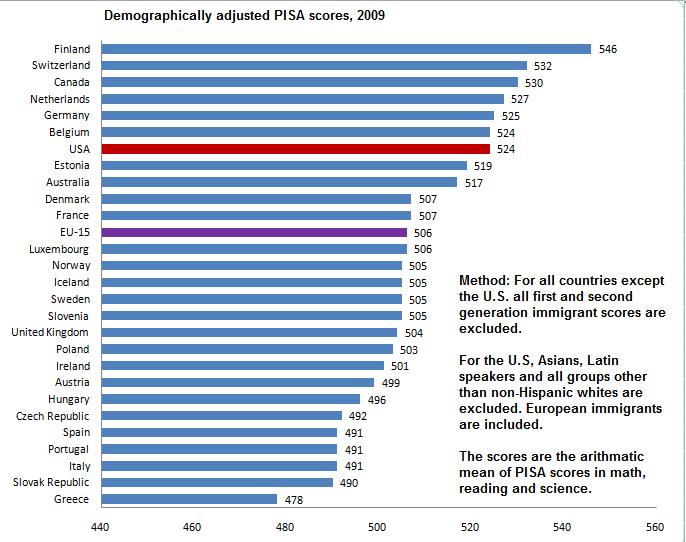
Teachers unions haven't seem to hurt Finland (#1 in education), and auto unions haven't seem to hurt Germany. Theirs are much stronger than our respective unions.
The point is that you can easily have a functional education system with strong teachers unions. Canada, Europe, most of the western world functions this way. To say that our education woes are due to teachers unions is short-sighted at best.
The issue with education in this country is in it's structure, funding, allocation, and methodology. Unions are a scapegoat for a larger philosophical failure in our approach to education. If people really cared about education in this country, they would look hard at how Finland moved away from the industrial model and towards one much more suited to an information economy.
As for Finland, their system only seems to work well for Finnish people. The gap in PISA scores between natives and immigrants (Gen 1 and 2, I believe) is almost 50 pts, vs about 20 in the US. This might work for Finland, with relatively few immigrants, but it wouldn't fly in a country like the US.
(For comparison, the demographically corrected PISA gap between the US and Sweden is 19 pts in favor of the US.)
Hypothetical: if teacher A has a class of poor black students, and teacher B has a class of rich asian students, shall we directly compare test scores? If teacher A's students perform 1 stddev worse than teacher B's, shall we fire teacher A for poor performance?
If you don't want to do it for teachers, why do it for educational systems?
I'm sure that's how you see it, but the fact is, that the OP posited the idea that unions were incompatible with a healthy education system. There are simply too many counter-examples to that.
Further, you've pushed the conversation into a discussion about race and class by way of an abstract hypothetical. From your posting history, I'm not really interested in having such a complex discussion with you.
> Our system is pretty, damn fair, even though once in awhile it fails and an innocent person goes to prison.
From Wikipedia, in Illinois, 12 men had been executed since 1977. During that same period, 13 men were freed from death row i.e. greater than 50% of the convicts facing the maximum possible penalty were actually found innocent.
Was anyone on Death Row ever found innocent in my state?
There have been a total 18 innocent people exonerated on Death Row in Illinois. Perry Cobb was released in 1987...
So, now you have an idea about the rigorous standards of evidence employed before handing out the death penalty. This should give you an idea about how many innocent people are convicted every day for lesser crimes.
And to see the mechanics of how so many innocent people get convicted, check this
A large percentage of convicts in prison are from drug related crimes. For information from Lancet - "Drug harms in the UK: a multicriteria decision analysis" regarding harmfulness of drugs
> The US has to babysit the world. I wish it wasn't the case, but most countries do not have their shit together.
I don't want to even bother refuting this, but the US is an economic entity that seeks to maximize its economic advantage, not a baby-sitter. It pretends to baby-sit by force but that isn't how baby-sitting works, most baby-sitters don't have a fire-arms license.
> I need more evidence than what we have (which is based on falsified data) to prove that it's man-made.
There is enough evidence, even when after eliminating whatever falsified data that had crept in. We are interfering with the Carbon-cycle and it will lead to more CO2 which will have a warming effect. You can sit around waiting for more evidence and when warming happens you can blame it on Sun spots or whatever, Are you also waiting on more evidence for heisenberg's uncertainty principle?
"most baby-sitters don't have a fire-arms license."
I didn't mean this literally. The US needs to use force because other countries either don't have the ability or refuse.
"I don't want to even bother refuting this, but the US is an economic entity that seeks to maximize its economic advantage, not a baby-sitter"
What country isn't trying to maximize its economic advantage?
"You can sit around waiting for more evidence and when warming happens you can blame it on Sun spots or whatever, Are you also waiting on more evidence for heisenberg's uncertainty principle?"
Can I use this argument for anything I don't agree with. I'm asking for evidence and you are telling me that I shouldn't be sitting around and waiting for it. I'm also not blaming it on sunspots, I'm basing it on real evidence.
Since the subject has been so politicized, and supporting it means billions of dollars in funding (or lack there of), I question any scientist that is involved in it. Especially when we have zealous believers saying that anyone that questions it (even when there is evidence to the contrary) is a moron.
When you take things like carbon credits and forced government taxes out of it, I might start to stop questioning motives. It's also funny that a guy like Al Gore, who is essentially passing carbon credit laws that will put money directly in his pockets, is lauded as a hero and a genius.
"A large percentage of convicts in prison are from drug related crimes."
If you smoked meth and then murdered a family, does that count as a "drug-related crime". You seem to be implying that people that are just smoking a joint are filling our prison systems, when those people make up a very small percentage.
(Seriously, I was expecting some relativist argument, but this is not even that. I'm surprised there's no mention of obesity rates as well, while we're at it)
Sure it is. The article was written by a US media corporation; that post I responded to advocated overthrowing Venezuela's government; and since many of us are citzens of the US, we should maybe deal with the real problems that we can affect, rather than go around attacking others.



Homicides per 10,000 people, 1983 to 2003:
http://bit.ly/hmivsb
http://bit.ly/gOATzm
Starting in 2004, the government prohibited release of the figures.
http://www.state.gov/r/pa/ei/bgn/35766.htm#econ
About 25% of the country lives in abject poverty, despite the fact that the country is doing over $10 billion in profits on $30 billion of revenues for oil.
Before I analyze, let me lay my cards on the table here philosophically - I'm a classical liberal, but I'm kind of flexible in my positions - I think a diverse set of governments across the world is good, and then let people vote with their feet. Different structures work for different people - I wouldn't want to live in Norway's system, but I think Norway's system is awesome for most Norwegians.
Now, let's talk about Venezuela. I think Venezuela is one of the most criminally misgoverned places on the whole planet. There's more violent deaths in Caracas in any given month than Baghdad. Baghdad, dude.
This is my beef with the sort of government Venezuela has - I think it's very conducive to degenerating into rule-by-bandit, which is what they have. (I'm in Vietnam, which is also under rule-by-bandit)
The biggest argument against Venezuela's sort of government isn't necessarily abstract philosophy - it's that it doesn't really work well in the real world. I think Venezuela is criminally misgoverned and in desperate need of change.
You and I are probably very, very far apart in political philosophies, but I wanted to write this anyways.
I'm kind of vaguely of the belief that capitalism + strong welfare state can work for some people, especially with a population that has similar goals and unified culture. There's downsides to it, but there's downsides to everything. But I'm pretty damn sure that the Venezuelan model leads to rule-by-bandit, leaving many people impoverished, and explosive growth in crime and violence and unrest. I don't know 100% what my goal here is with this comment - I guess just to put some numbers and views on the table. I think the Venezuelan model is a disaster for Venezuelans, and indeed, the whole world. I think everyone should work together against governments like Venezuela, North Korea, Libya, places like that, even if you'd like to live somewhere like Scandinavia. Venezuela ain't no Scandinavia.