3-1-1 is rarely enforced. I always got confused why the 100ml limit existed, since I could just take multiple bottles of 100ml of whatever I wanted and it was okay. Then I realized that technically I only could take 3 bottles but I’ve been getting away with more for decades.
> Amazon has about 350,000 corporate employees and a total workforce of approximately 1.56 million.
Is it mentioned anywhere that the roles eliminated are all going to be software engineers, because that’s what all the threads so far are interpreting this as. This feels more like preparing for a recession without saying it out loud. People aren’t buying as much anymore and with focus on cost savings across tech, can easily understand AWS not covering for lower retail revenue anymore.
Whether people like to admit it or not, very rarely do people work for anything but money and career advancement. You can claim you work for passion, the love of the game or whatever 100 other reasons people tend to give out. All it takes is 2 years of no raises and a couple of promotions for colleagues for you to start not wanting to work for whatever reason you convinced yourself you were working for.
I think that becomes more common with income brackets that can start to feel like "enough".
If you've spent time struggling to make ends meet, even median income can feel like previously unimaginable wealth and security, and workplace satisfaction is rarely something that you had a great deal of choice around. If you've spent most of a decade making six figures with benefits, it's easier to decide an extra 10k or even 50k isn't worth the added stress.
Cost of living and personal situation (dual incomes, dependents) can shift that needle around quite a lot too.
The only reason money comes second is because they’re paid enough. And even with enough money, like I said, two years without a raise while everyone else gets it, suddenly social life isn’t going to be that important.
No, I have plenty of friends who are not making enough (and could be making double) but due to being risk-averse and relatively content stay in low-paid jobs. Only a crisis moves certain people from their comfort spot.
Its incentives. If you’re an Indian student in India, unless you go to a prestigious university, your prospects of landing a job, let alone a good one are very small. Even tech companies that claim to be meritocratic elsewhere, rarely screen resumes beyond the top universities in India. The only other real prospect is to get your resume to stand out. Open source contributions, research papers etc are some ways to do that. And the talented ones make contributions, while the rest just try to fake it in the hopes to make it (it obviously doesn’t work).
There are similar incentives if you want your college application to stand out if you’re trying to go abroad for higher education. And if you’re already outside India, those incentives extend to job applications outside India. If you’re an international student looking for a job, even if you have work experience at known multinational companies, if it’s in India, the experience doesn’t count.
> Yes, it seems cruel and also counter to ensuring the org succeeds. Your perceived ability as an engineer might go up if your colleagues fail, but your colleagues failing when you knew a possible way for things to go better is harmful to your org's goals and culture
In hypothetical situations where every single person has good intentions, sure. Human beings are complex and sometimes, this doesn’t sit well with others. I personally know of someone who when did this, ended up with a manager escalation and eventually losing their job. Because someone else felt their competence being questioned and took it as an opportunity to get someone who tried to help, get fired.
Sometime a good deed doesn’t go unpunished. Corporate culture mostly dictates that only help when asked, when it will come back to bite you, or if the you know the people who are being helped closely. Everything else, don’t get involved.
I think the ALICE index is great for tracking pure essentials and survivability, which is definitely important, but it's also not unreasonable to track things that aren't 100% essential.
My household does care if basic games and toys are cheaper or more expensive; we have kids and want to get some amount of stuff for them. If the price changes we will get more or less of those things since our budget for them is limited. I probably won't fall into abject poverty if some non essential things go up in price, but I also will be buying less which has both personal and broader economic impacts.
Absolutely. You need both. The point I’m trying to make is that we only have CPI which drives most policy decisions. However when you need about $40k to just survive and 1/3 of the households make less than $50k before taxes, you also need something like this to make effective policy decisions. Social security payments are a great example. If you adjust them only based on CPI, and essentials get more expensive at a higher rate than non essentials, you create a system where over a period of time, social security payments would barely cover the essentials.
The CPI published (and in headlines) isn't about your personal spending, but the spending on average spread over millions of people/households. The CPI is a model of reality, and so pointing to a particular instantiation of consumer will not match exactly:
This isn't really indexing in the same way that the CPI is indexing.
Alice pulls medians from other surveys (so it uses what I assume to be CPI food and CPI housing data, though they may also use other things), and then includes childcare and healthcare costs with some (imo) pretty painful assumptions, and then tacks on a random 10% "misc" category. It does a good job of creating a very high estimate of costs. As one example, I looked at the housing cost for an suburb I'm familiar with, and it lists the housing cost for a single individual as nearly $1800, you can pretty easily find 1BR apartments for 1-1.2K in that area, and utilities aren't going to run $600/mo, and you can pretty easily go cheaper.
And then again after doing that it tacks on a "misc" 10% budget item. I wouldn't call it a good estimate of "what people really need" and also it consumes the basket of goods, it doesn't compare to it.
> Most households are able to afford more than the essentials and do care about the cost of entertainment.
1/3 of the households make less than $50k. Mean survival budget is $35k-40k. After taxes, if a third of the population can barely meet a survival budget, an index like this needs to be part of the overall economy.
And the point of the ALICE index is exactly to address what you are pointing out. When wages, social security etc. were increasing proportionally to the essential goods, it made sense to have the CPI include other goods and services, allowing policy makers to use it as a basis for policy directions. However, when essentials become expensive faster than non essentials, it creates a problem for policy makers. It explains the “vibeflation” where policy makers were pushing back hard on economic struggles that most people are feeling by pointing to CPI numbers that show a 2-3% inflation, meanwhile people are struggling and dipping into savings to make things work.
Beyond just the monthly/yearly changes are the cumulative affects of those changes and disparities of wage stagnation with record inflation over time. Increased rent/housing costs are also a massive factor.
Not even counting the number of households who are at credit card and other debt limits at close to 30% interest. Trump has given some lip service to trying to get this down to 10%, but it'll really take congress to make anything happen that has a chance of sticking.
Thinking about the “overall economy” increasingly means focusing on the spending of the rich, and ignoring the poor and struggling. A consequence of increasing inequality is the rich make up more and more consumer spending. Consumer spending can therefore easily look great while most people are struggling to get by. There really is no “overall economy”, there are many many different stories happening all at once, and focusing on simple metrics lets you easily fool yourself.
> Thinking about the “overall economy” increasingly means focusing on the spending of the rich, and ignoring the poor and struggling. A consequence of increasing inequality is the rich make up more and more consumer spending.
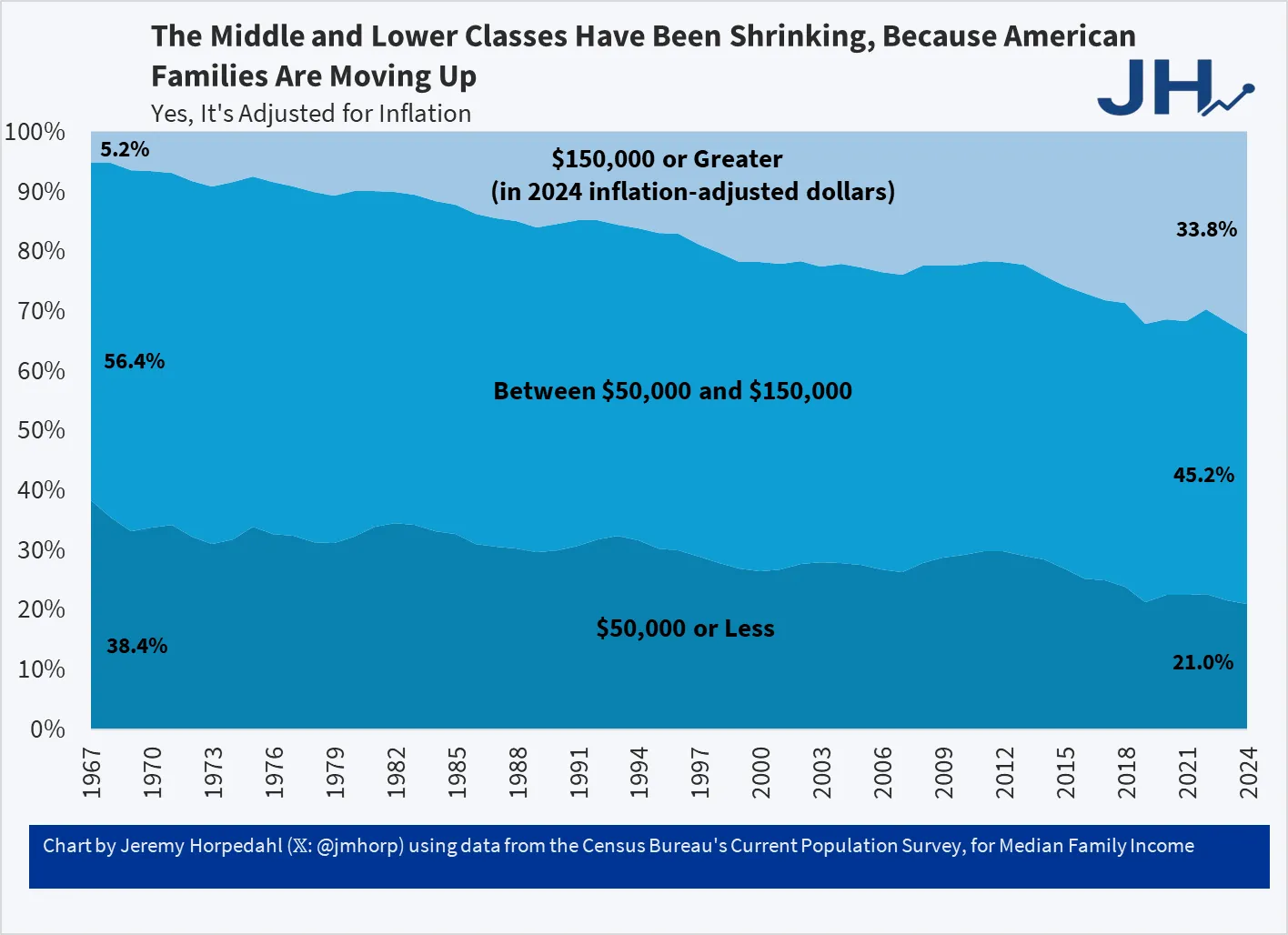
It means increasingly focusing on the spending of the rich, because the population is increasingly richer. Proportion of families making more that 150k (in 2024 dollars) has gone from 5% in 1967 to 33% in 2024, while both middle class (50k-150k) and poor (<50k) have decreased. [1]
Great example. The population as a whole is richer like you say, and also the richest 10% account for half of consumer spending, compared to 36% 30 years ago. [1] So yes, consuming spending has become more of a metric of the wealthy’s spending habits.
No single metric tells the whole story, and by taking them in isolation it’s quite easy to lose the forest for the trees.
It doesn't make a lot of sense to measure the cost of entertainment in terms of monetary inflation though. Hugely price-tiered status-signaling goods like kids toys just don't respond to market forces in the same way commodities do.
People could save so much money if they bought used instead of new more often, especially toys. It's crazy how much garbage we produce basically just because we literally don't share our toys.
In the grand scheme of things, toys are cheap and kids are huge influences on parents. I don't think pinching pennies on toys will change much unless that toy is an iPhone.
I have come away from Christmas with almost the opposite conclusion. I have 3 young kids, and I notice almost an inverse correlation between the number of toys around and how contently they play.
The ideal number of toys is non-zero, but my experience suggests that it is pretty low.
Toys/gifts are important, but you'll find most of what you need (baby toys to bicycles) for pennies on the dollar at your local yard sale, estate sale, or free as hand-me-downs from an older family.
I would hesitate to include the retail prices for these kinds of goods to a CPI type metric because the price are incredibly flexible.
So many that I can't play with all of them, most of them are broken, and I don't have time to fix them, so I get really depressed because they aren't usable when I want to play with them. Now I'm trying to get rid of most of them.
Mostly sarcastic, but I don't think it's a hot take to realize that the curtain has shifted substantially over the decades in terms of how to raise a child.


reply