The article falsely assumes that the HOV lane has spare capacity. During rush hour here all lanes are equally clogged, and sometimes the HOV lane is actually slower than the other 4 lanes. The only way to fix LA traffic with current infrastructure is self driving car pools. If/when they can get to the point in which they are safer than normal drivers, and safe for the riders (crime inside of self driving cars) LA traffic will be solved. This will eliminate the necessity of having a car allowing for increased taxes on car ownership, reducing traffic on the roads.
True ride-sharing could also help, and sooner than self-driving cars. Uber and Lyft talked about matching departing commuters in real-time, which would greatly reduce the inflexibility that makes traditional carpooling so unpleasant. I'm not sure why that never took off.
I'd guess because people would rather have the certainty of getting to work in 1.5 hours, rather than wait for a stranger to pick them in a semi-determined block of time (or pick up a stranger in the same) for a 1 hour commute.
Waiting and hoping that the person who promised to pick you up will actually do so seems annoying and nerve-wracking. "Sorry, boss, I know I'm late again, but a complete stranger was 30 minutes late picking me up today, and then decided to stop for donuts on the way to work."
> rather than wait for a stranger to pick them in a semi-determined block of time
I think the idea is that it's supposed to match you in real-time and give GPS updates, just like regular Uber and Lyft. That is, it's not like BlancRide in Canada (which has been struggling) where you schedule in advance, have blocks of time, etc.
> Waiting and hoping that the person who promised to pick you up will actually do so seems annoying and nerve-wracking
Unlike most carpooling services, Lyft and Uber have strong reputation mechanisms that can greatly reduce this. You can always fall back on a taxi or normal Uber for couple times a month when the driver is flaky.
Sorta. Unlike a normal Uber driver, the carpool driver (1) specify their rough route, (2) can decline riders without penalty, and (3) isn't paid as much (basically enough to cover gas, I think). But yes, the pick-up/drop-off interface was supposed to be more or less the same.
I've taken Uberpool for longish distances around LA (mostly between ~Beverly Hills and the Valley), and it suuuuucks. Having to get off the freeway and get back on to pick up people adds a ton of time to commutes that aren't that long from the LA perspective.
Agreed, and that's always very important. I'm just skeptical of how high the density of use would have to be for this to make sense; and even then, LA just may be unconducive to this kind of an infrastructure. As people have mentioned elsewhere in this thread, making the freeways necessary conduits to get anywhere in a timely manner just screws up getting around period.
If the HOV lane is gridlocked, that means the price to use the HOV lane is not high enough. Keep raising the toll until traffic in the HOV lane moves at the desired speed.
By "price", you point out that California "HOV" lanes... aren't.
"Carpool/HOV" lanes have been political toys from the start. A true carpool means more than one would-otherwise-be driver per vehicle. A minority of HOV lane users in CA have more than one licensed driver. The rest are "kidpools", "hybrids" (which, for all but the first 10-30 miles on a charge are less efficient than non-hybrids), "non-polluting vehicles" (pure electrics, CNG, fuel cell), buses, and government vehicles.
Such lanes are now as crowded as conventional lanes more often than not.
Actual trip reduction could be obtained by limiting HOV use to actual carpools (>1 licensed driver) and buses with passengers, and narrowing their hours of exclusivity a bit.
They set a max price on those lanes because otherwise poor people would get stuck in even worse traffic while rich people would be able to move quickly. That's already true but they are trying to minimize the disparity between rich and poor.
You could also make the argument that a rich persons time is worth less because they can afford to hire people to do what poor people have to do themselves, like clean the house or go shopping or drive their kids around. They are also more likely to have a job that can be done from home.
Depends on the HOV lane. The Fastrak lanes on the 110 south of downtown are regularly moving at 45+ mph, regardless of the state of the other lanes. There are two HOV lanes each direction, often separated by grade.
I drive every day on the 101 and deal with the worst of the worst for >20 miles each way. I was hoping someone would mention this!
This toll plan is foolish at best and detrimental otherwise. We need incentives for car pools bad! Last count (I carpool and for fun we sometimes count cars' occupants because traffic is always a discussion) out of 46 cars we saw only 2 with multiple occupants. This is the major problem.
Here's my idea: Rather than high-occupancy lets make the left lane a guaranteed-speed lane. The rule is that all cars in the lane move at 80 mph. If you can't merge in or out of the lane is such a way that no one else has to brake, then you're not allowed to merge. You're not allowed to slow down unless there's an emergency and those will be rare because users will be required to maintain their vehicles in top condition and crashing is strictly prohibited.
This will dramatically increase the throughput of the lane and will inescapably lead to an increase in usage. But the increase will naturally be capped around 20k cars per hour per lane.
To make it work, you'll need precise data about conditions far ahead and far behind. You'll also need an inescapable enforcement mechanism or the system will succumb to cheating. The good news is that very soon many cars will be covered in sensors, networked and able to implement the concept.
I don't actually think the concept is a good one (it's unworkable without a level of automation at which you'd have much better alternatives) but the exit problem is already frequently addressed with HOV/bus lanes—have dedicated left-sode exits so they don't need to cross the slower lanes to exit.
I agree advanced automation would be needed to maximize capacity. A basic system only needs cruise control, lights and cameras installed at the merge points and a transponder like fasttrak that monitors your speed and automatically fines you if you hit the brakes.
Adaptive cruise control, lane assist, higher standards of maintenance and driver skill don't seem like too much to ask of a select group of people and vehicles licenced to use the lane and would help to maximize capacity and minimize incidents without getting too futuristic.
If they are needed, they might as well be paid a decent wage.
If they are not, they might as well close down -- living close to subsistence levels with 2-3 part time BS jobs is not any long term solution.
It might be worse for those people short term, if they are fired from those jobs, but at least it would reflect the true issue in the economy/employment, instead of hiding it under the carpet (in that below $xx jobs are not a solution). And then there could be actual corrective measures and policies, instead of feeling complacent while people make pittance.
The most effective way I've seen work ethic develop in a young person is by real world trial and error. You work hard in an entry level unskilled job, you are rewarded for that work, you develop something akin to self respect, pride, or whatever you want to call it, and that becomes the foundation for the rest of your professional life. Or you make a mistake and screw up, get fired, learn a valuable lesson, and reboot. Higher minimum wage eliminates these entry level jobs and encourages automation. In a world where the vast majority of entry level tasks have been automated away, what happens? Some kids will continue to leap frog from high school to college to medical school/law school to the operating room/the courthouse and populate the white collar professional ranks. But what about all the others? Automation and basic income aren't silver bullets for a better life.
>The most effective way I've seen work ethic develop in a young person is by real world trial and error. You work hard in an entry level unskilled job, you are rewarded for that work, you develop something akin to self respect, pride, or whatever you want to call it, and that becomes the foundation for the rest of your professional life.
Unskilled jobs and below minimum wage jobs have little to do with either young persons or "work ethic development".
There are tons of 30 and 40 and 50 and even 70 year olds working in such jobs. And lots of young people with excellent work ethic to begin with, often juggling 2 of those to make ends meet.
This is far closer to what's going on out there that Horatio Alger:
Someone wrote: "wrong - those jobs are currently needed at a specific pay rate. They may not be needed if hourly wage is raised enough that automation is cheaper."
Well, that makes the argument more solid, not "wrong", as I covered that case already.
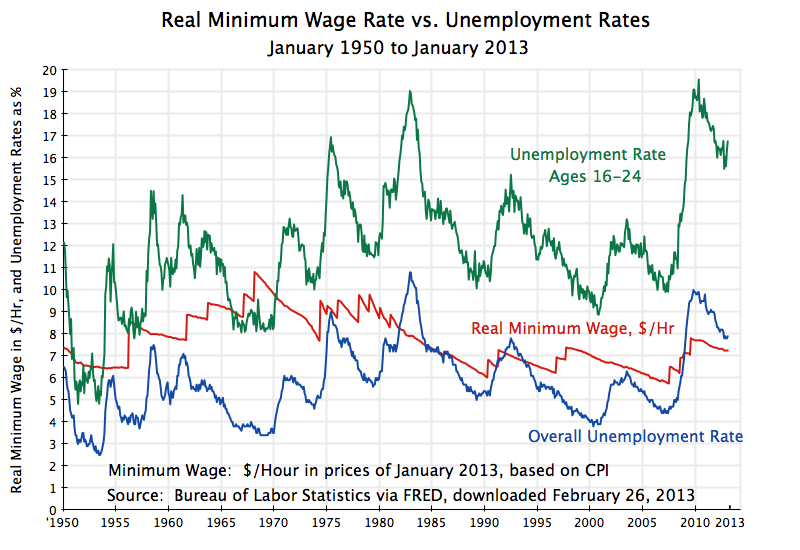
Also, I don't mean to imply that these events correlate. I was simply saying we have data that shows how these two things correlate. (There is no strong correlation between the two)
How could killing the engine cause an accident? I guess it could be a problem if you were stopped on a railroad crossing, but really?. Pretty much all cars on sale today come with an immobilizer built in, and services like lojack and onstar allow you to activate it remotely.
> Pretty much all cars on sale today come with an immobilizer built in, and services like lojack and onstar allow you to activate it remotely
Doesn't that just not let you start the car? I don't think it turns off the car.
edit: according to [1], OnStar "can limit the speed at which it can be driven, remotely lock the ignition so that it can’t be started, and track the car’s location".
(as for the original question, even ignoring situations where you need to have acceleration to get out of them, just cut the power steering on someone who has never driven without it and see how well they pull over to the side of a busy intersection or the like)
> just cut the power steering on someone who has never driven without it and see how well they pull over to the side of a busy intersection or the like
Having had power steering (and power everything else) go out on me in an F250, it's pretty much kind of terrifying. Brakes? Sort of. Steering? Sure, if you put your back into it.
Slowing down, without lights, unexpectedly in traffic while modern day humans pay no attention to driving by using their phone? Seems totally likely to cause an accident.